.svg)




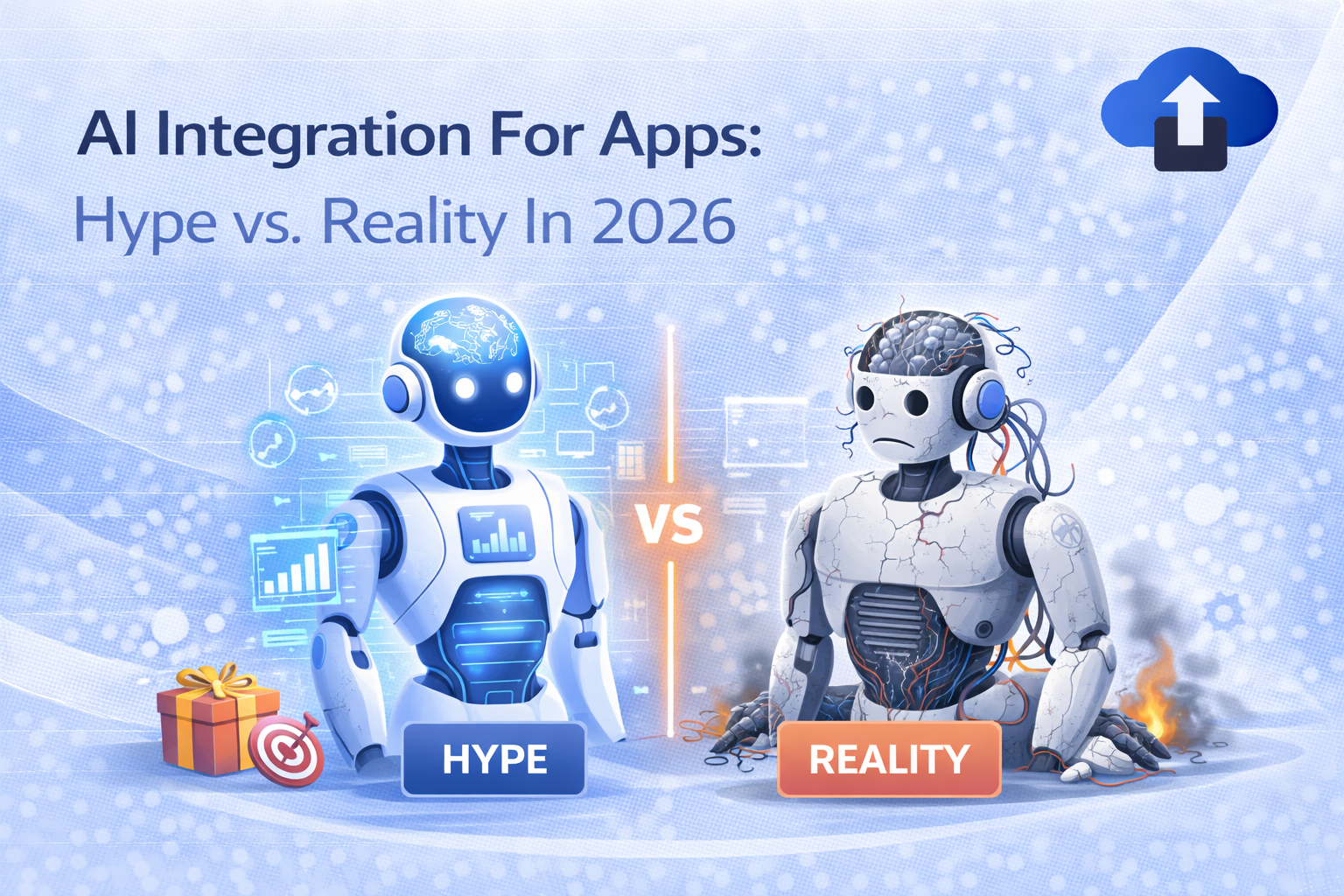
Everyone Wants AI But Does Your App Really Need It?
AI is everywhere in 2026. From productivity tools to shopping apps, nearly every product claims to be powered by artificial intelligence. For founders and product teams, the pressure is clear: add AI or risk falling behind.
But here's the reality — not every AI feature adds value. Many apps integrate AI just for marketing, not for solving real user problems. This leads to wasted development time, higher costs, and confusing user experiences.
The real question isn't “Should you add AI?”
It's “Will AI actually improve your app?”
In this guide, we break down the hype vs. reality of AI integration in 2026 and help you decide what actually works.
The AI Hype in 2026
AI Is Being Added to Everything
Many apps now advertise AI features even when they provide minimal value. Chatbots, smart recommendations, and auto-generated content are being added simply because competitors are doing it.
Marketing-Driven AI Decisions
Teams often prioritize AI for buzz instead of solving real problems. This leads to features that look impressive in demos but aren’t used in real workflows.
Overpromised Automation
Some platforms claim AI can fully automate workflows, customer support, and development. In practice, most apps still require human oversight and manual control.
“AI-Powered” Without Real Impact
Adding AI doesn’t automatically improve engagement, retention, or revenue. Without clear use cases, AI becomes just another unused feature.
The Reality of AI Integration in Apps
AI Works Best for Specific Problems
AI delivers the most value when solving narrow, well-defined problems. Examples include summarization, classification, prediction, and personalization.
Simple AI Often Beats Complex AI
Many successful apps use lightweight AI instead of heavy models. Rule-based logic combined with basic machine learning often provides better reliability and lower cost.
AI Needs Clean Data to Work Well
Without structured, high-quality data, AI features produce inaccurate or irrelevant results. Data preparation often takes longer than building the AI itself.
AI Adds Operational Complexity
Monitoring outputs, handling failures, and controlling costs all require additional infrastructure. AI is not a “set and forget” feature.
Where AI Actually Delivers Real Value
Smart Search and Discovery
AI-powered semantic search helps users find content faster and improves navigation inside large apps.
Personalized Recommendations
Recommendation engines improve engagement when based on user behavior, not generic suggestions.
Content Generation and Drafting
AI can help create drafts, summaries, and suggestions — especially for productivity and creator tools.
Automated Tagging and Classification
Apps handling large volumes of content benefit from AI-based categorization and labeling.
Predictive Insights
AI helps forecast trends, user behavior, or potential issues before they occur.
Where AI Often Fails in Apps
Generic Chatbots Without Context
Chatbots that aren’t connected to real data provide shallow responses and frustrate users.
Over-Automated Workflows
Fully automated AI flows often break in edge cases and require manual fallback options.
Expensive Features With Low Usage
Some AI features increase infrastructure cost but are rarely used by users.
Unclear User Value
If users don’t understand how AI helps them, they won’t use it — even if it's powerful.
Questions to Ask Before Adding AI
Does This Solve a Real User Problem?
If the feature doesn’t remove friction or save time, AI may not be necessary.
Can This Be Solved Without AI?
Sometimes simple logic or better UX design solves the problem more effectively.
Do You Have the Required Data?
AI without quality data leads to poor performance.
Will Users Trust the Output?
AI-generated content must be reliable and transparent.
What Is the Cost vs. Benefit?
AI features increase infrastructure costs. The ROI should justify the investment.
Best AI Features Apps Are Adding in 2026
Intelligent Search
Apps are replacing keyword search with semantic understanding.
Smart Recommendations
Personalized content based on user behavior improves retention.
AI-Assisted Content Creation
Draft generation, summarization, and rewriting features save time.
Predictive Notifications
Apps send alerts based on user patterns and behavior.
Automated Support Assistance
AI helps support teams with suggested replies and knowledge lookup.
Common AI Integration Mistakes
Adding AI Too Early
Building AI before validating product-market fit leads to wasted effort.
Overengineering the Solution
Complex AI models aren’t always better than simple approaches.
Ignoring UX Design
AI should enhance UX, not replace clarity and usability.
Not Measuring Impact
Without analytics, teams don’t know whether AI improves engagement.
A Practical AI Integration Framework
Step 1: Identify a High-Friction User Problem
Focus on tasks users repeat frequently.
Step 2: Define a Clear Success Metric
Measure time saved, engagement, or conversion rate.
Step 3: Start With a Simple Version
Use lightweight AI or rule-based logic first.
Step 4: Add Intelligence Gradually
Improve accuracy using real usage data.
Step 5: Monitor and Iterate
Track performance and refine continuously.
The Future of AI in Apps
AI Will Become Invisible
Instead of obvious chat interfaces, AI will quietly enhance workflows in the background.
Smaller Models Will Gain Popularity
Apps will use optimized models to reduce cost and latency.
Personalization Will Improve
AI will adapt to individual users rather than generic behavior.
Human + AI Collaboration
The best apps will combine AI suggestions with user control.
Conclusion: Focus on Value, Not Hype
AI integration in 2026 is no longer about adding flashy features. It’s about solving real problems and improving user experience.
The most successful apps use AI selectively — for search, personalization, automation, and insights. They avoid unnecessary complexity and focus on measurable impact.
Before adding AI, ask one simple question:
Will this make the app genuinely better for users?
If the answer is yes, AI is worth it.
If not, it’s just hype.