.svg)




Here is a scenario most app teams know too well. You spend weeks shipping a new feature. You are proud of it. You push the update, watch the installs roll in, and then the reviews start coming in. Not about the feature you just built. About that one tiny bug that has been sitting in the corner of your app for three months. The one your team dismissed as low priority.
That is user feedback doing exactly what it is supposed to do. Cutting through assumptions and pointing directly at what actually matters to the people using your product.
The difference between apps that grow and apps that stagnate often has nothing to do with marketing budget or feature count. It comes down to whether the team genuinely listens to its users and builds a system that turns that listening into action. This blog breaks down how to do exactly that.
The Real Value Of User Feedback (It Is Not Just Bug Reports)
Most app teams think of user feedback as a support function. Something you deal with reactively when things break. But the teams building the most successful apps treat feedback as a strategic asset that informs every major decision they make.
Feedback Tells You What Data Alone Cannot
Analytics can tell you that users are dropping off on screen three of your onboarding flow. But analytics cannot tell you why. Is the copy confusing? Is the form too long? Is there a trust issue? User feedback fills that gap. It gives context to the numbers and turns metrics into a story you can actually act on.
Feedback Reveals The Features Users Actually Want
Every product team has a roadmap full of features they think users want. And then there is the list of features users are actually asking for in reviews, support tickets, and community threads. The gap between those two lists is where most product decisions go wrong. Feedback closes that gap and helps you build things that create real retention rather than release notes that nobody reads.
Feedback Is Your Earliest Warning System
A sudden spike in one-star reviews is not just a PR problem. It is a signal that something in your product experience has broken down and users are noticing before your internal monitoring does. Teams that check their feedback channels regularly catch problems early. Teams that do not end up reading about them on Twitter.
Why Most Teams Fail To Use Feedback Effectively
Collecting feedback is easy. Almost every app has a rating prompt and a support email. The hard part is building a system that turns raw feedback into prioritized action. And most teams never build that system.
Feedback Gets Collected But Never Organised
Reviews come in through the app store. Support requests come in through email. In-app reports go to a different tool. Community complaints surface in a Discord server nobody checks. When feedback is scattered across five different channels with no central place to make sense of it, the loudest voices win and the most useful signals get lost.
Teams Prioritise Volume Over Signal
Not all feedback is equal. A single user who writes a detailed three-paragraph review explaining exactly where and why they got confused is worth more than fifty users who gave you three stars without a comment. Treating all feedback the same means spending time on noise and missing the insights that would actually change your product trajectory.
The Feedback Loop Never Closes
One of the most damaging mistakes an app team can make is asking users for feedback and then going silent. If users report a bug and never hear back, if they suggest a feature and never see it acknowledged, they stop giving feedback entirely. Worse, they start telling others not to bother either. A feedback loop that never closes does not just fail to help you. It actively damages trust.
Building A Feedback System That Actually Works
A good feedback system does three things: it collects feedback from the right users at the right moments, it organises and prioritises what comes in, and it closes the loop by communicating back to users. Here is how to build each layer.
Layer One: Collecting Feedback With Intention
The best time to ask for feedback is immediately after a meaningful user action. Not on app open. Not after thirty seconds of use. After a user completes a key task, achieves a milestone, or experiences something worth commenting on. Contextual prompts at the right moments generate far more useful responses than generic rating requests.
Feedback Collection Channels Worth Using
• In-app micro surveys triggered after key actions
• Post-session feedback prompts asking one specific question
• Beta testing platforms that allow testers to submit structured reports with screenshots and recordings
• App store reviews monitored and categorised regularly
• Community channels where power users share unfiltered opinions
Layer Two: Organising And Prioritising What You Receive
Once feedback starts coming in, the challenge is making sense of it at scale. Tag and categorise every piece of feedback by theme: onboarding, performance, UI, specific features, pricing, and so on. This makes patterns visible. When thirty different users independently mention that the navigation is confusing, that is not a coincidence. That is your next sprint.
A Simple Prioritisation Framework
•High frequency and high impact: fix or build this immediately
• High frequency and low impact: schedule it for a future sprint
• Low frequency and high impact: investigate before deciding
• Low frequency and low impact: log it and revisit quarterly
Layer Three: Closing The Loop
This is the step most teams skip, and it is the most important one. When you act on a piece of feedback, say so. Update your changelog with plain-language notes that reference community or tester input. Respond to app store reviews personally. Send a quick message to beta testers whose suggestions made it into the build. These small acts of acknowledgment transform one-time feedback givers into long-term advocates.
How Beta Testing Supercharges Your Feedback Quality
Public app store reviews are valuable, but they are also reactive. By the time users are leaving reviews, the experience has already happened and the damage is already done. Beta testing gives you a fundamentally different kind of feedback: structured, proactive input from users who opted in specifically to help you improve.
Beta Feedback Is More Detailed And More Actionable
A beta tester who encounters a bug does not just give you a star rating. They can describe exactly what happened, show you a screenshot of the broken state, record a video of the steps they took, and tell you what they expected to happen instead. That level of detail is the difference between knowing something is wrong and knowing exactly how to fix it.
Beta Users Represent Your Actual Target Audience
When you recruit beta testers who match your ideal user profile, the feedback you receive is calibrated to the experience of the people who matter most to your product's success. You are not guessing what your target users think. You are hearing it directly from them before launch.
Running A Beta Program With AppsOnAir
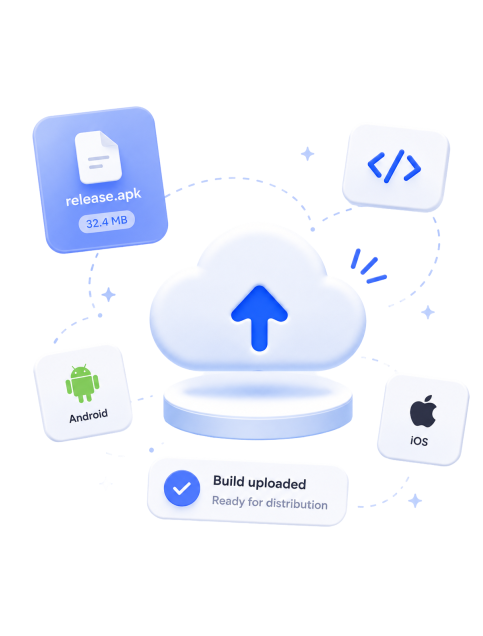
AppsOnAir is built specifically to make this kind of structured beta feedback possible at scale. You can distribute your iOS or Android build to testers with a single link, without going through the public app store. Testers can submit feedback directly through the platform with screenshots and screen recordings attached. You can manage multiple app versions, track tester activity, and keep all feedback centralised in one place.
The result is a feedback pipeline that is fast, organised, and deeply connected to the real experience of your real users. Not guesswork. Not assumptions. Actual data from actual humans using your actual product before it goes live.
Turning Feedback Into Measurable App Growth
Collecting and acting on feedback is not just good product management. It has direct, measurable impact on the metrics that drive app growth.
Better Ratings And More Organic Downloads
Apps that respond to user feedback and fix reported issues consistently improve their app store ratings over time. Higher ratings improve your visibility in app store search results, which drives more organic downloads without additional spend. Feedback is essentially free SEO for your app.
Higher Retention And Lower Churn
When users see that their feedback leads to real changes, they stay. The psychological effect of feeling heard is powerful. Users who believe their input matters develop a sense of ownership over the product and a loyalty that no retention campaign can replicate artificially.
Faster Iteration And Fewer Costly Mistakes
Teams that build feedback loops into their development cycle catch problems earlier, fix them faster, and spend less time building features that users do not actually want. The cost of fixing a UX issue during beta is a fraction of the cost of fixing it after a public launch when negative reviews are already accumulating.
The Feedback Mindset: What Separates Good Teams From Great Ones
The tactical stuff matters: the right tools, the right channels, the right prompts. But the teams that truly unlock the growth potential of user feedback share something more fundamental. They treat every piece of feedback, positive or negative, as a gift.
Negative Feedback Is Your Most Valuable Asset
A user who takes the time to explain exactly what frustrated them is doing something incredibly valuable. They are telling you precisely where your product is falling short of expectations. That information, if you act on it, is worth more than any A/B test or competitor analysis. The worst thing you can do is get defensive about it.
Build Feedback Into Your Culture, Not Just Your Process
The most feedback-driven teams do not just have a system for collecting reviews. They talk about feedback in their standups. They celebrate when a user suggestion makes it into a release. They share notable reviews with the whole team, not just the product manager. When feedback is part of the culture, acting on it stops feeling like extra work and starts feeling like the natural way to build.
Final Thoughts: Reviews Are Not The End Of The Conversation
A review is not just a rating. It is a user extending an invitation to improve. It is someone taking time out of their day to tell you something real about their experience with your product. The teams that treat every review as the beginning of a conversation, rather than the end of one, are the teams that build apps worth keeping.
Whether you are preparing for your first launch or refining a product that has been live for years, a structured approach to user feedback is the single most reliable path to sustainable growth. Fix what users are telling you to fix. Build what they are asking you to build. Tell them when you do. And watch what happens to your ratings, your retention, and your revenue.
AppsOnAir gives you the infrastructure to run this process properly, from beta distribution to structured feedback collection to organised tester management. Because growth does not come from guessing what users want. It comes from listening.