.svg)



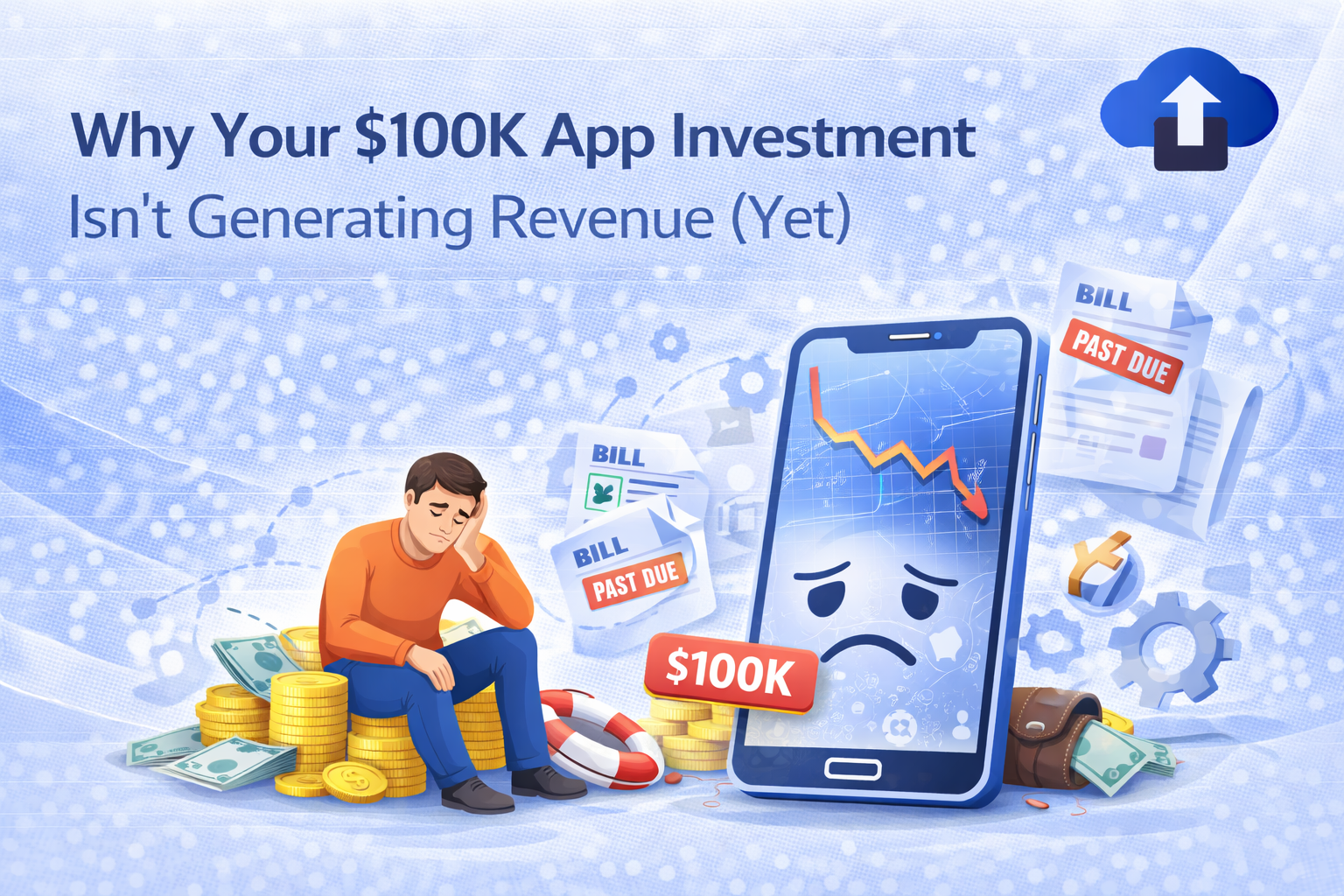
You invested $100,000 into your app.
The product is built.
The UI looks great.
The launch happened.
So why isn’t the revenue showing up?
This is one of the most common (and painful) realities in the startup world:
investment does not automatically translate into income.
Money can build software—but only strategy builds sustainable revenue.
The Revenue Reality Gap: Why Investment ≠ Instant Returns
Many founders assume that once development is complete, growth and revenue will follow naturally.
In reality, you’ve only finished the starting line.
Revenue is created at the intersection of:
- Real user problems
- Clear value delivery
- Smart monetization strategy
- Efficient acquisition
- Strong retention systems
Miss just one of these, and your app becomes an expensive hobby instead of a business.
Mistake #1: You Built Features Users Don’t Want To Pay For
Users may love your app and still never pay.
Why?
Because engagement ≠ monetization.
Many teams build impressive features without validating:
- What problem users would actually pay to solve
- How painful that problem really is
- What alternatives already exist
If users can live without your solution, they won’t open their wallets.
Fix This By:
- Interviewing your most active users
- Identifying the one feature that solves a critical pain
- Making that feature the core paid offering
Revenue comes from solving urgent problems, not interesting ones.
Mistake #2: Wrong Monetization Model For Your Audience
Your pricing model must match user behavior.
Common mismatches include:
- Subscriptions for tools used once a month
- One-time fees for products that provide ongoing value
- Freemium models without strong upgrade incentives
Fix This By:
Testing monetization options such as:
- Subscription (recurring value)
- Usage-based pricing
- Tiered plans
- One-time purchases with add-ons
Your audience should feel the pricing model fits naturally into how they already use the product.
Mistake #3: Your Value Proposition Isn’t Clear (Or Compelling)
If users can’t immediately answer:
“Why should I pay for this instead of doing nothing?”
You’ll struggle to convert.
Many apps explain what they do — but not why it matters.
Weak Example:
“We offer AI-powered task management.”
Strong Example:
“Finish work 30% faster without burnout.”
Fix This By:
- Leading with outcomes, not features
- Using numbers when possible
- Making the benefit instantly obvious
Clear value sells. Vague innovation doesn’t.
Mistake #4: The User Acquisition Cost Is Killing Your Margins
You might be getting users—but losing money on every one.
If it costs you $20 to acquire a user who generates $10 in revenue, your business is upside down.
Fix This By:
Tracking three core metrics:
- Customer Acquisition Cost (CAC)
- Lifetime Value (LTV)
- Payback period
Then optimizing:
- Organic growth channels
- Referral programs
- Retention before scaling ads
Profitability starts with sustainable acquisition.
Mistake #5: Poor Onboarding Destroys Conversion Opportunities
Most users decide whether your app is “worth it” in the first 5 minutes.
If onboarding is confusing:
- Users won’t reach your core value
- They won’t convert
- They won’t return
Fix This By:
- Reducing setup steps
- Showing users their “aha moment” fast
- Using tooltips and guided flows
- Removing unnecessary friction
Your product should guide users to success—not expect them to figure it out.
Mistake #6: Pricing Based On Costs Instead Of Value
Many founders price like this:
“We spent $100K building it, so let’s charge $10/month.”
That’s backwards.
Customers don’t care about your development cost.
They care about the value you create.
Fix This By:
Pricing based on:
- Revenue impact
- Time saved
- Risk reduced
- Business growth enabled
If your app helps someone earn $1,000 more per month, $49/month is a bargain.
Mistake #7: You’re Ignoring The Critical Retention Metrics
Revenue isn’t just about getting users.
It’s about keeping them.
Poor retention means:
- High churn
- Rising marketing costs
- Flat revenue
Fix This By Tracking:
- Day 1, Day 7, Day 30 retention
- Churn rate
- Feature usage patterns
Then improving:
- Product stickiness
- Engagement loops
- Ongoing value delivery
Retention is the foundation of scalable revenue.
The Pivot Decision: When To Fix vs. When To Rebuild
Not every struggling app needs to be scrapped.
Ask yourself:
- Are users actively using it?
- Do they report real value?
- Is churn due to UX or core product issues?
Fix If:
- The problem is messaging, pricing, onboarding, or marketing
Pivot If:
- Users don’t experience meaningful value
- The core problem isn’t painful enough
- Market demand is weak
Smart founders adjust direction early instead of burning more cash.
Your 90-Day Revenue Rescue Plan
Days 1–30: Diagnose
- Interview 20+ users
- Audit onboarding flow
- Analyze conversion funnel
- Identify your strongest value feature
Days 31–60: Optimize
- Improve value proposition messaging
- Adjust pricing model
- Redesign onboarding
- Reduce friction points
Days 61–90: Scale
- Launch monetization experiments
- Optimize acquisition channels
- Improve retention systems
- Double down on what converts
Consistency beats perfection.
Final Thoughts
Your $100K investment wasn’t wasted.
But software alone doesn’t create revenue.
Strategy does.
If you focus on:
- Real user pain
- Clear value delivery
- Smart monetization
- Sustainable growth systems
Your app can still become profitable—even if the first launch didn’t deliver immediate returns.
Revenue isn’t magic.
It’s built intentionally.