.svg)




Your app has a critical bug. A payment flow is broken. Users are dropping off at checkout. Your developer has the fix ready in 20 minutes.
Then the wait begins.
App Store review time in 2026 averages 1–3 days for routine submissions — but that number doesn't tell the whole story. During major iOS releases, holidays, or policy enforcement waves, app store approval time can stretch to 5–7 days or longer. And while you wait, the bug stays live, users keep dropping, and your team watches a problem they've already solved continue to cause damage.
This is the hidden cost of app store review delays — and for most mobile teams, it's far larger than anyone has officially calculated.
How Long Does App Store Review Actually Take in 2026?
Apple's App Store review time has improved significantly since the days of 2-week waits, but it remains unpredictable. Based on data tracked by the developer community
- Standard review: 1–3 business days on average
- App with new features or permissions: 2–5 days
- Rejections requiring resubmission: Add another 1–3 days per cycle
- Holiday periods (November–January): Often 5–7+ days
- App Store policy enforcement waves: Unpredictable delays, sometimes over a week
Google Play's app store approval time is faster on average (a few hours to 24 hours for updates), but is equally unpredictable when policy reviews are triggered.
The key issue isn't the average — it's the variance. You cannot plan around a process you cannot predict.
The Real Cost of App Store Review Delays (It's Not Just Time)
Most teams frame the app store review process as an inconvenience. The reality is it's a recurring business risk with measurable financial, operational, and human costs.
1. The Revenue Cost of a Live Bug
When a bug affects a conversion-critical flow — payment, onboarding, login — every hour it stays live costs money. If your app generates $10,000/day in revenue and a checkout bug reduces conversion by 15%, that's $1,500 per day lost while your fixed version sits in the review queue.
Multiply that across a 3-day wait: $4,500 gone on a bug your team fixed in an afternoon.
2. The Client Trust Cost
For agencies and dev shops building apps for clients, app store review time directly impacts client relationships. Promising a hotfix "by end of day" and delivering it three days later — because of a process outside your control — erodes the trust you've spent months building.
Clients don't see the app store review process. They see a team that couldn't deliver on time.
3. The Competitive Cost
Mobile markets move fast. A competitor launching a feature while yours is stuck in review can mean the difference between being first and being irrelevant. App store approval time creates a compulsory lag between your decision to ship and your users actually getting the update — a lag your competitors face too, unless they've found a smarter way to work around it.
4. The Team Morale Cost
This one rarely makes it into cost calculations, but it's real. Developers who fix a bug quickly, then watch users suffer through it for three more days because of an external review process, get frustrated. Product managers lose confidence in their ability to respond to user feedback. The entire culture of "ship fast, iterate" breaks down when every change requires waiting in line.
When App Store Review Delays Hurt the Most
Not all updates are equal. The app store review process is especially damaging in three specific scenarios:
Critical Bug Fixes (Hotfixes)
A hotfix by definition needs to go out immediately. The faster the fix reaches users, the less damage done. App store review time turns every hotfix into a slow-motion crisis — the bug is fixed in your codebase but still live in your users' hands.
Product Launches and Feature Rollouts
Coordinating a marketing campaign around a feature launch requires certainty. If your campaign goes live on Tuesday but your app update is still in review, you're driving traffic to an experience that doesn't match your messaging. Launch day becomes launch week, and the momentum you built evaporates.
Seasonal and Time-Sensitive Updates
Flash sales, holiday promotions, event-driven features — these live and die by timing. An app update tied to a Black Friday campaign that arrives on Saturday is worthless. The app store review process doesn't respect your calendar.
How Smart Mobile Teams Are Reducing Their Dependency on App Store Reviews
The best mobile teams haven't accepted the review queue as a fixed constraint. They've restructured how they ship to minimize how often a full app store submission is actually necessary.
Over-the-Air (OTA) Updates
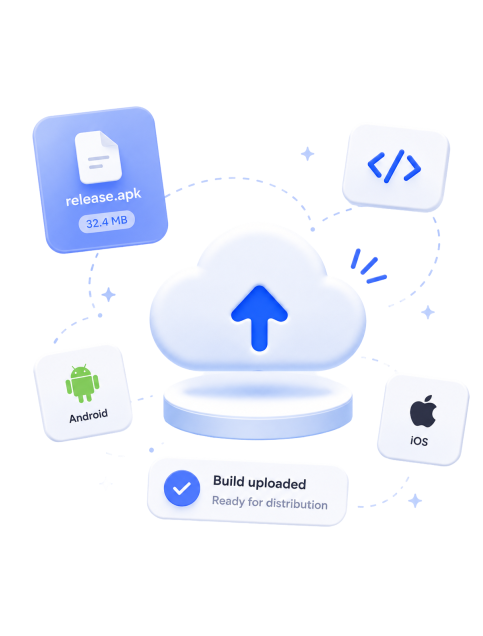
OTA updates allow teams to push changes to users without going through the app store review process at all — for the right types of updates. JavaScript-layer changes (for React Native apps), content updates, feature flag toggles, and configuration changes can often be delivered directly to users the moment they're ready.
This is the most impactful change a mobile team can make to their release process. A bug in your React Native app? Fixed and live in minutes, not days. A new onboarding flow to test? Deployed to a segment of users before lunch.
Platforms like AppsOnAir are built specifically for this workflow — combining OTA update delivery with distribution management, staged rollouts, and automatic rollback. Teams that adopt OTA updates consistently report that the app store review process goes from a daily frustration to an occasional formality.
Feature Flags and Remote Configuration
For features that don't require code changes to toggle, remote configuration means you control when users see something — independently of when the app was last reviewed. Ship the code in the next release, but flip the switch when you're ready.
Staged Rollouts
Both Apple and Google support staged rollouts, where an update is delivered to a percentage of users before full release. This doesn't bypass the review process, but it limits damage if something goes wrong — you catch issues with 5% of users instead of 100%.
What You Can and Can't Bypass
It's important to be clear: OTA updates are not a workaround for Apple and Google's policies. Both platforms permit OTA delivery of certain types of changes — primarily JavaScript and content-layer updates for hybrid apps. Native code changes, new app binary submissions, and permission requests still require app store review.
The strategy isn't to avoid the review process entirely — it's to design your release workflow so that app store submissions are infrequent, deliberate, and low-stakes, while the changes that matter most (bug fixes, content, configuration) move at the speed your business requires.
The Bottom Line
App store review time is not going to zero. Apple and Google's review processes exist for legitimate reasons, and they're not going away. But treating the review queue as an immovable constraint — and absorbing its costs silently — is a choice, not a necessity.
The mobile teams consistently shipping fastest in 2026 have separated "what needs a review" from "what can go out now." They've invested in OTA infrastructure, feature flags, and staged rollouts. They've stopped letting a 1–3 day wait dictate their ability to respond to users.
The question isn't whether your team can afford to look at OTA updates. It's whether you can afford not to.
→ See how AppsOnAir helps mobile teams push updates without waiting for App Store review