.png)


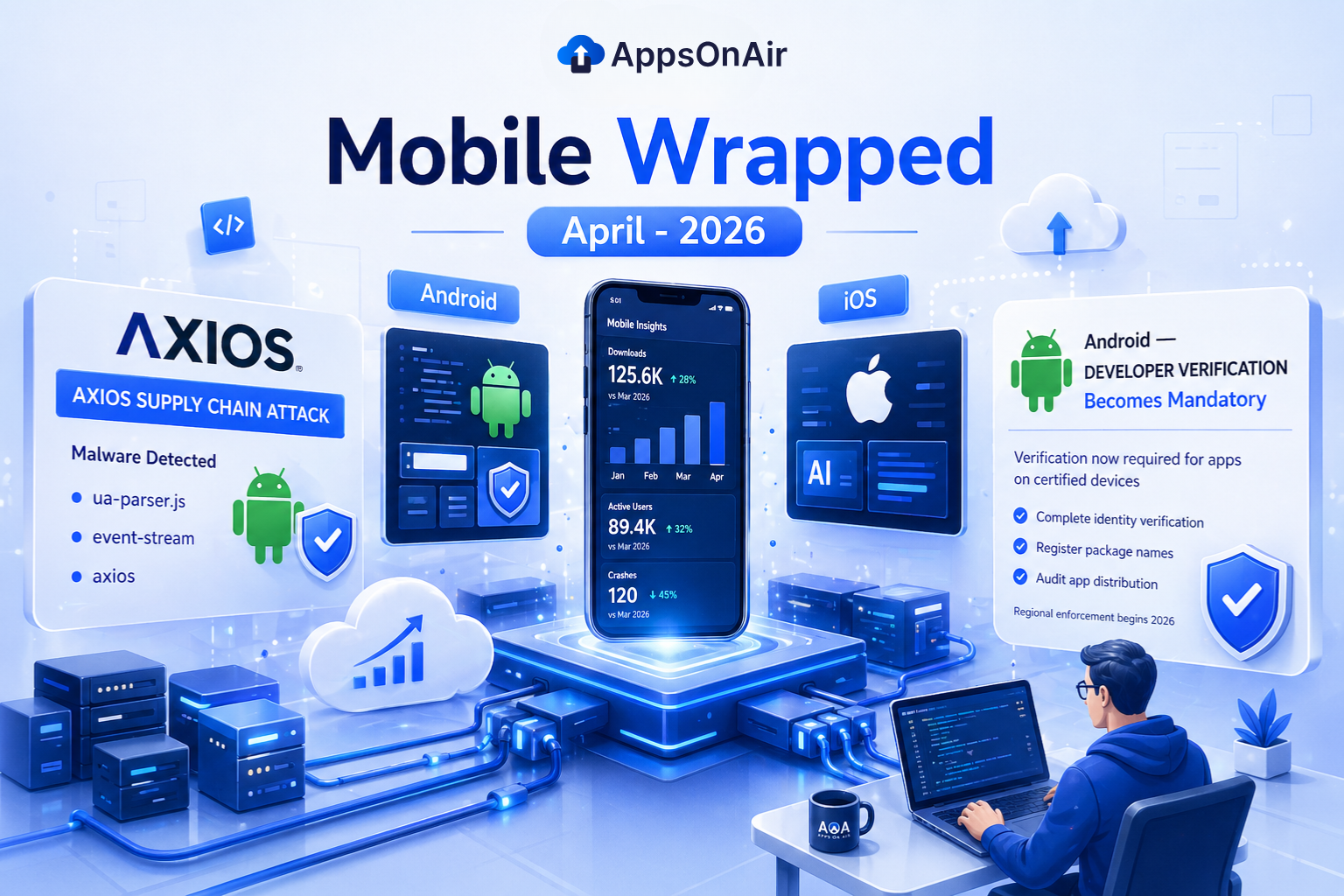
April 2026 marks a shift not driven by new APIs, but by enforcement, stability, and ecosystem risk awareness. Across Android, iOS, Flutter, and React Native, platforms are converging toward predictability—reducing undefined behavior and pushing engineers toward disciplined architecture and build systems. At the same time, the npm supply chain attack highlights a growing reality: mobile applications are only as secure as their weakest dependency.
Native Android — Compose Enters Predictable Phase
Jetpack Compose updates this cycle focus heavily on recomposition stability and compiler alignment. This is less about features and more about eliminating edge-case rendering inconsistencies. Teams with large UI layers should now revisit recomposition hotspots and state management decisions, as tooling visibility has improved.
Impact:
Large-scale Compose apps with complex state and multi-module UI.
Build Systems — Gradle Enforcement Tightening
Gradle is pushing strict configuration cache adoption. Builds relying on implicit task execution or dynamic configuration are increasingly unstable. CI/CD pipelines must be audited to ensure compatibility with configuration cache and avoid build-time regressions.
What to do:
Enable configuration cache and fix violations early; audit custom Gradle tasks and plugins for cache compatibility before CI failures surface.
Android — Developer Verification Becomes Mandatory
Android is rolling out a new developer verification system that links real-world identity with app ownership. Going forward, apps must be registered under verified developers to remain installable on certified Android devices.
This marks a major shift in Android’s ecosystem—from open distribution toward identity-based trust and accountability.
Who is impacted:
Developers distributing apps outside the Play Store, organizations managing multiple package names, and teams using sideloading or private distribution channels.
What to do:
- Complete developer identity verification (individual or organization)
- Register package names and link them with signing keys
- Audit all distributed APKs (Play + non-Play) for compliance
- Prepare before regional enforcement begins in 2026
More details check this official documentation and blogs.
.
iOS — SwiftUI Rendering Gains Consistency
SwiftUI improvements in diffing and layout recalculation reduce performance unpredictability in complex UI trees. Combined with stricter Xcode warnings, Apple is signaling a strong push toward leaner binaries and cleaner module structures.
Impact: Apps with complex SwiftUI layouts and dynamic rendering.
App Store — Privacy & AI Scrutiny Expands
Privacy manifests are now a submission blocker for non-compliant SDKs. Additionally, AI-driven features are under stricter review, requiring clear disclosures and moderation safeguards. Compliance is now a core architectural concern.
Who is impacted:
Apps using third-party SDKs (analytics, ads, tracking) or AI-driven features.
What to do:
Verify all SDK privacy manifests, add AI disclosures, and implement basic content moderation to avoid review delays.
Flutter — UI Layer Stabilization Window
Material and Cupertino libraries have entered a code freeze inside the Flutter SDK as part of their extraction into standalone packages. This marks a major architectural shift toward decoupled UI systems, where design libraries will evolve independently from the framework.
Who is impacted:
Teams building design systems, white-label apps, or UI abstraction layers.
What to do:
Avoid deep coupling with internal Material/Cupertino APIs and prepare for separate package versioning once decoupled.
Flutter introduced the SensitiveContent widget to protect sensitive data during screen sharing and recording (like OTPs, passwords, payments, etc.).
class MyWidget extends StatelessWidget {
  @override
  Widget build(BuildContext context) {
    return SensitiveContent(
      sensitivity: ContentSensitivity.sensitive,
      child: MySensitiveContent(),
    );
  }
}
- Works on Android API 35+ only
- No effect on lower Android versions or iOS
- Not a partial blur — it obscures the full screen
- For older Android versions → use FLAG_SECURE
For more details, review this our technical blog.
React Native — Architecture Shift Becomes Mandatory
Fabric and TurboModules are becoming the default expectation. Legacy bridge-based apps face long-term performance and maintenance challenges. Hermes updates further improve startup performance and memory efficiency.
Who is impacted:
Apps still running on the legacy bridge architecture.
What to do:
Start migration planning to Fabric/TurboModules and audit third-party libraries for new architecture compatibility.
Security — NPM Supply Chain Attack
The recent npm attack demonstrates how easily trusted dependencies can be compromised. Mobile apps relying on Node-based tooling, CI scripts, or React Native packages are directly exposed. Dependency trust must now be actively managed.
Who is impacted:
Teams using React Native, Expo, or any Node-based tooling in their mobile pipeline (including build scripts, CLI tools, and CI/CD integrations).
What to do:
Dependency trust must now be actively managed as part of the build pipeline:
- Lock dependency versions (package-lock.json, yarn.lock)
- Avoid automatic dependency upgrades without review
- Run security audits (npm audit, SCA tools) in CI
- Prefer well-maintained and verified packages
- Isolate build environments to reduce blast radius
Recent Incidents involving packages like ua-parser-js, event-stream, and widely used dependencies such as axios demonstrate that even highly trusted libraries can introduce critical risk into modern mobile pipelines.
For teams that want a quick validation, you can run a lightweight scan to detect compromised dependencies and related indicators in your environment.
chmod +x check_axios_compromise.sh
./check_axios_compromise.sh
The script checks for:
- Malicious Axios versions (1.14.1, 0.30.4)
- Suspicious dependencies (e.g., plain-crypto-js)
- Known C2 domain activity (sfrclak.com)
- Platform-specific compromise indicators
Full analysis and remediation steps are covered in the detailed blog.
AI + Mobile — Moving into Engineering Workflows
AI is now embedded in development workflows, assisting with testing, debugging, and code generation. However, it also introduces compliance risks, as app stores increasingly regulate AI-driven functionality.
Teams that integrate AI into their development and release workflows early will gain a compounding advantage in both speed and reliability.
Dev Insight — Stability is the New Velocity
The ecosystem is shifting toward deterministic systems. Success is no longer defined by how fast features are shipped, but by how reliably systems behave under scale, policy pressure, and dependency constraints.
Closing Perspective
April clearly shows a shift toward stability and control across mobile platforms.
Frameworks are maturing, store policies are tightening, and dependency risks are becoming more visible.
For teams, this means focusing less on speed and more on building reliable, compliant, and secure systems.
Happy coding! 🚀