.svg)



.png)
Remember the last time you tried to push a critical bug fix to your mobile app? You probably opened TestFlight, waited for Apple's review process, checked Firebase for your deep links, logged into another platform for your OTA updates, and maybe even juggled a separate tool for team feedback. By the time everything aligned, your users had already started leaving frustrated reviews. OTA distribution with AppsOnAir
If this sounds familiar, you're not alone. Mobile development teams worldwide are drowning in a sea of disconnected tools, each solving one piece of the puzzle while creating ten new headaches in the process.
The Hidden Cost of Tool Sprawl
Let's talk about what's really eating away at your productivity and budget. When you're managing app distribution through TestFlight, deep linking through Firebase Dynamic Links, over-the-air updates through CodePush, and feedback through yet another platform, you're not just paying multiple subscription fees. You're paying with something far more valuable: time.
Your developers spend hours context-switching between platforms. Your QA team wastes precious minutes tracking down which tool has the latest build. Your clients get confused about where to download the test version. And when something breaks? Good luck figuring out which platform is causing the issue.
The average mobile development team uses between five to eight different tools just to handle distribution, updates, and testing. That's five to eight logins, five to eight billing cycles, five to eight support channels, and five to eight potential points of failure. The math doesn't just add up—it multiplies into chaos.
Why Finding Reliable Solutions Feels Like Mission Impossible
Here's where it gets even more frustrating. You finally settle on a toolset that works, invest time training your team, integrate everything into your workflow, and then—surprise—one of the services announces they're shutting down. Sound familiar? That's exactly what happened when Google announced Firebase Dynamic Links would sunset in August 2025, and when Microsoft discontinued App Center CodePush.
Suddenly, you're back to square one, researching alternatives, comparing features, negotiating new contracts, and disrupting your entire development cycle. The reliability you thought you had? Gone. The time you invested in setup and training? Wasted.
And let's not forget the trust issue. How do you confidently recommend a solution to your team or client when you're not sure if it'll still exist next year? How do you build long-term strategies around tools that might disappear with 90 days' notice?
What If Everything Worked Together Instead?
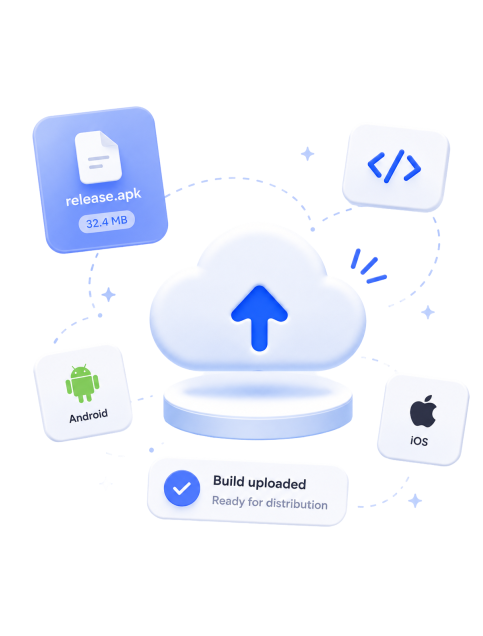
Imagine starting your workday and opening a single dashboard. From there, you upload your latest build with a simple drag-and-drop. Within seconds, your QA team receives push notifications on their devices with instant access to the new version—no TestFlight waiting periods, no complex setup.
Your tester in Mumbai finds a UI bug and shakes their phone to activate in-app feedback. They circle the problematic element, add a comment, and submit. in-app feedback with AppRemark You receive the feedback with complete context: screenshots, device information, console logs, and exact screen details. No more "it doesn't work on my phone" messages with zero context.
Meanwhile, you notice a critical JavaScript error affecting user experience. Instead of submitting a new build to app stores and waiting days for approval, you push a CodePush update that reaches all users within minutes. instant updates with AppsOnAir CodePush No downloads required, no store reviews, just instant fixes.
Your marketing team launches a campaign with deep links that actually work across platforms. When users click the link, they're taken exactly where they need to go—whether they have your app installed or not. The links don't break, routes don't fail, and fallback behavior is exactly what you configured.
This isn't a fantasy. This is what happens when you stop duct-taping separate tools together and start using a platform designed to handle your entire mobile lifecycle.
The All-in-One Approach That Actually Makes Sense
AppsOnAir emerged from a simple observation: mobile teams don't need more tools; they need better integration. Instead of being forced to choose between specialized solutions that don't communicate with each other, what if you could access everything through one unified platform?
The platform brings together five critical capabilities that traditionally required five separate subscriptions, five separate setups, and five separate headaches.
Over-the-Air Distribution That Removes Bottlenecks
Forget waiting for TestFlight reviews or navigating the Google Play Console for internal testing. Upload your IPA or APK files, generate a shareable link or QR code, and your builds are in testers' hands immediately. Whether it's internal QA, client approvals, or live UAT sessions, distribution happens at the speed your team actually works.
You control access through password protection, set expiration dates for links, organize testers into groups, and track every installation through a centralized dashboard. Your iOS testers can even retrieve their UDIDs directly through the platform—no more back-and-forth emails explaining how to extract device identifiers through Xcode.
Deep Linking That Actually Works
Firebase Dynamic Links left thousands of apps scrambling for alternatives when Google announced its shutdown. AppLink deep linking solution AppsOnAir's AppLink steps in as a drop-in replacement that requires minimal configuration changes—no rebuilds, no friction.
The difference? You're in complete control. Configure custom routing logic, define fallback behavior for edge cases, use branded domains that reflect your company, and access granular analytics that show exactly how users interact with your links. Whether users are on Android, iOS, or cross-platform frameworks like React Native and Flutter, your links route them precisely where they're supposed to go.
Instant Updates Without App Store Delays
When Microsoft discontinued CodePush, React Native developers lost their go-to solution for over-the-air updates. AppsOnAir's CodePush alternative lets you deploy JavaScript bundles and assets instantly, bypassing app store submissions entirely.
Push bug fixes during lunch breaks. Roll out feature toggles without recompiling. Update UI elements while users continue using your app. The migration from App Center CodePush requires minimal effort—update a few configuration files and you're running on infrastructure built for performance and reliability.
In-App Feedback That Captures Context
Testing tools that rely on external screenshots and email threads lose critical context. AppsOnAir's AppRemark embeds feedback collection directly into your app through a lightweight SDK integration.
Testers shake their device, circle the problematic area, add comments, and submit—all without leaving your app. Every remark includes screen metadata, device logs, visual markers, and environmental information. Your development team sees exactly what's broken, where it's broken, and why it's broken. Feedback-to-resolution time drops from days to hours.
Version Control and Remote Configuration
AppSync gives you instant control over your app's behavior at launch. Enforce version policies that require users to update before continuing. Push optional updates with custom messaging. Trigger maintenance mode when you need downtime. Handle kill switches and forced migrations with precision.
Support version thresholds, define rollout rules, and manage your entire app lifecycle through configuration changes that take effect immediately—no new releases required.
Real Teams, Real Results
Mobile development teams at companies like TATA Consumer Products trust AppsOnAir to manage their entire mobile lifecycle. These aren't small side projects—they're mission-critical applications serving millions of users, where downtime costs real money and bugs damage real reputations.
Development teams report reducing their testing cycles by 40% after consolidating their tools. QA teams eliminate the confusion of juggling multiple platforms. Product managers gain visibility into the entire release process through a single dashboard. Finance departments celebrate when they see five subscription fees replaced by one.
Making the Switch Isn't the Headache You're Imagining
The thought of migrating from your current toolset probably makes you anxious. You're imagining weeks of downtime, endless configuration, confused team members, and angry stakeholders. But here's what actually happens.
If you're coming from Firebase Dynamic Links, you update a few configuration files. Your existing links keep working. Your routing logic transfers over. Your branded domains migrate smoothly. There's no downtime, no broken links, no frustrated users clicking dead ends.
Migrating from CodePush? The workflow stays nearly identical. Your existing deployment scripts work with minimal changes. Your React Native or Flutter apps continue receiving updates without interruption. The learning curve is so gentle it barely qualifies as a curve.
Starting fresh? The platform's intuitive interface means your team is productive within hours, not weeks. Comprehensive documentation, responsive support, and straightforward integration mean you're not gambling with your launch timeline.
The Economics Actually Work in Your Favor
Let's do some quick math. TestFlight is free but severely limited. Firebase charges per project with scaling costs. CodePush alternatives range from $50 to $500+ per month depending on features. Feedback tools add another $30-$100. Deep linking services charge $100-$300 monthly for decent features.
You're looking at $200-$900 per month across multiple subscriptions—and that's before factoring in enterprise features, additional user seats, or premium support. AppsOnAir consolidates everything into a single, predictable cost structure with flexible plans that scale with your needs, not against them.
But the real savings aren't in subscription costs. They're in the developer hours you reclaim. Every hour your team spends juggling tools instead of building features is an hour of wasted salary. Every delay caused by tool limitations is a delay in reaching your market. Every bug that sits unfixed because your update process is too slow is a hit to your user retention.
Calculate what your developers' time costs. Now multiply that by the hours they'll save not context-switching between platforms. The ROI becomes obvious quickly.
Your Next Move
Your mobile app deserves better than a patchwork of disconnected tools held together with hope and prayer. Your team deserves better than wasting hours on workflows that should take minutes. Your users deserve better than bugs that linger because your update process is stuck in app store review.
The question isn't whether you need a better solution. You already know you do. The question is whether you're ready to stop accepting the status quo as inevitable.
Start with a free account. Upload a test build. See how fast distribution actually happens. Push a CodePush update and watch it deploy in real-time. Create a deep link and test it across platforms. Let your team experience what integrated mobile development feels like.
You don't need to commit to a complete overhaul tomorrow. You need to see for yourself what's possible when your tools finally work together instead of against you.
The mobile development landscape is moving too fast to waste another day fighting with your toolchain. While you're managing five different platforms, your competitors are shipping features. While you're waiting for TestFlight reviews, they're iterating based on real user feedback. While you're debugging which tool broke your workflow, they're celebrating successful launches.
Your complete mobile lifecycle command center is waiting. The only question left is: how much more time are you willing to lose?