.svg)



.png)
You drag your IPA file into Diawi. Wait for the upload. Copy the link. Paste it into Slack. Your QA team clicks the link three hours later and... nothing happens. The link expired. Or maybe it worked, but now nobody knows which version they're testing. Or perhaps it installed fine, but when someone finds a bug, you have no context about what build they were using.
Sound familiar? If you've used Diawi for mobile app distribution, you've lived this frustration. Diawi solves one problem well—getting an IPA or APK file onto a device quickly. But modern mobile development requires so much more than file transfer. OTA distribution platform
When Simple File Sharing Becomes a Bottleneck
Diawi launched as a straightforward solution: upload your build, get a link, share it with testers. For solo developers working on side projects, this simplicity is beautiful. Upload, share, test, repeat. No accounts, no configuration, no complexity.
But the moment your team grows beyond a handful of people, or your testing process needs to involve clients, stakeholders, and distributed testers, the cracks start showing.
Your QA lead has no visibility into which builds are circulating. Testers install outdated versions because someone shared the wrong link in a thread from two weeks ago. Clients complain about bugs you already fixed, but they're testing version 1.2.4 when you're on 1.3.1. Your developers waste hours trying to reproduce issues that only exist in specific builds nobody can identify anymore.
The simplicity that made Diawi attractive becomes the limitation that slows your entire development cycle down.
The Hidden Costs of "Quick and Easy"
Every time you upload a build to Diawi, you're creating technical debt that will cost you later. Not in dollars—Diawi's free tier is genuinely free—but in the currency that matters more: time and team efficiency.
The Version Control Problem
You upload build 47. Someone shares the link. Two days later, you upload build 48. The old link is still circulating. Now you have testers on different versions reporting contradictory behavior. One person says the login flow is broken. Another says it works perfectly. Neither mentions which version they're testing because the link doesn't tell them.
You spend the next thirty minutes asking everyone to uninstall, reinstall, and confirm which build they're actually using. That's thirty minutes nobody's testing. Multiply that across every build cycle, every week, every sprint, and the "quick and easy" solution starts looking expensive.
The Access Control Nightmare
Diawi links are public by default. Anyone with the link can download your app. For some teams, this is fine. For others working on stealth projects, handling sensitive data, or building apps for regulated industries, it's a compliance nightmare waiting to happen.
Password protection exists, but now you're managing passwords across multiple links, multiple testers, and multiple builds. Someone shares the password in a Slack channel. The link gets forwarded outside your organization. You have no visibility into who's downloading what.
By the time you discover a competitor downloaded your pre-release build, it's too late to do anything about it.
The Feedback Black Hole
Your tester finds a bug. They take a screenshot. They send it to Slack or email. You ask for more details. They provide what they remember. You try to reproduce it. You can't, because you don't know the exact device, OS version, or app state when the issue occurred.
This back-and-forth consumes hours every week. The feedback loop that should take minutes stretches into days because Diawi only handles distribution—it has no concept of feedback collection, device information, or context capture.
The Enterprise Scalability Wall
When you're distributing builds to five people, Diawi works fine. At fifty people? The wheels start coming off. At five hundred? You need spreadsheets tracking who has which version, manual processes for removing old builds, and prayer that nobody installs the wrong version at the wrong time.
Enterprise teams need role-based access, team management, version tracking, and audit trails. Diawi provides none of these. The tool that worked perfectly for your startup phase becomes the bottleneck preventing your team from scaling efficiently.
What Actually Matters in Modern App Distribution
If you've hit the limitations of file-sharing-as-distribution, you probably have a clearer picture of what modern app distribution actually needs to provide. It's not just about moving files from servers to devices. It's about enabling fast, organized, secure testing workflows that scale with your team.
Version Management That Doesn't Require Spreadsheets
Every build should be tracked automatically. Version numbers, build dates, release notes, and who uploaded it—all captured without manual data entry. Testers should see exactly which version they're installing. AppsOnAir AppSync QA leads should view every version currently in circulation. Developers should trace every bug report back to its exact build.
This isn't enterprise overkill. It's basic hygiene for teams that ship regularly and need to know what they're testing.
Access Control That Matches How Teams Actually Work
Some builds go to internal QA. Others go to external beta testers. secure app sharing with AppLink Some need client approval before proceeding. Each audience requires different access levels, different communication, and different visibility.
Your distribution platform should support this naturally. Create groups, assign permissions, control who sees what—without generating fifteen different links that all need password management.
Integrated Feedback With Actual Context
When testers report issues, you need more than their memory of what happened. You need device information. OS versions. Screen recordings of the exact action that triggered the bug. Console logs showing what broke. Precise location within the app.
Feedback collection shouldn't be a separate tool you bolt on. in-app bug reporting with AppRemark It should be part of the distribution workflow, capturing context automatically so developers receive actionable reports instead of vague descriptions.
Real-Time Distribution Without Waiting
Upload a build and testers should be notified immediately—push notifications on their devices, not emails they'll check later. Install the new version with one tap, not by hunting through old Slack threads for the latest link.
Speed matters when you're iterating quickly. The distribution platform shouldn't add friction to a process that needs to be as fast as possible.
How AppsOnAir Solves What Diawi Can't
AppsOnAir started with a simple observation: teams using Diawi loved the simplicity but constantly hit limitations that slowed them down. What if a distribution platform maintained that ease of use while adding the capabilities modern teams actually need?
Distribution That Stays Organized Automatically
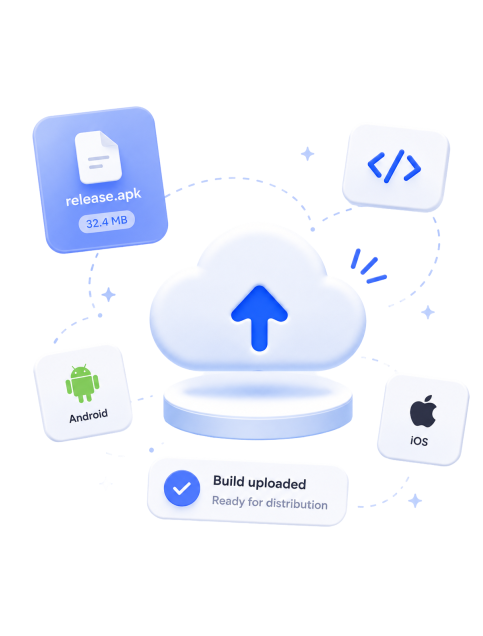
Upload your IPA or APK and AppsOnAir handles everything else. Version tracking is automatic. Release notes are captured during upload. Every build lives in a central dashboard where your entire team can see what's available, what's current, and what's archived.
Testers receive push notifications the moment a new build is available. They open the notification, tap install, and they're testing within seconds. No hunting for links. No confusion about versions. Just fast, organized distribution that keeps everyone synchronized.
Access Control Without Complexity
Create tester groups organized by role, project, or any other criteria that matches your workflow. Internal QA gets automatic access to every build. External beta testers see only production candidates. Clients receive builds pending their approval.
Every link can be password-protected, given expiration dates, or made available only to specific groups. You control access at whatever granularity makes sense for your security requirements without generating link management overhead.
In-App Feedback That Captures Everything
AppRemark integrates directly into your app through a lightweight SDK. Testers shake their device to activate feedback mode, circle the problematic area on screen, add comments, and submit—all without leaving your app.
Every feedback submission includes device information, OS version, app state, console logs, and visual markers showing exactly what the tester highlighted. Developers receive actionable reports with complete context instead of vague descriptions requiring follow-up questions.
The feedback-to-resolution time drops from days to hours because you're not playing telephone trying to understand what actually happened.
UDID Collection That Doesn't Require Instructions
Getting UDIDs from iOS testers is traditionally painful. You send instructions. Testers attempt to follow them. Half get confused. You end up on video calls walking people through Xcode or configuration profiles.
AppsOnAir collects UDIDs automatically through the platform. Testers install a lightweight profile, their UDID is captured and stored, and you can add them to your provisioning profile without the back-and-forth. What used to take thirty minutes per tester now takes thirty seconds.
Team Collaboration Built for Modern Workflows
Your QA lead sees a dashboard showing every active build, who's testing what, and what feedback has been submitted. Developers filter feedback by version, device type, or severity. Product managers review release notes and approve builds for distribution.
Everyone works from the same central source of truth instead of scattered information across Slack threads, email chains, and shared spreadsheets. The distribution process becomes a coordinated workflow instead of chaos.
The Transition Nobody Dreads
Moving from Diawi to AppsOnAir isn't the multi-week migration project you might expect. There's no complex setup, no mandatory training, and no workflow disruption.
Create your account. Upload your first build using the drag-and-drop interface identical to what you're used to. Generate a link or organize testers into groups. Share the build via push notification or shareable link.
Your team tests the same way they always have—click a link, install the app, and start testing. The difference is what happens behind the scenes: version tracking, access control, and feedback collection working automatically without requiring anyone to change their habits.
For teams currently managing distribution through Diawi, the transition happens incrementally. Start with one project. See how it works. Gradually move other projects over as your team sees the benefits. There's no forced cutover, no deadline pressure, just a steady migration at whatever pace makes sense for your organization.
What Changes When Distribution Just Works
The teams already using AppsOnAir report something interesting: they stop thinking about distribution entirely. It shifts from something requiring active management to infrastructure that just works in the background.
QA cycles that used to take a full day now complete in hours because everyone's testing the right version with integrated feedback collection. Client approvals happen faster because stakeholders receive builds immediately with clear version information and release notes.
Developers ship more confidently because the feedback loop tightened dramatically. Issues get reported with full context, reproduced quickly, and fixed before they compound into bigger problems.
That compounding efficiency gain isn't visible in feature comparison charts, but it's what actually matters when you're trying to ship quality software quickly. The right distribution platform doesn't just move files—it accelerates your entire development cycle.
The Price of Staying Simple
Diawi's simplicity is its greatest strength and its biggest limitation. For individual developers or tiny teams, that trade-off makes perfect sense. For everyone else, the simplicity that initially attracts you becomes the bottleneck preventing your team from operating efficiently.
The question isn't whether Diawi works—it does, for what it does. The question is whether what it does is enough for your team's actual needs.
If you're managing multiple testers, coordinating across time zones, gathering structured feedback, or trying to maintain any semblance of version control, the answer is probably no. The time you spend working around Diawi's limitations exceeds the time you'd spend using a platform designed for modern mobile development workflows.
Your distribution infrastructure should accelerate development, not add friction to it. It should organize information automatically, not require manual tracking. It should scale naturally as your team grows, not become increasingly painful to manage.
Diawi was built for a simpler time when mobile development meant one developer, one app, and a handful of testers. Modern mobile development operates at a completely different scale and complexity. Your distribution platform should match that reality, not force you to work around its limitations.
The teams making the switch aren't looking for complexity—they're looking for capabilities that match how mobile development actually works today. That's what AppsOnAir delivers: all the simplicity that made Diawi attractive, plus all the capabilities that modern teams actually need.