

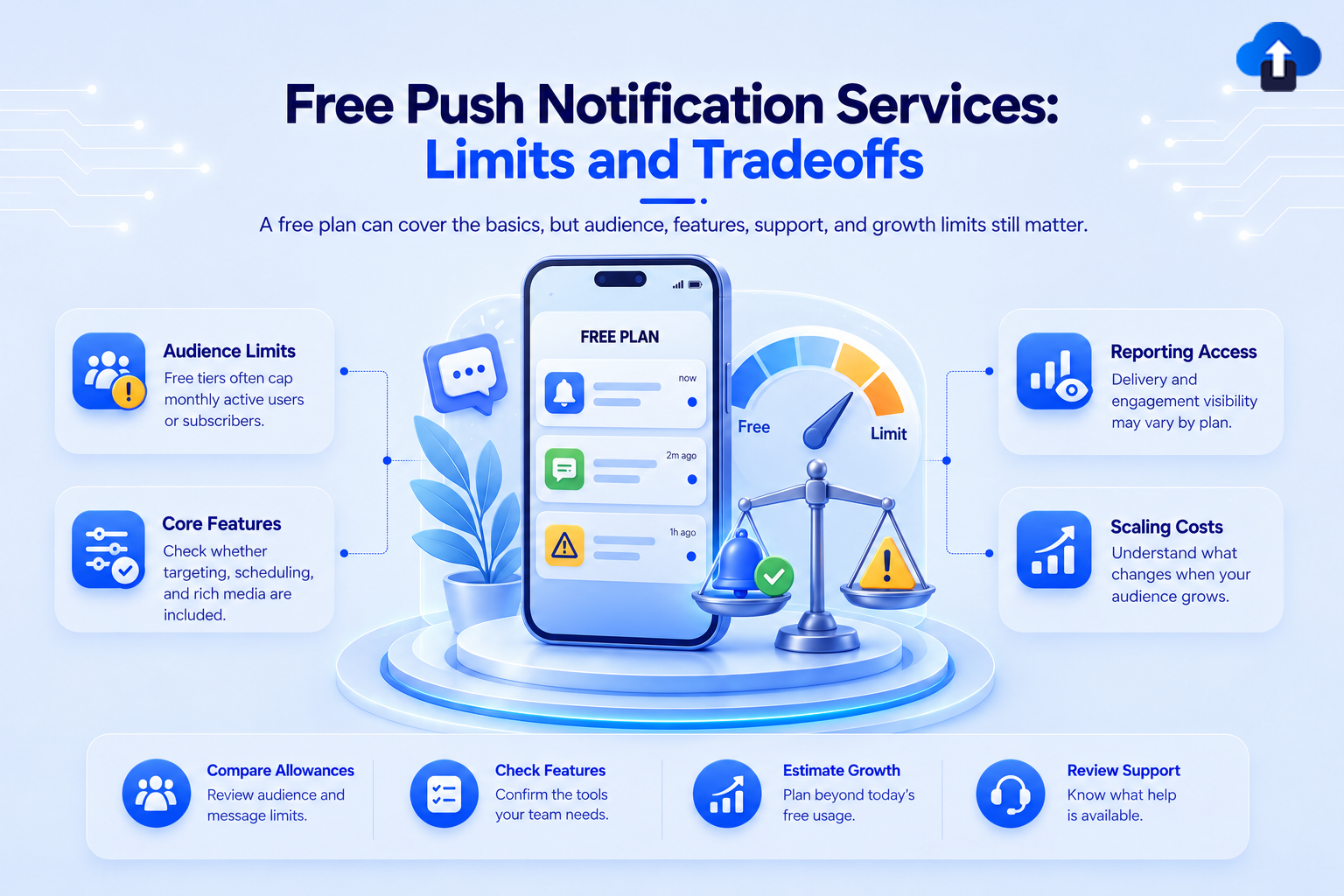
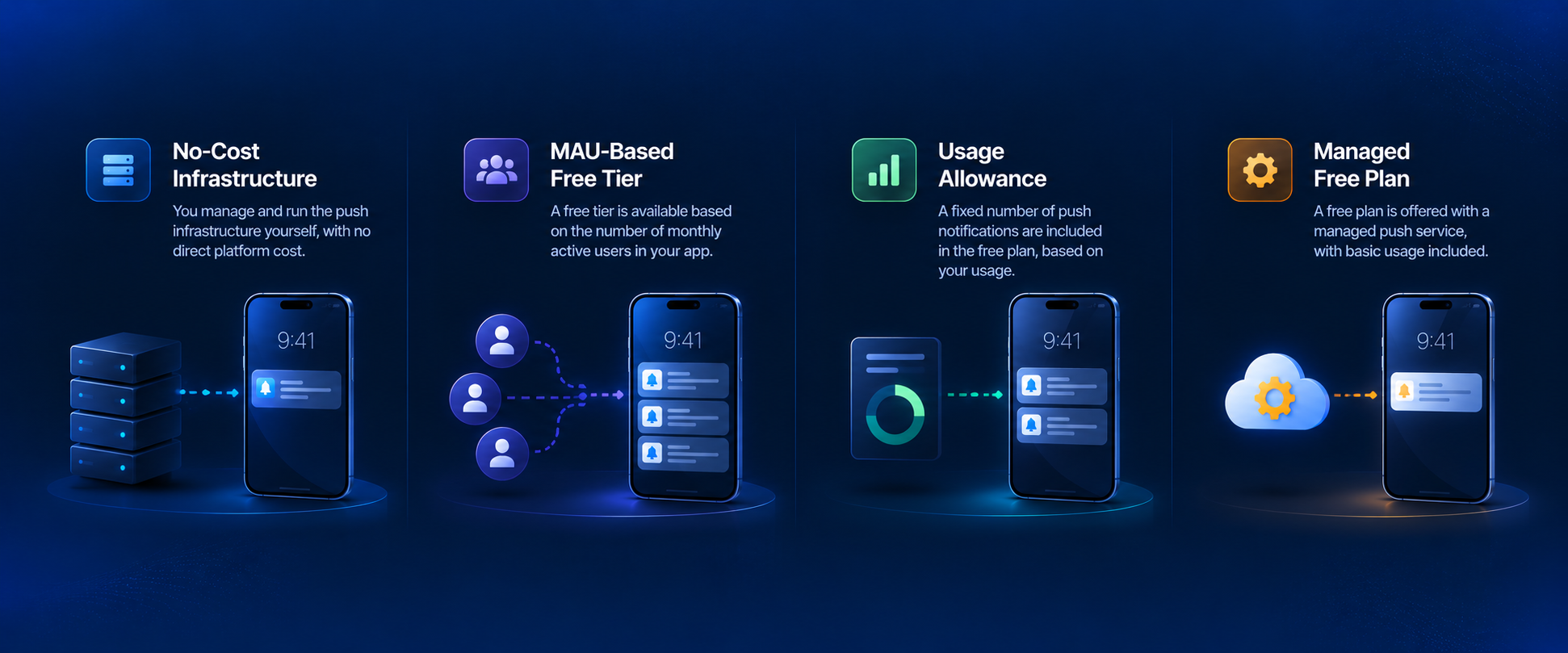
A free push notification service can help a mobile app team launch messaging without an immediate software bill. However, “free” means different things across providers. It may describe a no-cost product, a plan capped by monthly active users, or a limited monthly allowance.
The right comparison must include campaign tools, reporting, engineering effort, and upgrade costs. This guide compares four options using information from their official product and pricing pages.
Pricing and plan details were checked in October 2026. Verify the linked pages before publishing or selecting a service.
Free push notification service comparison
What does “free” actually mean?
Free push services usually follow one of three models:
- No-cost messaging infrastructure: Delivery is free, but the team builds and maintains more of the surrounding system.
- Free software tier: Campaign tools are included until the app reaches an audience or feature limit.
- Free usage allowance: A set number of notifications or requests is included before charges begin.
These models are not directly equivalent. One million notifications cannot be compared with 1,000 MAU without knowing how frequently each user receives a message. Audience size, sending frequency, required features, and engineering time all affect the actual cost.
1. Firebase Cloud Messaging
Firebase Cloud Messaging supports Android, iOS, and web apps. Google states that Cloud Messaging is available at no cost. It supports notification and data messages, device and topic targeting, scheduling, and integrations with Google Analytics and Firebase A/B Testing.
FCM is a strong choice for an engineering-led team that wants direct control. The tradeoff is that the team may still need to build or connect campaign management, localization, approvals, and reporting workflows. Other Firebase or Google Cloud products can have separate pricing.
FCM also documents a default HTTP v1 downstream quota of 600,000 messages per minute per project. This is a throughput quota, not a paid-plan threshold.
Best for: Teams that want a no-cost delivery layer and can build the experience around it.
2. OneSignal
OneSignal’s Free plan includes unlimited mobile push for organizations with up to 1,000 mobile MAU. It currently includes six segments, six data tags, three active Journeys, up to two A/B test variants, and 30 days of reporting history.
Advanced analytics, conversion metrics, CSV exports, the Notification History API, and confirmed delivery receipts are not included in the Free plan. The paid Growth plan currently starts at $19 per month, with mobile MAU usage priced separately.
Best for: Small teams that want a ready-made campaign interface and basic automation.
3. Amazon Simple Notification Service
Amazon SNS can deliver mobile notifications through services including Apple Push Notification service and Firebase Cloud Messaging. AWS currently lists 1 million mobile push notifications in its free tier. After that allowance, the published price is $0.50 per million notifications.
SNS is notification infrastructure, not a complete mobile engagement workspace. A team may need to build or integrate segmentation, campaign creation, consent handling, analytics, and business-user workflows. Related AWS services may add charges, and teams should confirm Free Tier eligibility and current regional terms in their AWS account.
Best for: Teams already using AWS that can build or integrate the campaign layer.
4. AppsOnAir Push Notification
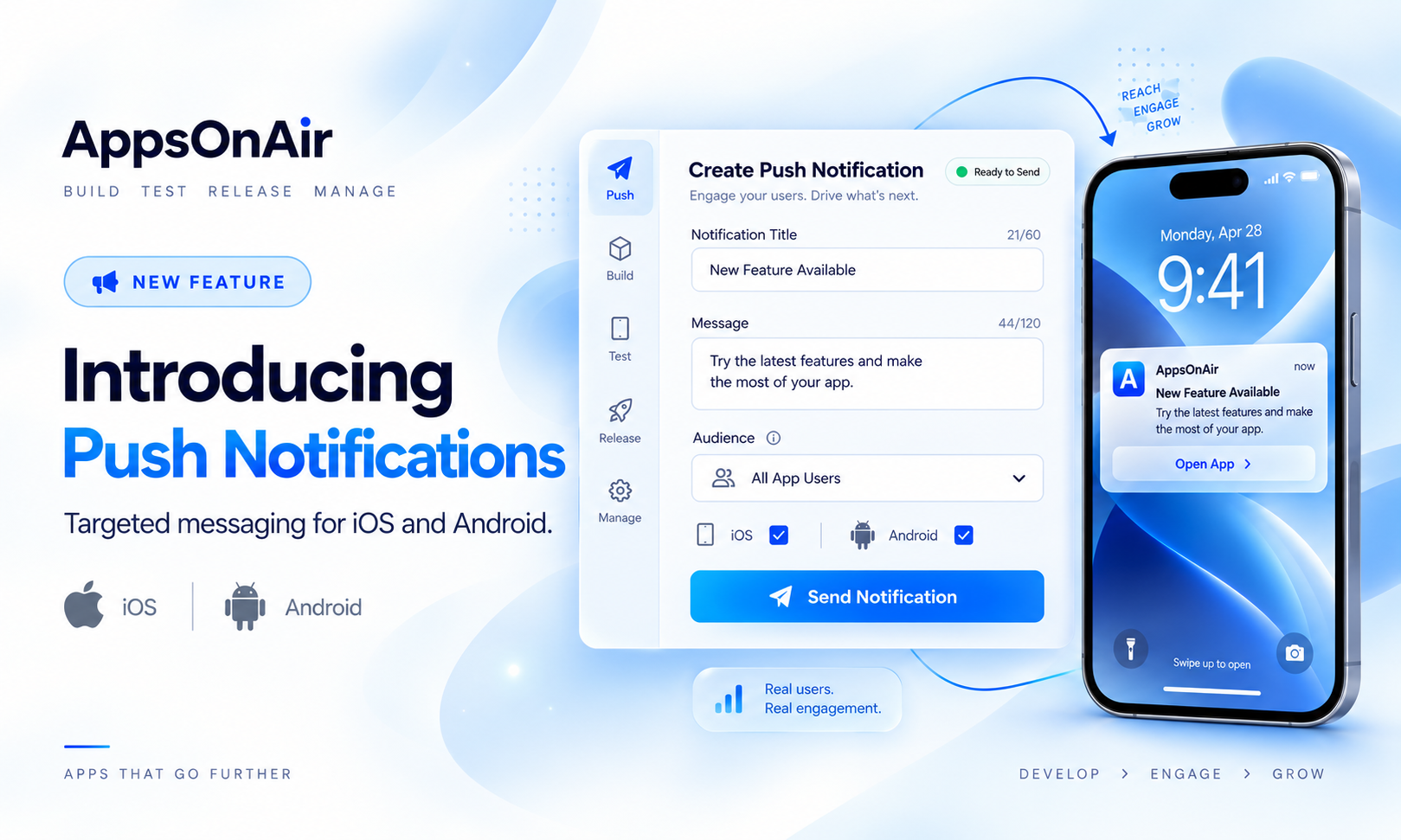
AppsOnAir Push Notification is free for mobile apps with up to 2,000 MAU. It supports Android and iOS, with segmentation based on criteria such as language, platform, app version, activity, and customer data. Teams can create language-specific message versions and track notifications sent, delivered, and opened.
AppsOnAir Push provides a managed campaign interface rather than only a delivery layer. It supports native Android and iOS apps, Flutter, React Native, and REST API integrations.
Above the free allowance, AppsOnAir pricing currently starts at $9 for up to 10,000 MAU. This gives teams a visible upgrade path without rebuilding their push workflow at the first growth milestone.
If your team wants campaign-ready Android and iOS push without assembling the surrounding workflow, Explore AppsOnAir Push.
When is a free service enough?
A free mobile push notification service can be enough when the app fits comfortably within its allowance, message volume is predictable, and the included targeting and reporting meet current needs. Your developers should also have capacity for any setup and maintenance the service requires.
Consider paying earlier when push is central to onboarding, transactions, retention, or revenue. Better automation, reporting, access controls, and support may be worth more than keeping the software line item at zero.
Common mistakes when comparing free services
- Treating MAU and message limits as equal: Estimate both active users and messages per user.
- Looking only at the headline allowance: Check restrictions on segmentation, automation, analytics, exports, and support.
- Ignoring engineering costs: Include implementation, security, monitoring, localization, and maintenance.
- Waiting until the limit is reached: Review paid pricing and migration requirements before growth makes the decision urgent.
Frequently asked questions
Is there a completely free push notification service?
Firebase Cloud Messaging is available at no cost, but implementation and related services can still create costs. AppsOnAir Push and OneSignal have MAU-based free plans, while AWS SNS lists a free usage allowance.
What is the best free push notification service for Android or iOS?
The best choice depends on your team. FCM suits developers who want direct delivery infrastructure. AppsOnAir Push or OneSignal may suit teams that also want campaign, segmentation, and reporting tools. Amazon SNS is more appropriate when AWS infrastructure and custom workflows are already part of the stack.
Are free push notification services suitable for production apps?
Yes, when their capacity, features, support, and reliability model meet the app’s requirements. Production teams should plan for audience growth, traffic spikes, consent, monitoring, and an eventual paid tier where applicable.
What should I check before choosing a free plan?
Confirm how usage is measured, supported platforms, targeting, analytics, automation, support, data export, overage rules, and paid pricing. Include the engineering time required to launch and maintain it.
Final thoughts
The best free push notification service is the one whose limits fit both your app today and its next stage of growth. FCM minimizes delivery-platform cost but requires more technical ownership. Amazon SNS provides inexpensive infrastructure with a free allowance. OneSignal offers a campaign platform for smaller audiences. AppsOnAir Push combines a 2,000-MAU free plan with mobile-focused segmentation, multilingual messaging, and delivery reporting.
Compare total operating cost, not only the advertised price. If you want a managed mobile workflow with a clear upgrade path, explore AppsOnAir Push Notifications.