.png)


Getting a mobile app ready for release involves more than writing code. Every update must be reviewed by developers, quality assurance (QA) teams, stakeholders, and sometimes clients before it reaches production. If testers cannot access the latest build quickly, the entire release process slows down.
Many iOS teams use TestFlight because it is Apple's official beta testing platform. While it works well for many scenarios, it can introduce delays when teams need to share multiple builds in a short period. This is especially true during bug fixing, client reviews, and fast-paced development cycles.
Direct OTA (Over-the-Air) distribution offers another approach. Instead of relying solely on TestFlight, development teams can distribute internal builds directly to authorized testers, allowing them to install and test updates much faster.
In this guide, we'll compare TestFlight and Direct OTA distribution, explain when each option makes sense, and show how choosing the right workflow can speed up client approvals and QA without sacrificing quality.
What Is TestFlight?
TestFlight is Apple's official platform for beta testing iOS applications. It allows developers to share pre-release versions of their apps with internal team members and external testers before publishing to the App Store.
How TestFlight Works
Developers upload a build to App Store Connect and invite testers through TestFlight.
Internal testers can usually access new builds quickly, while external testers may require Apple's beta app review before testing begins.
Once approved, testers install the TestFlight app and download the latest build from there.
Benefits of TestFlight
TestFlight offers several advantages for iOS development teams.
Some of its key benefits include:
- Official Apple-supported testing
- Secure tester management
- Built-in feedback collection
- Crash reporting integration
- Easy distribution to internal and external testers
For many teams, TestFlight remains an important part of the release process.
TestFlight Distribution Flow
1. Upload build to App Store Connect

2. Invite testers (internal/external)

3. (External) Wait for Apple beta review

4. Testers install via TestFlight app

5. Download latest build
What Is Direct OTA Distribution?
Direct OTA distribution allows developers to share internal app builds directly with authorized users without distributing them through the App Store.
Instead of waiting for TestFlight availability, testers can install builds using a secure download link or an internal distribution platform.
How Direct OTA Distribution Works
A development team generates a signed application build and uploads it to an OTA distribution platform.
Authorized testers receive a link that allows them to install the latest version directly on their devices.
Whenever a new build is available, developers simply upload the updated version and notify testers.
Benefits of Direct OTA Distribution
Direct OTA distribution is designed for speed and flexibility.
Key benefits include:
- Faster build delivery
- Immediate access for QA teams
- Simplified client reviews
- Frequent internal testing
- Reduced release bottlenecks
This makes it especially useful during active development cycles.
Direct OTA Distribution Flow
1. Generate signed build

2. Upload to OTA platform (e.g., AppsOnAir)

3. Share secure download link

4. Testers install directly on device

5. Instant updates on new build upload
TestFlight vs Direct OTA Distribution
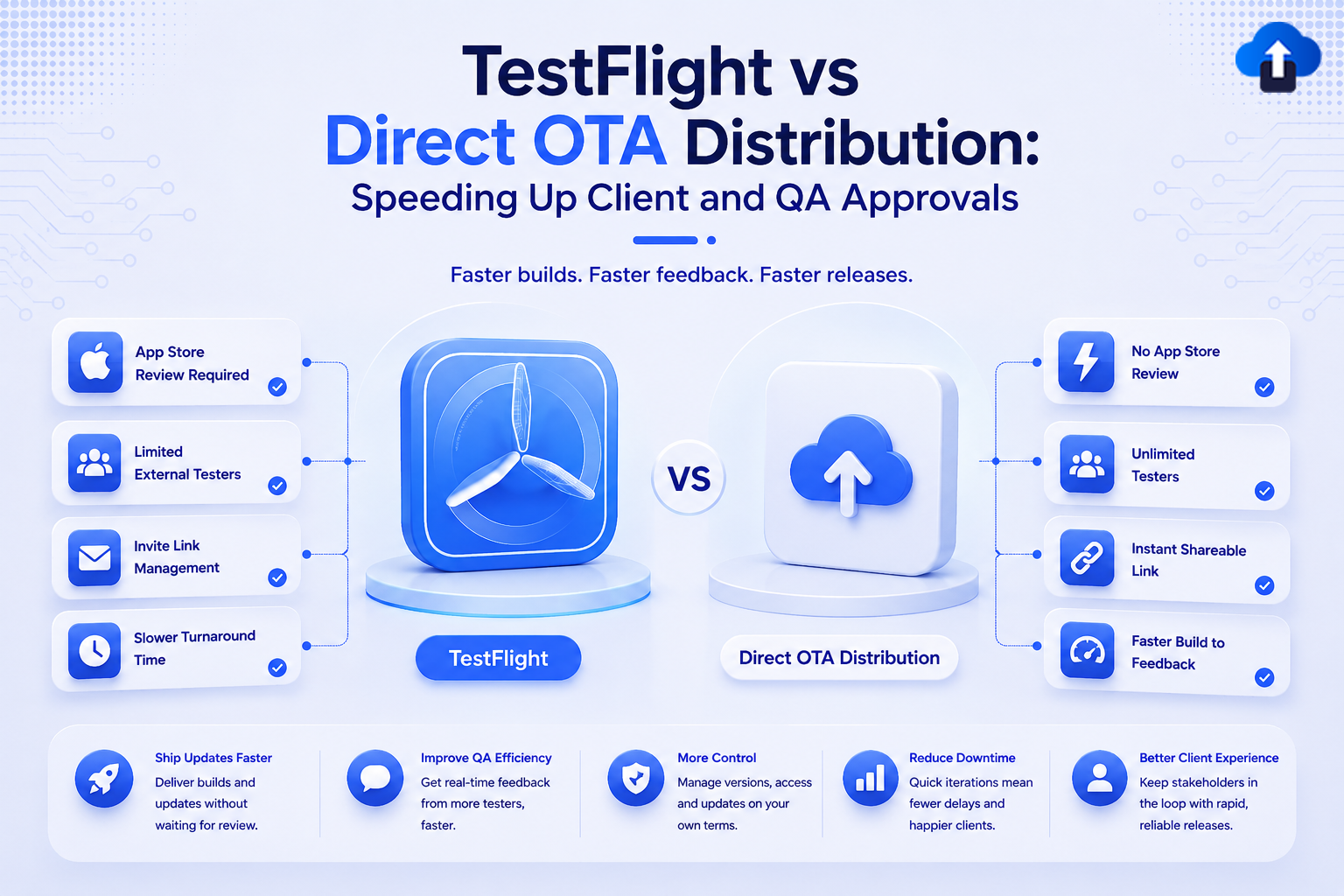
Both methods help teams test apps before release, but they are designed for different workflows.
Build Availability
With TestFlight, builds are uploaded through App Store Connect and typically require processing before they become available.
Additionally, when the app version number changes, Apple may require the build to go through beta app review before it can be distributed to external testers, which can add extra waiting time.
Direct OTA distribution eliminates the wait associated with App Store Connect processing and beta review for internal distribution.
With AppsOnAir, you can share your build directly with clients, QA teams, or stakeholders as soon as it is ready, without waiting for App Store review, enabling faster feedback and testing cycles.
Speed of QA Testing
QA teams often test multiple builds in a single day.
Waiting for every build to become available through traditional workflows can slow testing considerably.
Direct OTA distribution enables testers to receive updates almost immediately, making rapid bug verification much easier.
Client Feedback Cycles
Clients frequently request small UI changes, wording updates, or feature adjustments.
Using TestFlight for every revision can increase turnaround time.
With OTA distribution, developers can send updated builds quickly, allowing clients to review changes sooner and keep projects moving forward.
Release Flexibility
Modern development teams follow continuous integration and continuous delivery (CI/CD) practices.
Direct OTA distribution fits naturally into these workflows by enabling frequent build sharing throughout the development process.
TestFlight remains valuable for structured beta testing before public release.
TestFlight vs Direct OTA Distribution
When TestFlight Is the Better Choice
TestFlight continues to be an excellent option for many situations.
External Beta Testing
When testing with a larger group of external users, TestFlight provides a familiar and trusted experience.
Its integration with Apple's ecosystem makes tester management straightforward.
Pre-Release Validation
Many teams perform a final beta phase before submitting to the App Store.
TestFlight helps validate the release candidate under conditions similar to the production environment.
Feedback Collection
TestFlight includes tools for collecting screenshots, comments, and crash reports from testers.
This simplifies communication between developers and beta users.
When Direct OTA Distribution Is the Better Choice
Direct OTA distribution is particularly valuable during active development.
Internal QA
Internal testers often need immediate access to new builds.
Direct OTA distribution eliminates unnecessary waiting and accelerates testing cycles.
Client Demonstrations
Clients appreciate receiving updated builds quickly without navigating additional review processes.
This leads to faster approvals and smoother collaboration.
Rapid Bug Fix Verification
Developers frequently need QA teams to verify bug fixes immediately after implementation.
Direct OTA distribution allows testers to install updated builds within minutes rather than waiting for another distribution cycle.
Frequent Daily Builds
Teams practicing agile development may produce several builds every day.
Direct OTA distribution supports this pace more efficiently than traditional beta testing workflows.
Quick Guide: Which to Use?
Best Practices for Faster Build Distribution
Regardless of the distribution method you choose, following a structured workflow helps reduce delays.
Automate Build Generation
Use CI/CD pipelines to generate builds automatically after successful code changes.
Automation reduces manual work and shortens release cycles.
Example CI/CD Trigger (Simplified):
# After successful build
appsonair upload --build latest.ipa --notify qa-team
Maintain Clear Build Versions
Every shared build should include a clear version number and release notes.
This prevents confusion among testers and simplifies issue tracking.
Organize Tester Groups
Separate testers into groups such as:
- Developers
- QA engineers
- Internal stakeholders
- Clients
- Beta users
Different groups often require different build frequencies:
Track Feedback Efficiently
Build distribution is only one part of the testing process.
Collect feedback, bug reports, and approval status in a centralized system so issues can be resolved quickly.
How AppsOnAir Simplifies Internal App Distribution
Sharing development builds shouldn't become a bottleneck in your release process.
AppsOnAir enables development teams to distribute internal iOS and Android builds directly to QA teams, stakeholders, and clients through secure OTA distribution. Instead of waiting for every build to move through traditional testing workflows, teams can share updates immediately, making bug verification and client approvals significantly faster.
Combined with build management, version tracking, and streamlined distribution, AppsOnAir helps organizations accelerate testing while maintaining full control over who can access each release.
Common Mistakes to Avoid
One common mistake is relying on a single distribution method for every testing scenario. TestFlight and OTA distribution each have strengths, and using them together often produces the best results.
Another issue is failing to document build changes. Without clear release notes, testers may struggle to verify fixes or understand what has changed.
Some teams also distribute builds to everyone at once. Organizing testers into appropriate groups helps ensure the right people receive the right builds at the right time.
Finally, delaying build distribution until multiple changes are complete can slow feedback. Frequent, smaller releases usually lead to faster approvals and more efficient testing.
Frequently Asked Questions
What is the main difference between TestFlight and Direct OTA distribution?
TestFlight is Apple's official beta testing platform, while Direct OTA distribution allows organizations to share internal app builds directly with authorized testers without relying solely on TestFlight.
Is Direct OTA distribution faster than TestFlight?
For internal development, QA, and client reviews, Direct OTA distribution is often faster because builds can be shared immediately after they are created.
Can TestFlight and Direct OTA distribution be used together?
Yes. Many development teams use Direct OTA distribution for internal testing and rapid client reviews while using TestFlight for structured external beta testing before an App Store release.
Which option is better for QA teams?
QA teams that test multiple builds daily often benefit from Direct OTA distribution because it reduces waiting time and speeds up bug verification.
Does Direct OTA distribution replace the App Store?
No. Direct OTA distribution is intended for internal testing and controlled build sharing. Public releases still need to follow Apple's App Store requirements.
Final Thoughts
There is no single solution for every mobile testing workflow. TestFlight remains an excellent platform for official beta testing and external user feedback, while Direct OTA distribution excels at rapid internal testing, client reviews, and fast QA cycles.
For modern mobile teams, combining both approaches often delivers the best results. Developers can use Direct OTA distribution to quickly share builds with QA engineers and clients, then rely on TestFlight for broader pre-release validation before submitting to the App Store.
As release cycles become shorter and expectations for faster delivery continue to grow in 2026, adopting the right build distribution strategy can help development teams reduce delays, improve collaboration, and deliver higher-quality mobile applications more efficiently.