.svg)



React Native developers have always looked for ways to deliver updates faster. Traditional app store releases can take hours or even days, making it difficult to fix bugs or ship small improvements quickly.
For years, CodePush was one of the most popular solutions for updating React Native apps without waiting for App Store or Google Play approval. However, as mobile development workflows evolved and CodePush support changed, many teams started exploring broader OTA update solutions.
Today, developers often ask an important question: should they use CodePush or a modern OTA update platform?
The answer depends on your app's requirements, release process, and long-term goals. Understanding the differences can help you choose the right approach for your React Native application.
What Is CodePush?
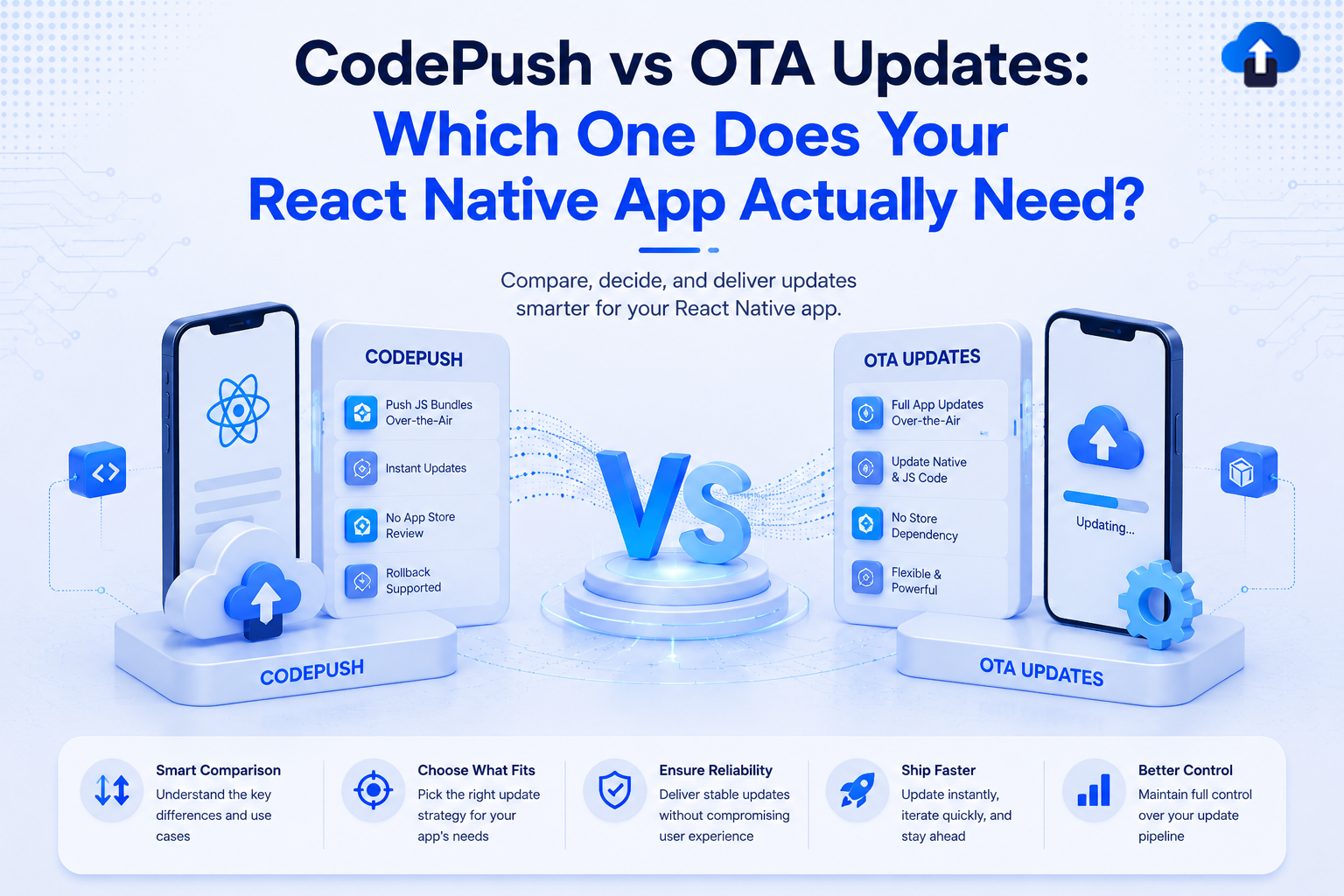
CodePush is a technology that allows React Native developers to push JavaScript bundle updates directly to users without submitting a new app version to app stores.
Instead of requiring users to download a completely new app build, CodePush delivers updated JavaScript code and assets over the air.
How CodePush Works
React Native applications separate much of their business logic from native code.
When developers make changes to JavaScript files, CodePush packages those updates and distributes them directly to devices.
Users receive the latest version when they open the application, allowing bug fixes and improvements to be deployed quickly.
Benefits of CodePush
CodePush became popular because it offered several advantages:
- Faster bug fixes
- Reduced dependency on app store review
- Improved release velocity
- Better user experience
- Smaller update packages
For many teams, these benefits significantly improved mobile development workflows.
What Are OTA Updates?
OTA (Over-the-Air) updates refer to any system that delivers app updates directly to user devices without requiring a full app store release.
CodePush is actually one type of OTA update solution. However, modern OTA platforms often provide additional capabilities beyond simple bundle distribution.
How OTA Updates Work
OTA update platforms distribute updated JavaScript bundles, assets, and application content directly to devices.
When users launch the app, the platform checks for available updates and downloads approved releases automatically.
This allows teams to respond quickly to production issues and ship improvements more frequently.
Why OTA Updates Are Growing in Popularity
Modern development teams need more than just update delivery.
They also need deployment management, release control, monitoring, analytics, rollback functionality, and staged rollouts.
As mobile applications become more complex, comprehensive OTA update platforms have become increasingly important.
CodePush vs OTA Updates: Understanding the Difference
One of the biggest misconceptions is that CodePush and OTA updates are competitors.
In reality, CodePush is a specific implementation of OTA update technology, while OTA updates represent a broader category.
Scope of Functionality
CodePush primarily focuses on delivering JavaScript bundle updates.
Modern OTA update platforms often include:
- Update delivery
- Rollout management
- Release tracking
- Version targeting
- Deployment analytics
- Rollback controls
- Team collaboration features
For many organizations, these additional capabilities are just as important as the update mechanism itself.
Deployment Control
Development teams often need precise control over how updates are released.
Modern OTA solutions typically support staged rollouts, allowing updates to reach a small percentage of users before expanding to the entire user base.
This approach reduces deployment risk and helps identify issues early.
Monitoring and Visibility
Shipping updates is only part of the process.
Teams also need visibility into:
- Update adoption rates
- Installation success
- Crash reports
- Deployment performance
- User impact
Advanced OTA platforms provide these insights, helping teams make informed release decisions.
When CodePush May Be Enough
For smaller projects, a basic update solution like CodePush is often entirely sufficient to meet your deployment goals.
It streamlines the release process by allowing you to push critical JavaScript fixes directly to users without waiting for app store approvals.
Internal Applications
Internal business applications often have a limited user base and simpler release requirements compared to public, consumer-facing apps.
In these cases, delivering critical JavaScript updates and bug fixes quickly to keep employees productive is the primary goal
Small Development Teams
Teams with only a few developers may not require advanced deployment workflows.
A straightforward update mechanism can help maintain efficiency without introducing unnecessary complexity.
Simple Release Processes
Applications with infrequent updates and low deployment risk may benefit from a lightweight approach.
However, as products grow, release management requirements often become more sophisticated.
When a Full OTA Update Platform Makes More Sense
While lightweight solutions work perfectly for smaller projects, scaling an application changes the stakes entirely.
As your user base grows and deployment frequencies increase, relying on basic update tools can introduce significant operational bottlenecks.
Large User Bases
When thousands or millions of users rely on your application, deployment mistakes become expensive.
Staged rollouts and rollback capabilities help reduce operational risk.
Frequent Releases
Modern mobile development teams often release updates weekly or even daily to stay competitive and resolve bugs instantly.
Managing this high volume of releases manually quickly becomes unmanageable and prone to human error without dedicated deployment tools.
Multiple App Versions
Many organizations support multiple versions of their applications simultaneously.
Version targeting ensures updates are delivered only to compatible app builds.
This prevents crashes and compatibility issues.
Enterprise Requirements
Larger organizations often require:
- Release governance
- Deployment approvals
- Audit trails
- Team collaboration
- Monitoring dashboards
Comprehensive OTA platforms support these requirements more effectively than basic update tools.
Key Features to Look for in an OTA Update Solution
Not all OTA platforms offer the same capabilities, and choosing the right one can mean the difference between a seamless deployment and a broken app.
As your mobile application scales, you need features that go beyond simply pushing code to a server.
Staged Rollouts
Staged deployments release updates gradually over time rather than pushing them to your entire user base immediately.
This staggered approach allows you to monitor performance closely on a small percentage of devices (e.g., a 1% or 5% initial cohort), helping you identify hidden edge-case bugs and performance regressions before they affect all of your users.
Instant Rollbacks
If a bad update introduces critical crashes or breaks core functionality, teams must be able to revert users to a stable version instantly.
Automated or one-click rollback functionality acts as your ultimate safety net, significantly reducing app downtime, preventing negative app store reviews, and minimizing user frustration during an incident.
Version Management
Strong version management ensures that your JavaScript or asset updates target only the specific, compatible native app builds already installed on user devices.
This precise mapping is especially important for complex applications supporting multiple older native releases, ensuring an update meant for version 2.1 never accidentally triggers on version 1.0 and causes a crash.
Deployment Analytics
Real-time analytics help development and product teams understand exactly how an update is performing in the wild, tracking adoption rates, download success metrics, and active user counts.
This deep visibility eliminates guesswork, allowing you to make data-driven decisions on when to ramp up a rollout or pause a deployment.
Security Controls
Because OTA updates modify application behavior outside of traditional app store review pipelines, update packages must be delivered securely and strictly verified before installation.
Implementing robust security controls—such as cryptographic code signing, secure token authentication, and data encryption—is absolutely vital for protecting enterprise and consumer-facing applications from malicious tampering.
How AppsOnAir Supports React Native OTA Updates
AppsOnAir helps React Native teams manage OTA updates with greater control and flexibility.
Instead of focusing solely on update delivery, AppsOnAir provides tools for managing deployments, controlling rollouts, monitoring releases, and maintaining application stability.
Development teams can ship bug fixes faster, reduce release risk, and improve the overall update experience for users.
This makes OTA updates easier to manage throughout the entire mobile application lifecycle.
Common Mistakes When Choosing an Update Solution
Many teams choose an update strategy based only on immediate needs.
One common mistake is ignoring future growth. A solution that works for a small app may become limiting as the user base expands.
Another mistake is overlooking deployment monitoring. Delivering updates without visibility into performance can make troubleshooting difficult.
Some teams also underestimate the importance of rollback capabilities. Every deployment carries risk, and recovery options should always be available.
Finally, developers should avoid focusing solely on update delivery speed. Reliability, control, and visibility are equally important for long-term success.
Frequently Asked Questions
Is CodePush the same as OTA updates?
No. CodePush is one implementation of OTA update technology. OTA updates represent the broader process of delivering updates directly to devices without app store approval.
Do OTA updates replace app store releases?
No. OTA updates can deliver JavaScript and asset changes, but native code changes still require App Store or Google Play submissions.
Which option is better for large React Native apps?
Large applications typically benefit from a complete OTA update platform that includes rollout management, analytics, monitoring, and rollback capabilities.
Can OTA updates improve release speed?
Yes. OTA updates allow developers to distribute bug fixes and improvements much faster than traditional app store releases.
What is the most important OTA update feature?
While update delivery is essential, staged rollouts and rollback functionality are often the most valuable features for reducing deployment risk.
Final Thoughts
The question is not necessarily CodePush versus OTA updates. A more accurate question is whether your React Native app needs basic update delivery or a complete OTA update management solution.
For smaller projects, a simple approach may be enough. However, as applications grow, release management becomes more complex. Teams need better visibility, rollout controls, version management, and deployment monitoring.
In 2026, successful React Native teams are focusing on reliable update workflows rather than just faster deployments. Choosing the right OTA update strategy can help improve release quality, reduce risk, and deliver a better experience for users.