.svg)



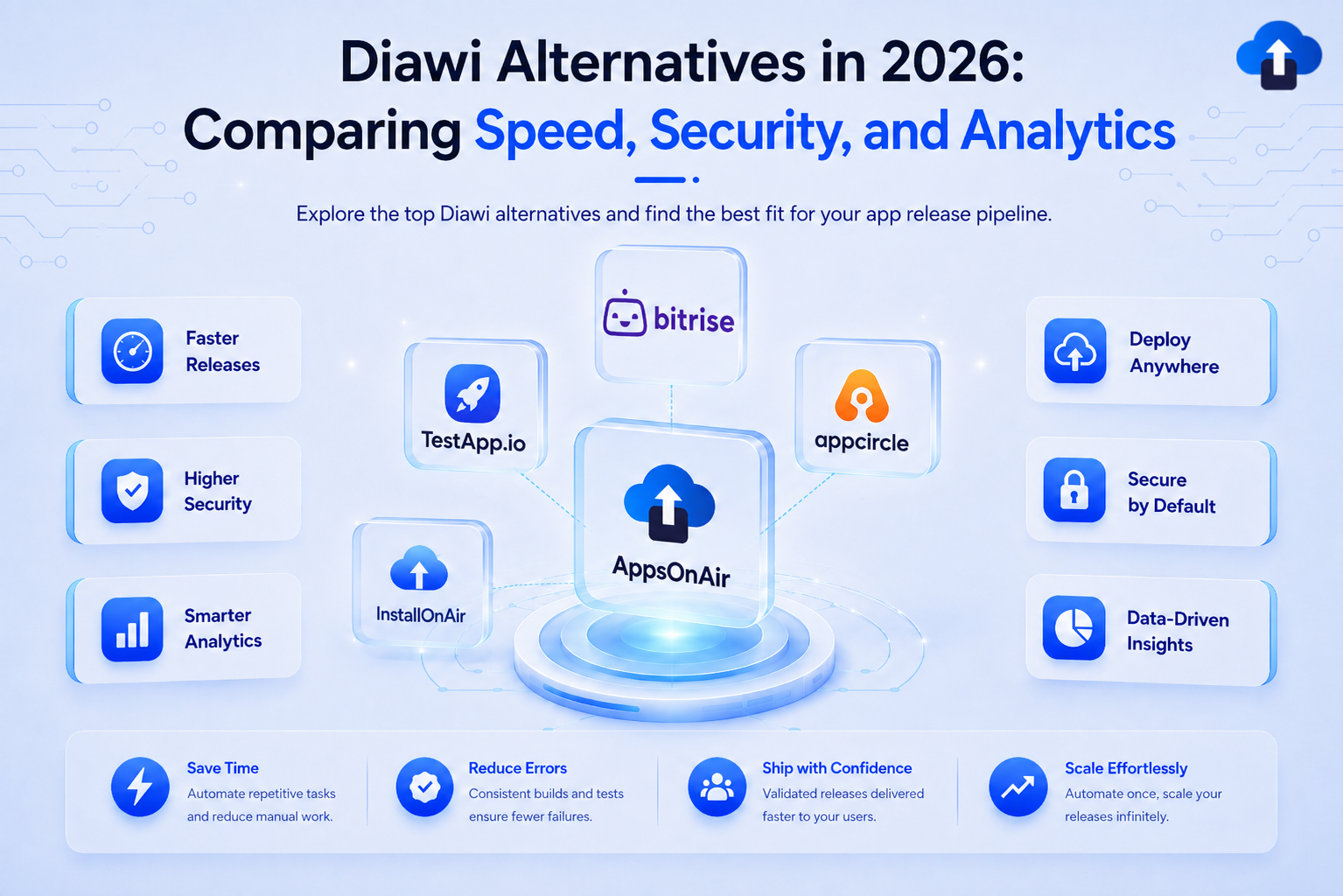
Sharing mobile app builds with testers, clients, and stakeholders is an essential part of the development process. Teams need a reliable way to distribute internal builds quickly, collect feedback, and keep everyone working with the latest version.
For many years, Diawi has been a popular choice for sharing iOS and Android builds. It offers a simple way to upload an app and generate a download link. However, as mobile development has become more complex, many teams now need more than basic file sharing.
Modern development workflows require stronger security, build management, analytics, version tracking, and collaboration features. That's why many organizations are exploring Diawi alternatives in 2026.
In this guide, we'll compare what modern build distribution platforms offer, the key features to look for, and how solutions like AppsOnAir help development teams distribute builds faster and more securely.
What Is Diawi?
Diawi is a mobile app distribution platform that allows developers to upload iOS and Android application builds and share them through downloadable links.
It is commonly used for internal testing, client reviews, QA, and pre-release app demonstrations.
Why Developers Use Diawi
Diawi simplifies the process of sharing development builds without publishing them on the App Store or Google Play.
It is popular because it offers:
- Simple build uploads
- Shareable installation links
- Support for iOS and Android
- Quick setup
- Easy testing workflows
For small teams, these features are often enough to begin internal testing.
Why Teams Look for Diawi Alternatives
As development teams grow, so do their requirements.
Simply uploading a build is no longer enough for many organizations.
More Frequent Releases
Modern agile teams release builds every day, sometimes multiple times a day.
Managing these builds manually becomes increasingly difficult as projects scale.
Larger Testing Teams
Development often involves multiple groups:
- Developers
- QA engineers
- Product managers
- Designers
- Clients
- Business stakeholders
Managing permissions and ensuring everyone installs the correct build requires better organization.
Enterprise Security Requirements
Internal builds often contain confidential features and unreleased functionality.
Organizations need stronger access controls, authentication, and permission management than basic file sharing provides.
Better Visibility Into Testing
Development managers want answers to questions such as:
- Who installed the latest build?
- Which version is currently being tested?
- Has the client reviewed the latest release?
- Which builds are no longer active?
Analytics and reporting become increasingly valuable as teams grow.
What to Look for in a Diawi Alternative
Not every build distribution platform offers the same capabilities.
Here are the features that matter most in 2026.
Fast Build Distribution
The primary purpose of an internal distribution platform is speed.
Uploading a build should allow authorized users to install it within minutes, helping QA teams verify bug fixes and clients review new features without unnecessary delays.
Strong Security
Security should be built into every stage of the distribution process.
Look for features such as:
- Secure authentication
- Password-protected downloads
- Role-based permissions
- Controlled build access
- Expiring download links
These controls help protect confidential applications from unauthorized access.
Build Version Management
Managing multiple builds manually quickly becomes confusing.
A modern platform should clearly organize build history, version numbers, release dates, and supported operating systems.
This ensures testers always install the correct version.
Installation Analytics
Knowing whether a build has actually been installed is just as important as sharing it.
Useful analytics include:
- Installation counts
- Device information
- Build adoption
- Active versions
- Download history
These insights help development teams monitor testing progress more effectively.
QR Code Distribution
Many modern platforms generate QR codes for every build.
Stakeholders can simply scan the code using their mobile device to begin installation, eliminating the need to copy long download links.
CI/CD Integration
Automation has become a standard part of mobile development.
Integration with CI/CD pipelines allows builds to be uploaded automatically after successful builds, reducing manual work and accelerating release cycles.
5 Best Diawi Alternatives in 2026
Here are five of the best Diawi alternatives in 2026, starting with the platform best suited for modern OTA app distribution.
1. AppsOnAir — Best Overall Diawi Alternative
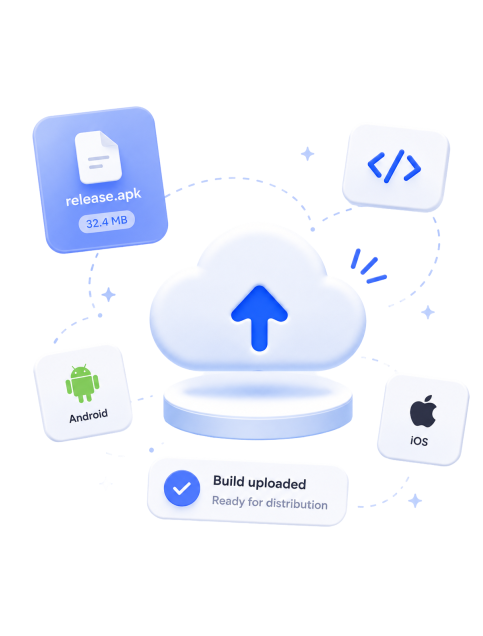
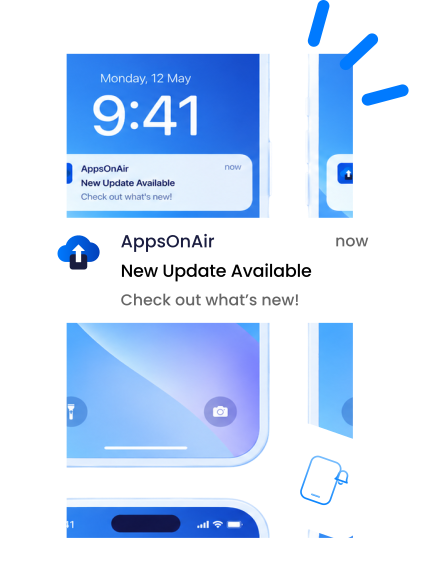
AppsOnAir is built specifically for teams that need more than simple build uploads. Instead of acting as a file-sharing service, it provides a complete over-the-air (OTA) app distribution platform that helps organizations manage the entire internal release process.
Development teams can securely distribute iOS and Android builds, organize versions, control tester access, and monitor build adoption from a centralized dashboard.
This makes it particularly valuable for companies that release multiple builds every week or work with distributed QA teams, clients, and stakeholders.
Key features include:
- Secure OTA build distribution
- QR code-based installation
- Build version management
- User roles and access control
- Installation tracking and analytics
- Release notes management
- Centralized build history
Best for: Growing startups, software agencies, enterprise development teams, and organizations looking for a complete internal app distribution solution.
2. TestApp.io — Best for GitHub-Based Mobile Teams
TestApp.io focuses on making mobile app distribution simple for development teams that build and release apps frequently. It integrates closely with GitHub, allowing developers to automatically distribute iOS and Android builds to testers whenever new code is pushed or a release is created.
The platform emphasizes quick setup and streamlined tester experiences, making it easy to share builds without managing complex distribution workflows. It also supports CI/CD automation through GitHub Actions and other popular development tools, helping teams reduce manual effort during testing cycles.
Strengths
- Native GitHub integration
- Automated build distribution
- Simple tester onboarding
- CI/CD support
- Fast setup with minimal configuration
Best for: Development teams using GitHub to automate mobile app testing and build distribution.
3. Bitrise Build Distribution — Best for CI/CD-Driven Teams
Bitrise Build Distribution is part of the Bitrise mobile DevOps platform, enabling teams to automatically distribute Android and iOS builds directly from their CI/CD pipelines. It simplifies the release process by delivering builds to testers and stakeholders immediately after successful builds, eliminating the need for manual uploads.
Its biggest advantage is seamless integration with Bitrise's automation workflows, making it an excellent choice for teams that rely heavily on continuous integration and continuous delivery. Developers can also connect Bitrise with tools like GitHub, GitLab, Bitbucket, Slack, and Jira to streamline collaboration throughout the development lifecycle.
Strengths
- Automated build distribution
- Powerful CI/CD integration
- GitHub, GitLab, and Bitbucket support
- Tester groups and release notifications
- Integrated with the Bitrise mobile DevOps platform
Best for: Development teams that want to automate app distribution as part of a CI/CD-driven mobile development workflow.
4. Appcircle — Best for End-to-End Mobile CI/CD
Appcircle combines mobile CI/CD with internal app distribution, making it an attractive option for teams that want both automated build pipelines and tester distribution in a single platform.
Beyond simply sharing builds, Appcircle offers automated signing, workflow automation, build pipelines, testing, publishing, and OTA distribution.
Its internal distribution capabilities include:
- Secure build sharing
- Tester groups
- Build history
- Version management
- Role-based permissions
- Release management
Because it focuses on the complete mobile DevOps lifecycle, Appcircle is often chosen by teams looking to consolidate multiple development tools into one platform.
Best for: Organizations seeking a full mobile DevOps platform alongside app distribution.
5. InstallOnAir — Best for Simple OTA Build Sharing
InstallOnAir is another lightweight OTA distribution platform designed to simplify sharing iOS and Android builds with testers and clients.
Like Diawi, it focuses on generating installation links, but also includes features that improve the testing experience, such as QR code sharing and easier device installation workflows.
For smaller teams that primarily need to distribute builds quickly without implementing a full enterprise release management platform, InstallOnAir provides a straightforward solution.
Common features include:
- OTA app installation
- QR code downloads
- Build hosting
- Simple sharing links
- Support for iOS and Android apps
While it is easy to use, larger organizations may eventually require more advanced capabilities such as detailed analytics, granular permission controls, release tracking, and CI/CD automation.
Best for: Small teams, agencies, and client demos requiring quick build sharing.
Which Diawi Alternative Is Right for You?
The best alternative depends on your team's size, workflow, and release process.
Best Practices When Choosing a Build Distribution Platform
Selecting the right platform depends on your team's workflow.
Prioritize Security
Internal builds often contain sensitive business logic and unreleased features.
Choose a platform that offers robust authentication and access management.
Think Beyond File Sharing
Uploading builds is only one part of the testing process.
Version management, release tracking, analytics, and collaboration become increasingly important as projects grow.
Consider Automation
Manual uploads consume valuable development time.
Platforms that integrate with your CI/CD pipeline help accelerate releases and reduce repetitive work.
Plan for Growth
A solution that works well for a five-person team may become limiting as your organization expands.
Choose a platform that can support larger teams and more complex release workflows.
Common Mistakes to Avoid
One common mistake is choosing a platform based only on upload speed. While fast uploads are important, security, version management, and analytics often become equally valuable as development teams grow.
Another mistake is overlooking access controls. Internal builds should never be publicly accessible without appropriate authentication and permissions.
Some organizations also fail to maintain build history. Without centralized version management, testers may unknowingly install outdated builds and report issues that have already been resolved.
Finally, avoid relying entirely on manual build uploads. Automating distribution through CI/CD pipelines reduces human error and significantly speeds up release cycles.
Frequently Asked Questions
What is Diawi used for?
Diawi is a platform that allows developers to upload and share iOS and Android application builds for internal testing without publishing them to public app stores.
Why do teams look for Diawi alternatives?
Many teams need additional features such as stronger security, build version management, analytics, QR code distribution, user permissions, and CI/CD integration.
What should I look for in a Diawi alternative?
Important features include secure OTA distribution, build tracking, access controls, installation analytics, QR code sharing, version management, and automation support.
Is OTA distribution better than manually sharing app builds?
For most development teams, yes. OTA distribution simplifies internal testing, improves collaboration, and reduces the time required to distribute new builds.
How does AppsOnAir help with internal app distribution?
AppsOnAir provides secure OTA build distribution for iOS and Android, allowing teams to share builds quickly, manage versions, organize tester access, generate QR codes, monitor installations.
Final Thoughts
Diawi continues to be a useful tool for sharing mobile app builds, particularly for smaller teams with straightforward testing needs. However, as development practices evolve and release cycles become faster, many organizations require more than simple file sharing.
Modern build distribution platforms combine speed with advanced security, analytics, automation, and collaboration features. These capabilities help teams distribute builds more efficiently, monitor testing progress, and maintain better control over every release.
If your team is growing, releasing builds frequently, or working closely with clients and QA teams, investing in a comprehensive OTA distribution platform like AppsOnAir can simplify your workflow and make internal app distribution faster, safer, and easier to manage.