.png)


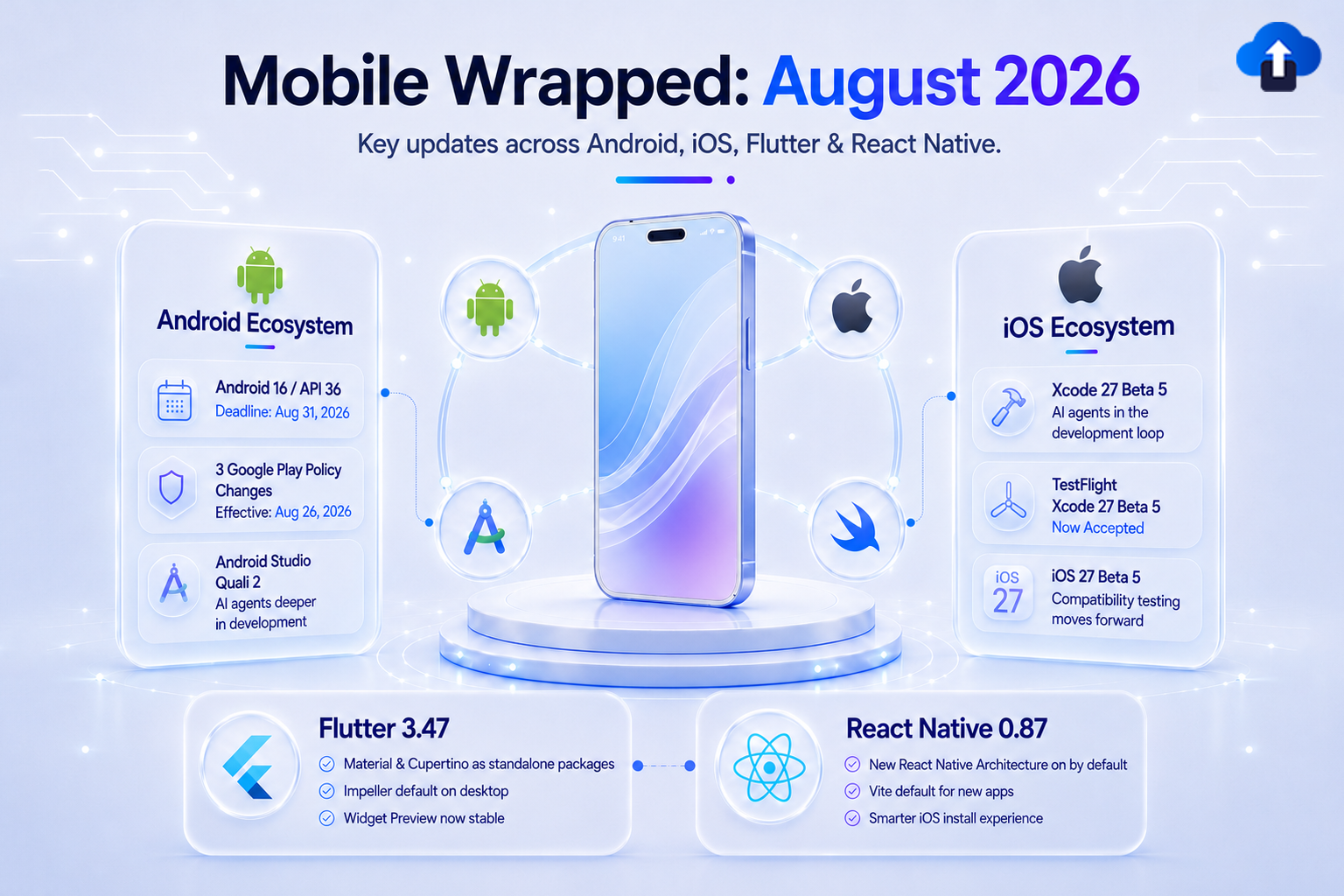
The mobile ecosystem is entering a more operational phase. This month is less about another collection of framework features and more about release readiness, platform compliance, and AI moving directly into the engineering workflow.
Google Play's Android 16 targeting deadline arrives on August 31, while several Play policy changes take effect on August 26. React Native 0.87 has entered its release cycle, Apple continues its iOS 27/Xcode 27 beta program, and both Android Studio and Xcode are pushing AI agents beyond code completion into testing, debugging, and project-level tasks.
Android Ecosystem
Android 16 / API 36: August 31 is the deadline
From August 31, 2026, new apps and app updates submitted to Google Play must target Android 16 (API 36) or higher. Existing apps need to target Android 15 (API 35) or higher to remain available to new users on devices running newer Android versions. Google provides an extension until November 1, 2026.
Why it matters: This is now a release-engineering deadline, not a future migration task. A target SDK upgrade can expose behavior changes, dependency incompatibilities, native-library issues, and test failures across the application.
Action: Before your next production release, validate:
- compileSdk = 36
- targetSdk = 36
- Android 16 behavior changes
- foreground services
- permissions and notifications
- third-party SDK compatibility
- release builds and CI pipelines
Google Play: Three policy changes land August 26
Google Play has three important policy changes scheduled for August 26:
- Anonymous chat apps cannot target children.
- Age-Restricted Content and Functionality requirements expand to anonymous and random chat apps.
- Geofencing is removed as an approved foreground-service use case; developers should use the Geofence API instead.
Why it matters: The geofencing change is particularly relevant to Android teams that use foreground services for location-triggered functionality. This is a case where a policy change can require an architectural change rather than simply updating documentation.
Action: Audit foreground-service declarations and identify any geofencing implementation that can move to Android's Geofencing API.
Android Studio Quail 2: AI moves deeper into development
Android Studio Quail 2 is now stable. Its Agent Mode supports multiple parallel conversations, allowing developers to run independent tasks such as test generation, feature planning, and documentation work simultaneously.
The release also integrates LeakCanary directly into Android Studio Profiler. Leak analysis runs on the development machine and is connected to source code, including jump-to-source functionality. Developers can also pass the leak analysis to Gemini for further investigation.
Why it matters: The useful shift isn't AI-generated Kotlin. It is AI being connected to real engineering context: source code, diagnostics, profiling and project state.
Action: Try Agent Mode on controlled tasks such as test generation, migration analysis and memory-leak investigation-but keep CI and human review as the final quality gates.
iOS Ecosystem
Xcode 27 Beta 5: agents become part of the development loop
Apple released Xcode 27 beta 5 on 10 August, alongside iOS 27 beta 5.
Xcode 27's coding-intelligence capabilities go significantly beyond autocomplete. Agents can:
- boot simulators
- install and launch apps
- synthesize touch events
- capture screenshots
- inspect and modify build settings
- interact with debugger state
- analyze crashes, energy, hangs and launch issues
- work with localization
- use MCP tools to interact with Xcode.
Why it matters: The development environment is becoming an executable engineering environment. An AI agent can increasingly move through the same workflow a developer follows: change → build → run → inspect → diagnose → modify.
Action: Keep Xcode 27 in a dedicated beta CI/testing lane. Do not replace your production toolchain with beta software yet.
TestFlight: Xcode 27 Beta 5 Now Accepted
Apple now allows apps built with Xcode 27 beta 5 and the iOS 27.0 beta 5 SDK to be submitted to TestFlight for both internal and external testing.
Why it matters: Teams can move their iOS 27 compatibility testing to the latest beta while keeping production builds on the stable Xcode toolchain.
Action: Maintain a dedicated iOS 27 beta testing lane and validate native SDKs, third-party frameworks, UI tests, signing, and release archives against Xcode 27 beta 5.
Flutter
Flutter 3.47 - verified August update
Flutter 3.47 landed on August 12, 2026, introducing one of the framework's biggest architectural changes this year: Material and Cupertino are now available as standalone packages. The release also prepares Flutter applications for Xcode 27/iOS 27, raises minimum iOS support, makes Impeller the default renderer on desktop, and graduates Widget Preview to stable.
Material & Cupertino leave the core SDK
The new material_ui and cupertino_ui packages have reached 1.0 and can now evolve independently of Flutter's quarterly SDK releases. Flutter says the legacy libraries bundled in the core SDK are scheduled for formal deprecation in the November 2026 stable release.
Why it matters: UI framework updates will no longer necessarily require a full Flutter SDK upgrade.
Action: Start testing the migration now:
dart fix --apply --code=migrate_design_widgetsFlutter also provides a compatibility bridge for applications whose dependencies still use the
legacy imports.
iOS minimum version moves to 15
Flutter 3.47 raises the minimum supported iOS version from iOS 13 to iOS 15, partly to prepare for Xcode 27 and upcoming Apple platform changes.
Impact: Teams supporting iOS 13/14 must review their deployment-target and device-support strategy before upgrading.
iOS 27 / Xcode 27 compatibility
Flutter 3.47 specifically prepares projects for Xcode 27 and iOS 27. The iOS 27 SDK requires the UIScene lifecycle for UIKit-based applications. Flutter handles the migration automatically in most projects, but custom AppDelegate implementations and plugins using the legacy lifecycle may require manual changes.
Action: Test Flutter applications and native plugins against the latest Xcode 27 beta before the production migration.
Swift Package Manager gains momentum
Flutter reports that 92 of the top 100 iOS plugins have migrated to Swift Package Manager. Developers who previously disabled SwiftPM can now retry it with:
flutter config --enable-swift-package-managerCocoaPods remains supported, but Flutter describes it as being in maintenance mode and is encouraging ecosystem migration toward SwiftPM.
Bottom line: Flutter 3.47 isn't just another framework release. It begins a significant transition toward independently versioned UI packages, stronger Apple-platform alignment, and a more modular native dependency ecosystem.
React Native
React Native 0.87: Now the Latest Stable Release
React Native 0.87 was released on August 10, 2026 and is now the latest stable React Native version. React Native's release train continues on a roughly two-month cadence, with React Native 0.88 currently scheduled for October 12.
The React Native documentation now lists 0.87 as the latest version, with 0.86 and 0.85 remaining active release lines.
Why it matters: React Native's predictable release train is becoming increasingly useful for teams planning framework upgrades. The project explicitly uses release candidates before stable releases, giving teams an opportunity to validate upcoming changes before they reach the stable channel.
For production teams, the important change this month is therefore not simply "upgrade to 0.87." It is the opportunity to move onto the latest supported stable release while validating the entire native dependency chain.
What to validate: Before moving an existing application to 0.87, test:
- Android Gradle and native build configuration
- iOS/Xcode compatibility
- Hermes/runtime behavior
- New Architecture integrations
- Native modules and third-party libraries
- Release builds and signing
- CI/CD environments
- Automated UI and end-to-end tests
Action: Start the 0.87 migration in a dedicated branch, run the complete Android and iOS release pipelines, and verify third-party native dependencies before making 0.87 your production baseline.
Release cadence: React Native 0.87 → August 10, 2026; 0.88 → scheduled for October 12, 2026.
AI + Mobile
From AI coding assistants to AI engineering agents
The most important mobile-development trend this month is the convergence happening inside
Android Studio: Android Studio Quail 2 allows parallel Agent Mode conversations and connects AI with profiling and LeakCanary diagnostics.
Xcode: Xcode 27 goes even further: agents can operate simulators, launch applications, interact with UI, capture screenshots, inspect debugging information, modify project configuration, and analyze performance diagnostics.
That changes the role of AI.
The workflow is moving from: Ask AI → receive code → copy/paste → test manually
Toward: Define task → agent plans → modifies project → builds → runs → observes → fixes → developer reviews
For mobile engineering teams, this makes automated tests, deterministic CI, clean project structure and observable diagnostics more valuable, not less.
Dev Insight of the Month
Compliance is becoming part of the build pipeline
Android 16 targeting, Play policy deadlines, App Store age-rating requirements, and new platform toolchains all point in the same direction:
Store compliance can no longer live only with release managers.
The engineering pipeline should know:
- target SDK requirements
- dependency versions
- signing configuration
- privacy/permission declarations
- platform-specific policy requirements
- release-track requirements
- upcoming enforcement dates
The same infrastructure that catches a failing unit test should eventually catch a release that is technically buildable but no longer publishable.
That is the real opportunity for mobile DevOps in 2026.
Tools & SDKs to Watch
Mobile development is moving toward faster releases, stricter platform compliance, and AI-assisted engineering.
Android and iOS are introducing new platform requirements, while Flutter and React Native continue evolving their native foundations. At the same time, AI is moving beyond code generation into testing, debugging, and development workflows.
For mobile teams, staying ahead now means keeping the stack updated, testing early, and building compliance into the release process.
Happy coding! 🚀