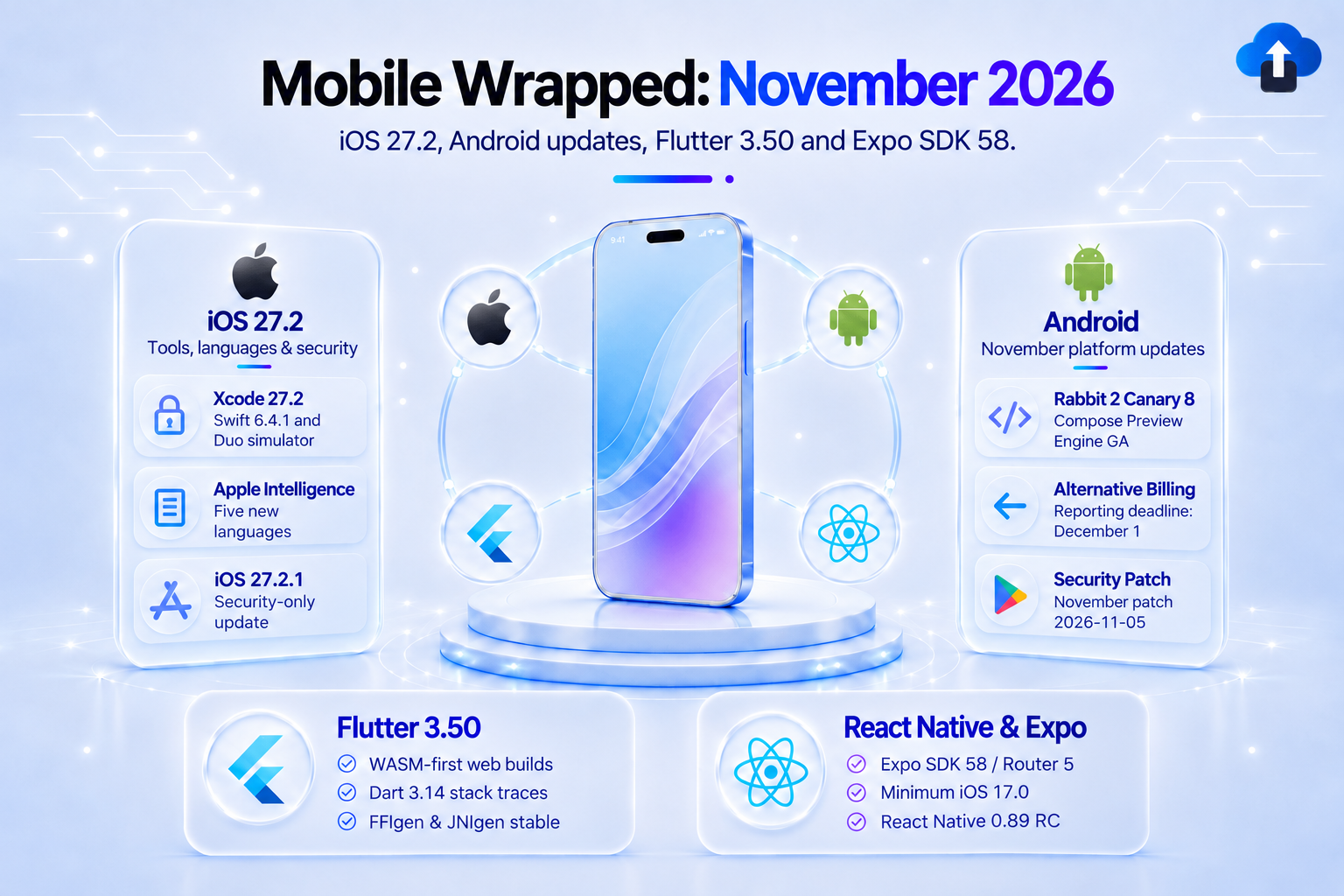
Everything that shipped, changed, or moved across native Android, native iOS, Flutter, React Native, and push infrastructure in November 2026.
Native Android
Android Studio Rabbit 2 Canary 8 - Compose Preview Engine GA and Device Mirror Redesign (November 12, 2026)
Android Studio Rabbit 2 Canary 8 arrived November 12, 2026 with the most substantive Canary build since the Rabbit 2 series began. Two changes warrant evaluation on a dedicated installation:
Compose Preview Engine GA in Canary 8
The new Compose preview rendering engine, in development since Rabbit 2 Canary 1, is now marked Generally Available within Canary. The engine replaces the previous preview renderer with a Compose-native pipeline that eliminates intermediate XML serialization. Projects with large `@Preview`-annotated composable sets should see significant reductions in preview render time. The GA designation in Canary means no opt-in flag is required; it is on by default in Canary 8+.
Device Mirror redesign complete
The Device Mirror view (which streams a live mirror of a connected physical device directly into the IDE) has been fully redesigned. The redesign adds: gesture pass-through (swipe, pinch, and long-press now transmit to the device directly from the IDE canvas), a floating control bar with quick-access shortcuts for screenshot, record, and input method toggle, and multi-device layout where up to two devices can be mirrored side by side.
Multi-preview interactive mode
The multi-preview pane now supports interactive mode: individual previews within a `@PreviewParameter`-driven multi-preview set can be interacted with directly in the IDE without launching an emulator. This is particularly useful for validating state-driven preview variants.
What teams should do:
Install Canary 8 on a dedicated machine alongside your production Android Studio installation. Do not update `classpath` for production builds to Canary build tooling. Canary builds are build-tooling independent, but the production AGP version should remain on the latest stable (AGP 9.4.0 from Android Studio Rabbit 1).
Google Play Alternative Billing Reporting - December 1, 2026 Deadline
The alternative billing reporting deadline moved from October 1 to December 1, 2026 in September. The deadline is now imminent.
Apps operating in markets with active alternative billing requirements - specifically EU, South Korea, and India - must have reporting configuration completed in Play Console by December 1 or face enforcement. This is not a new announcement. The window for configuration has been open since the October extension; teams that have not yet acted need to complete this before month end.
What "reporting configuration" means in practice:
- Navigate to Play Console → Monetization → Alternative billing.
- For each eligible market, confirm that your alternative billing provider is linked and reporting is active.
- Verify that transaction data is flowing. Play Console surfaces a reporting status indicator; a green status means reporting is active and Google is receiving data.
- Apps that use only Google Play billing (no alternative billing in any market) are not affected.
If you are unsure whether your markets are in scope, check your payment provider's compliance documentation for each of the three markets. The enforcement path after December 1 begins with a warning and escalates to removal for apps that remain non-compliant after the grace period.
November 2026 Android Security Patch - CVE-2026-58868 Critical RCE (November 3, 2026)
The November 2026 Android security patch (patch level 2026-11-05) began rolling out November 3, 2026 to Pixel 6 through Pixel 11. The bulletin resolved 216 CVEs, 23 of which are critical severity.
The bulletin resolves three critical RCEs and a notable denial-of-service bug:
CVE-2026-58868 - Critical Framework (FrameDecoder.cpp), Android 14–17.
Heap buffer overflow enabling remote code execution with no user interaction required.
CVE-2026-58876 and CVE-2026-58936 - Critical, System component, Android 14–17.
Two additional critical RCEs in the System component. No in-the-wild exploitation confirmed as of the bulletin date.
"SMS of Death" bug - High severity, Telephony, Android 14–17.
A specially crafted SMS message can silently disconnect active calls. No code execution; impact is denial of service to telephony functions. Fixed in the 2026-11-01 patch level.
Affected versions: Android 14, 15, 16, and 17.
What to do:
- Verify the November patch has rolled out to your device fleet. Check Settings → Security → Android Security Patch Level. Target: 2026-11-05 or later.
- Test any media pipeline-dependent features (video playback, media decoding, recording flows) against a patched build to confirm no behavioral regressions from the FrameDecoder fix.
- No in-app mitigation is available; the fix is at the OS level.
Native iOS
iOS 27.2 Public Release - Five New Apple Intelligence Languages and HealthKit Updates (October 26, 2026)
iOS 27.2 released publicly October 26, 2026, two days after the RC seeded October 19. App Store Connect began accepting iOS 27.2 builds immediately on release day.
The headline for end users is Apple Intelligence in five new languages: French, Japanese, Korean, Portuguese, and Spanish. At iOS 27.0 launch in September 2026, English on US-region devices was the only supported configuration. For app developers, language availability is a runtime concern, not a compile-time one.
Apple Intelligence feature gating pattern for 27.2:
Language support is determined at runtime via MLModelConfiguration. The correct pattern is to check both OS version and active language support before enabling any Apple Intelligence feature path:
import CoreML
func isAppleIntelligenceAvailable() -> Bool {
    // Check minimum OS version
    guard #available(iOS 27.0, *) else { return false }
    // Check active language support at runtime
    // Language availability is data-driven, not hardcoded
    let config = MLModelConfiguration()
    return config.computeUnits != .cpuOnly
}
HealthKit updates in 27.2:
Two new `HKQuantityType` identifiers were added for longevity metrics: VO2 max trend (a derived metric from repeated VO2 max samples over time) and sleep debt (cumulative sleep deficit calculated from sleep stage data). Teams with HealthKit integrations should:
1. Test existing `HKStatisticsQuery` and `HKSampleQuery` implementations against the iOS 27.2 simulator to verify data schema compatibility.
2. If your app surfaces longevity or health trend data, consider adopting the new identifiers to align with the updated Health app UI.
CoreMotion crash detection thresholds: The crash detection algorithm received updated sensor thresholds in 27.2. There are no API changes. Teams with UI flows triggered by crash detection events (emergency contact apps, safety apps) should validate behavior on a 27.2 device.
iOS 27.2.1 - Security-Only Update (November 9, 2026)
iOS 27.2.1 released November 9, 2026, containing nine security fixes and no new features. Teams running crash monitoring or security tooling should verify devices have updated to 27.2.1; the nine CVEs are not disclosed in the public release notes but Apple flagged the update as security-significant.
Xcode 27.2 and Swift 6.4.1 - Required for iPhone Duo Simulator Testing (November 10, 2026)
Xcode 27.2 released November 10, 2026, shipping Swift 6.4.1 and adding the macOS Sequoia 27.1 SDK. App Store Connect began accepting builds archived against Xcode 27.2 immediately.
Swift 6.4.1 is a targeted patch release. The single meaningful change: a compiler crash affecting typed throws with complex generic constraints is fixed. If your Swift 6.4 builds produced intermittent compiler panics in functions using `throws(ErrorType)` with nested generic type parameters, 6.4.1 resolves it.
iPhone Duo simulator. Xcode 27.2 is the first Xcode version to include the iPhone Duo simulator target, which is required for capturing App Store Connect screenshots in the Duo display specification. The April 2027 deadline for Duo screenshots is now approximately 5 months out. The practical action today: install Xcode 27.2, download the iPhone Duo simulator runtime, and begin capturing screenshots for any app that will require Duo support before April.
Xcode 27.3 Beta 1 was seeded on the same day as Xcode 27.2 final. Teams tracking upcoming SDK changes should pull Beta 1 for review.
Swift Testing 1.1 ships bundled with Xcode 27.2 and adds:
- Parameterized test suites with named parameters - `@Test("user login", arguments: testCases)` now accepts named parameter structs, making test output significantly more readable when a parameterized test fails.
- Shareable test traits as library modules - custom `TestTrait` implementations can now be packaged in a Swift library and shared across targets, removing the need to duplicate trait logic in each test target.
- `#expect(throws:)` macro for typed error assertions - replaces verbose `do/catch` blocks in XCTest-style error validation with a concise macro: `#expect(throws: AuthError.invalidCredentials) { try auth.login(with: badCredentials) }`.
Teams migrating from XCTest should evaluate Swift Testing 1.1 for new test targets. The XCTest interoperability layer from Xcode 27.0 remains in place; existing XCTest suites do not need to be migrated immediately.
Flutter & Dart
Flutter 3.50 Stable — WASM-First Web and Dart 3.14 (November 11, 2026)
Flutter 3.50 Stable released November 11, 2026. This is the headline release of November and the most significant Flutter release since 3.47 moved Impeller to default status across all platforms in August.
WASM-first web build targets. JavaScript output for `flutter build web` is deprecated (not removed) in 3.50. `flutter build web --wasm` is now the default invocation. Teams that need to retain JavaScript output for compatibility can still produce it with `--no-wasm`. The WASM output path uses a Dart-compiled WASM module with a thin JavaScript bootstrap layer, eliminating the Dart-to-JS transpilation overhead. Expect significant performance improvements for compute-heavy Flutter web apps: apps with heavy list rendering, animation, or business logic processing are the primary beneficiaries.
# Default in 3.50 -- produces WASM output
flutter build web
# Explicit WASM (same as default)
flutter build web --wasm
# Retain JavaScript output
flutter build web --no-wasm
# Verify version after upgrade
flutter upgrade
flutter --version   # expect Flutter 3.50.0 · Dart 3.14.0
Dart 3.14 — improved async stack traces.
Prior to 3.14, async call stacks in crash reports were truncated at the first `await` boundary. Dart 3.14 instructs the async scheduler to preserve the full call chain through `await` points. This directly improves crash report quality in tools that use `dart:developer`, `StackTrace.current`, or any crash reporter that captures Dart stack traces (Crashlytics, Sentry, Datadog).
The change is automatic. No code changes are required. Teams running crash reporting should expect fuller stack traces in new reports after upgrading to 3.50.
`dart:ffi` automatic struct layout.
Dart 3.14 adds automatic struct layout for common C ABIs. Teams using `dart:ffi` to interface with C libraries no longer need to manually calculate struct field offsets for `@Packed` structs on common platforms (x64, arm64). The layout engine handles alignment and padding automatically, matching the platform ABI.
material.dart and cupertino.dart formally deprecated.
`package:flutter/material.dart` and `package:flutter/cupertino.dart` are now deprecated in 3.50. New projects created via `flutter create` use `material_ui` as a dependency instead. Existing projects will see deprecation warnings but continue to work. A migration guide using `dart fix` and `MaterialUiCompatibilityBridge` is available in the official docs.
FFIgen and JNIgen reach stable.
Both FFIgen (for C and Objective-C bindings) and JNIgen (for Java and Kotlin bindings) are now stable in Flutter 3.50. Teams calling native platform code can generate direct, typed Dart bindings without manual bridging.
Impeller on web — experimental opt-in.
An experimental Impeller web renderer is available in 3.50 via `flutter build web --wasm --enable-impeller`. It is not production-ready. Enable it only in development or benchmarking contexts; do not ship it to users.
Dart 3.14 Async Stack Traces — What Changes for Crash Reporting
The async stack trace improvement in Dart 3.14 is worth calling out specifically because it changes the data quality of crash reports in production, not just in development.
The problem before 3.14: An async call stack in a crash report looked like this:
Error: StateError: Bad state: no element
  at _fetchUserProfile (user_service.dart:42)
  at <asynchronous suspension>
The stack terminates at the first `await` boundary. Everything that called `_fetchUserProfile` — the navigation event, the middleware, the route handler — is gone. Finding the root cause required log correlation and time.
The fix in 3.14: Dart instruments the async scheduler to preserve call chain context through `await` points. The same crash now produces:
Error: StateError: Bad state: no element
  at _fetchUserProfile (user_service.dart:42)
  at <asynchronous suspension>
  at UserBloc._onNavigate (user_bloc.dart:118)
  at <asynchronous suspension>
  at AppRouter.onRouteChanged (app_router.dart:67)
The impact: crash reports that previously required investigation now identify the caller chain directly. Teams running Crashlytics, Sentry, or similar tools will see this improvement in new crashes without any configuration change. Crashes from builds compiled before the upgrade will not be retroactively improved.
React Native
Expo SDK 58 — Expo Router 5, New Architecture Default, and Minimum iOS 17.0 (November 7, 2026)
Expo SDK 58 released November 7, 2026, targeting React Native 0.88
This release moves several items from "optional" to "required" and signals two end-of-life timelines that production teams need to track.
Expo Router 5.
File-based routing now supports typed routes without a separate codegen step. In earlier versions, typed route generation required running `npx expo customize` and committing generated type files. SDK 58 integrates the type generation into the Metro bundler pipeline; routes are typed automatically as files are added. The generated types are no longer checked into version control.
`expo-camera` v5 — unified Android/iOS capture API.
The camera module has been rewritten to surface a consistent API surface across platforms. The primary change: `takePictureAsync`, `recordAsync`, and `pausePreview` now behave identically on Android and iOS, eliminating the platform-conditional code that most `expo-camera` users maintained. Teams upgrading from `expo-camera` v4 should audit their camera implementations against the v5 migration guide — several prop names and callback signatures changed.
Expo Classic Updates end-of-life.
Teams using Expo Classic Updates (the legacy over-the-air update system) must migrate to EAS Update. SDK 58 is the final SDK version that ships Classic Update client support. Classic Updates will not receive bug fixes, security patches, or compatibility updates going forward. The EAS Update migration involves: installing `expo-updates`, configuring your EAS project, and replacing Classic manifest URLs with EAS channel configuration.
Minimum iOS version: 17.0.
SDK 58 drops support for iOS 16 and earlier. Apps built with Expo SDK 58 will not install on iOS 16 devices. If your app's minimum supported iOS version was 16, update your `app.json` and inform your user base.
New Architecture default.
React Native's New Architecture (Fabric renderer + JSI + TurboModules) is enabled by default for new projects created with Expo SDK 58. For projects upgrading from SDK 57 and earlier, the New Architecture is not automatically enabled, but migration is now the documented path. The React Native team has stated that Old Architecture will reach the end of support with React Native 0.90, targeted for Q2 2027.
If you are running Old Architecture in production, evaluate the migration now. The key friction points: third-party native modules that have not yet published New Architecture-compatible versions. Use the React Native New Architecture compatibility table to audit your dependencies before beginning migration.
# Upgrade to Expo SDK 58
npx expo upgrade
# Verify
npx expo --version
React Native 0.89.0 Release Candidates
React Native 0.89.0 entered RC in November: rc.0 on November 4, rc.1 on November 9, rc.2 on November 17. No stable 0.89 release as of month end. Teams tracking the release should monitor the GitHub releases page; production upgrades should wait for stability. The RC series is suitable for compatibility testing with your native modules.
Mobile Security: November 2026 US Threat Activity
APT29 "Poisoned Source" — Watering Hole Campaign Targeting iOS and Android (November 4, 2026)
French security firm Sekoia published details on November 4 of a watering hole campaign, attributed to APT29 (Russian state-linked) with moderate-to-high confidence, targeting iOS and Android devices across the US and Europe. The campaign, named Poisoned Source, compromised the Plerdy SEO Tracker script used by thousands of legitimate websites, injecting exploit chains that executed silently on visitors' mobile devices.
Two exploit kits were deployed depending on the visitor's iOS version:
- Coruna: targets iOS 13 through iOS 17. Exploits CVE-2025-43529 and CVE-2024-27834 to steal browser cookies from devices running iOS 16.7 or earlier. Zimperium counted 608 domains serving Coruna-family code as of October 2026.
- DarkSword: targets iOS 18. A five-flaw chain that extracts full device data: messages, WhatsApp and Telegram databases, iCloud Keychain, Wi-Fi passwords, photos, and Safari history from devices running iOS 18.7.2 or older.
On Android, the campaign exfiltrates Chrome data and saved Wi-Fi credentials without establishing persistence.
CISA issued a directive requiring all US federal civilian agencies to patch affected devices by November 18, 2026.
What to do: Ensure devices are updated to iOS 18.7.3 or later (which addresses the DarkSword chain). Advise users not to browse on unmanaged devices when visiting high-traffic web properties without endpoint protection.
FBI FLASH-20261113-001: ARTEX AI Attack Framework Targets Mobile Backends and APIs (November 13, 2026)
On November 13, 2026, the FBI issued FLASH-20261113-001 (TLP:CLEAR), warning organizations that the open-source ARTEX agentic penetration testing framework has been weaponized by malicious actors to automate intrusions from initial reconnaissance through data exfiltration. Some observed intrusions reached privileged access in under three hours with minimal human involvement.
ARTEX is an LLM-driven, multi-agent framework written in Go. A threat actor sets a goal in natural language; the AI agents convert it into commands and execute autonomously. As of early November, researchers had identified more than 1,600 publicly exposed ARTEX console instances.
Why mobile teams need to pay attention. The FBI explicitly identifies the following as high-value ARTEX targets because they receive less security attention than flagship applications:
- Mobile backends — the API layer serving your iOS and Android apps
- Employee mobile applications — internal tooling, HR, ops apps
- Partner and supplier portals
- Legacy services and third-party integrations
- Apps created by individual business units (outside main engineering)
These are exactly the systems mobile teams build and maintain. ARTEX is effective against APIs that lack per-record server-side authorization, have no rate limits on search and export endpoints, or expose stack traces on errors.
Mobile backend defense checklist (from FBI FLASH-20261113-001):
- Inventory every internet-facing endpoint your mobile app calls, including those built by other teams or departments.
- Verify every API route enforces authentication and authorization per record on the server — not just at the route level.
- Add rate limits and per-session request limits on lookup, search, and export endpoints.
- Confirm no stack traces, SQL errors, or internal paths are returned in API error responses.
- Scan your JavaScript bundles and web-accessible paths for embedded secrets or API keys.
- Set up alerts for unusual request volumes on any portal or API that exposes customer records.
The official alert is available at the IC3 link below. It is TLP:CLEAR — share it with your security team.
Optimizely Supply Chain Attack — 178 Sites Targeted iPhone Users (November 16, 2026)
On November 16, attackers injected malicious JavaScript into Optimizely's web personalization platform, affecting 178 organizations including Zoom, HSBC, Equifax, Salesforce, IKEA, and CNN. The script targeted iPhone users running iOS 18.7.2 or older, attempting to steal crypto wallet keys, skim card numbers, capture cookies and screenshots, and embed exploit code.
This is a supply-chain attack, not a direct app store compromise. No App Store apps were involved. The risk is to users visiting affected websites on mobile Safari.
Push Notification Infrastructure in 2026
Direct FCM/APNs Integration Is Not the Default Anymore
The mobile push notification stack has shifted in 2026. SDK-abstracted push (Firebase Messaging, OneSignal, AppsOnAir Push) is now the default starting point for new apps, while direct FCM/APNs integration has become a maintenance burden for teams that built it three or more years ago.
The shift is clearest when you look at the operational surface area of a hand-rolled push implementation:
Credential management: APNs auth keys rotate on a schedule. FCM service accounts require IAM governance. Teams running direct push integrations manage these rotations manually — a rotation failure means push stops delivering silently, often discovered via user reports rather than monitoring.
Token lifecycle: Android FCM tokens are regenerated on app reinstall. iOS APNs tokens are invalidated on account restore and can change on OS update. A direct integration requires a client-side token refresh listener, server-side token storage, and cleanup of invalidated tokens. Missing any of these produces delivery gaps and inflated subscriber counts in your backend.
Delivery analytics: Tracking delivery rate, open rate, and attribution requires a Notification Service Extension on iOS and a data payload handler on Android. Both require separate targets or receivers, testing against physical devices, and maintenance across OS updates. SDK-abstracted solutions provide this out of the box.
The pattern for teams maintaining hand-rolled push: engineering cycles go into plumbing, not features. The credential rotation, token lifecycle, and analytics problems are solved problems. SDK-abstracted push handles them. The question is not whether to use an abstraction layer; for most teams building in 2026, the question is which one.
"Push notification infrastructure is table stakes. The question is whether you own the table."
The AppsOnAir Push Notification SDK is in public beta for both native Android and native iOS (`v1.0.6-beta`). It sits on top of the underlying mobile push protocols and handles token lifecycle, delivery analytics, targeting by distribution group, and opt-in control. Setup and credential configuration is required once in the AppsOnAir console.
What This Means for Mobile Teams
- Flutter teams: upgrade to 3.50.0 / Dart 3.14.0. WASM is now the default web build target. If your CI or deploy pipeline runs `flutter build web`, output behavior has changed. Add `--no-wasm` explicitly if you need to retain JavaScript output for a compatibility reason.
- React Native / Expo teams: plan the Classic Updates migration. SDK 58 is the last SDK to ship Classic Update client support. EAS Update migration is not complex but requires project configuration and testing. Do not defer this into the SDK 59 upgrade window.
- Expo SDK 58 drops iOS 16. If your minimum supported iOS was 16, update `app.json` and audit whether your analytics or crash reporting data indicates meaningful iOS 16 usage before shipping.
- New Architecture adoption is now the documented path for new React Native projects. Old Architecture reaches the end of support with React Native 0.90 (Q2 2027). Audit your third-party native modules for New Architecture compatibility.
- Android Studio Rabbit 2 Canary 8 is worth evaluating on a secondary installation. The Compose Preview Engine GA and Device Mirror redesign are both production-quality within Canary. The new multi-preview interactive mode reduces the emulator round-trip for composable state validation.
- iOS 27.2 is public and Xcode 27.2 is the required tool for iPhone Duo screenshots. The April 2027 Duo screenshot deadline is 5 months out. Begin capturing Duo-spec screenshots now.
- Swift Testing 1.1 is worth adopting for new test targets. Parameterized tests with named parameters and `#expect(throws:)` make test authoring and failure diagnosis substantially cleaner than the XCTest equivalents.
- CVE-2026-58868 is a critical no-interaction RCE on Android 14–17. Verify your device fleet is on patch level 2026-11-05 or later. No in-app mitigation; fix is OS-level.
- APT29 "Poisoned Source" is actively targeting iOS 18.7.2 and older. Ensure users are on iOS 18.7.3+. DarkSword extracts full device data including iCloud Keychain and messaging app databases.
- FBI FLASH-20261113-001 (ARTEX) explicitly targets mobile backends and APIs. Run the defense checklist: per-record server-side authorization, rate limits on search/export endpoints, no secrets in bundles or error responses. Share the TLP:CLEAR alert with your security team.
- Alternative billing reporting deadline: December 1. If your app operates in EU, South Korea, or India with alternative billing active, complete Play Console reporting configuration before month end.
References
Mobile Security
Push Infrastructure