

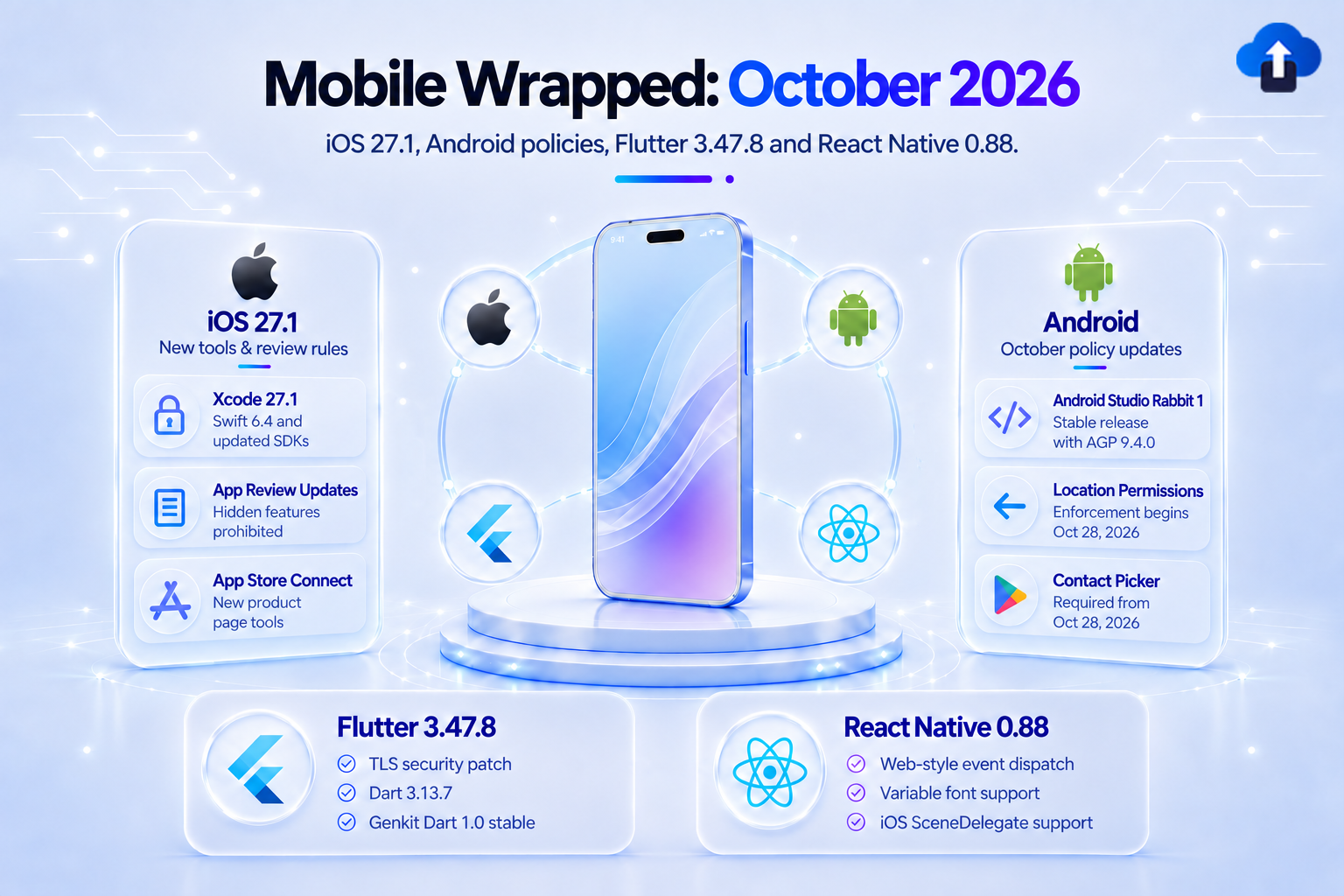
Everything that shipped, changed, or was enforced across native Android, native iOS, Flutter, React Native, and AI in mobile this October.
Native Android
Android Studio Rabbit 1 - Stable (October 1, 2026)
Android Studio Rabbit 1: hit the Stable channel on October 1, 2026, shipping with Android Gradle Plugin 9.4.0. The release is notable for three things beyond the version bump: tighter Gemini integration directly in the IDE (inline suggestions, code explanation, and build error analysis are now context-aware of your open project), an updated build tooling layer that aligns with AGP 9.4's configuration cache improvements, and measurable performance improvements in the Layout Editor for projects with large view hierarchies.
Android Studio Rabbit 2: entered Canary on the same day and had reached Canary 5 by October 15. Teams tracking upcoming changes to lint rules and the new Compose preview engine should pull Canary 5 now - it ships with an overhauled multi-preview pane and a redesigned Device Mirror. Canary builds do not affect production build tooling unless you explicitly update classpath in your project-level build.gradle.
Stable channel update:
# settings.gradle.kts / build.gradle.kts
id("com.android.application") version "9.4.0" apply false
Run ./gradlew --version after updating to confirm AGP 9.4.0 is resolved correctly. Configuration cache is on by default in 9.4 - if your build uses deprecated AGP APIs that bypass cache compatibility, the build will fail with a clear diagnostic.
Location Permissions Policy - Enforcement Begins October 28, 2026
Google Play's updated location permissions policy takes effect in two stages for apps targeting API level 37 (Android 17):
What changed
Precise location is now a last resort: ACCESS_FINE_LOCATION (GPS-level precision) is only permitted when the feature genuinely requires street-level accuracy. Apps must default to ACCESS_COARSE_LOCATION (approximate, ~3 km radius) for features such as weather, nearby business listings, regional pricing, or any case where city-level location is sufficient.
The Location Button is now required for one-time precise location: For flows where the user taps a button to get precise location for a single action (e.g., "find stores near me", "use my location to fill address"), apps targeting API 37+ must use Android's built-in Location Button instead of requesting a standing ACCESS_FINE_LOCATION permission. The button grants precise location for a single session only, expiring when the session closes. Declared in manifest with the onlyForLocationButton flag.
Play Console declaration required: Apps requesting precise or background location must complete a formal declaration in Play Console, selecting from predefined use cases and documenting why lower-scope alternatives are insufficient. Generic justifications will not pass review.
Background location remains the most restricted: ACCESS_BACKGROUND_LOCATION eligible categories are now limited to fitness tracking, navigation, and family safety. Declaration requires a 30-second demo video, prominent store listing disclosure, and a linked privacy policy.
What to do before October 28:
- Audit all location permission requests using Android Studio's Merged Manifest view.
- Downgrade ACCESS_FINE_LOCATION to ACCESS_COARSE_LOCATION for any feature where city-level precision is sufficient.
- Migrate one-time precise location actions to the Location Button.
- Complete the Play Console declaration for any retained sensitive permission.
Contact Picker Mandate - Effective October 28, 2026
Google Play policy enforcement begins October 28, 2026: apps that do not have a legitimate need for broad contact access must migrate to the Android Contact Picker and remove READ_CONTACTS permission declarations where a picker flow is sufficient.
The policy distinguishes between two use cases:
Picker-appropriate: selecting a contact to pre-fill a form, sharing content to a contact, or initiating communication with a single user-selected contact. These must use ContactsContract based picker intents or the system contact picker UI. READ_CONTACTS are not permitted for these flows after October 28.
Broad access required: CRM-type apps, sync apps, or apps whose core function requires reading the full contact database. These remain permitted but must provide justification in the Play Console declaration.
Apps submitted or updated after October 28 with READ_CONTACTS declared for picker-eligible use cases will be non-compliant and subject to enforcement. This is not a new announcement
Google flagged this in Q2 2026 - but enforcement begins at the end of month.
An unrelated but notable policy shift: the alternative billing reporting deadline moved from October 1 to December 1, 2026, giving developers in relevant markets additional time to comply with alternative billing reporting requirements.
Kotlin 2.4.21 and 2.5.0 Beta
Kotlin 2.4.21 shipped October 8 as a bug fix release on the 2.4 stable line. No new language features - the release addresses compiler edge cases and IDE plugin stability issues introduced in 2.4.20. If you are on 2.4.x, upgrade to 2.4.21.
Kotlin 2.5.0-Beta2 followed on October 21. The K2 compiler is now the default across all Kotlin builds - projects that pinned languageVersion = "1.9" to avoid K2 will need to drop that override when 2.5.0 goes stable, as 1.9 language version support is being retired. No stable 2.5.0 release as of October 2026. Beta2 is suitable for evaluation and plugin compatibility testing; do not ship production builds against it without explicit testing of your annotation processors and compiler plugins.
Key K2 implications for Android teams:
kapt remains functional but is soft-deprecated. KSP 2 is the forward path for annotation processing. If you are running kapt for Room, Hilt, or Moshi, begin KSP migration now - the tooling is stable and the performance improvement on incremental builds is significant.
Compose compiler: no longer requires a separate composeCompiler plugin reference in K2 builds. Verify your Compose compiler extension version aligns with your Kotlin version using the compatibility map.
Android 17 October Security Patch
The October 2026 security patch (patch level 2026-10-01) resolved 28 CVEs and began rolling out to all supported Pixel devices Pixel 6 through Pixel 11 and starting October 6, 2026. No critical severity CVEs in this month's bulletin, but four high-severity framework issues affect apps using ContentResolver with URI permissions across UID boundaries. If your app uses cross-process content sharing, review the bulletin.
Android 17 (API Level 37) shipped in June 2026. October's notable API additions and policy changes that affect active development:
Cross-Device Handoff API - Apps can now declare handoff-eligible activities that surface in the system's cross-device transfer UI (visible when a user switches between signed-in Android devices). Requires android.permission.TRANSFER_WIFI_CREDENTIAL and a declared <handoff-activity> element in AndroidManifest.xml.
- Mandatory large-screen resizability: The opt-out (resizeableActivity="false") is removed. All apps targeting API 37 must handle multi-window and large-screen layouts. There is no deprecation warning - the manifest attribute is silently ignored.
- UWB DL-TDOA Ranging: Downlink Time-Difference-of-Arrival ranging for Ultra-Wideband is now exposed via UwbManager. This enables precision indoor positioning on supported hardware without requiring a UWB initiator device in the loop.
- VVC (H.266) codec support: MediaCodec now exposes video/vvc on Android 17 devices with hardware VVC decoders. Query MediaCodecList for availability before use; hardware support is device-dependent.
Native iOS
Xcode 27.1 and Swift 6.4 - Released October 15, 2026
Xcode 27.1 released October 15, 2026, shipping SDKs for iOS 27.1, iPadOS 27, tvOS 27, watchOS 27, and macOS Sequoia 27 (Golden Gate). App Store Connect began accepting iOS 27.1 builds on the same day. Xcode 27.0 remains valid for iOS 27.0 targets; if your app uses any iOS 27.1 APIs, Xcode 27.1 is required to compile and archive.
Swift 6.4 ships bundled with Xcode 27.1. The headline Swift 6.4 additions:
- Typed throws improvements: throws(ErrorType) syntax from Swift 6.0 gains inference improvements; the compiler can now propagate typed throw annotations through generic constraints without explicit annotation at each call site.
- @_silgen_name promotion: previously unofficial, now a stable @_extern attribute for calling C functions by symbol name from Swift without a bridging header. Useful for teams embedding C libraries in Swift packages.
- Concurrency diagnostics - Xcode 27.1's Issue Navigator groups Swift 6 concurrency errors by actor boundary instead of by file, significantly reducing the cognitive load of auditing isolation violations in large codebases.
- Xcode 27.2 Beta 3 was seeded October 14 - one day before Xcode 27.1 went final. Teams should pull Beta 3 for SDK change review, particularly if targeting features announced for iOS 27.2.
iOS 27.2 Release Candidate - Seeded October 19
iOS 27.2 RC was seeded to developers October 19, 2026. Public release is expected October 26–27. The RC is build-for-submission ready; App Store Connect submissions targeting iOS 27.2 APIs should validate against this build before the public drop.
Key developer-facing changes in iOS 27.2:
- Apple Intelligence expands to five languages - French, Japanese, Korean, Portuguese, and Spanish. At iOS 27.0 launch, English was the only supported language. Language availability is runtime-determined via `MLModelConfiguration`; teams using Apple Intelligence APIs must gate feature availability on both OS version and active language support.
- Redesigned Health app - new Insight and Longevity tabs. The `HealthKit` API surface does not change in 27.2, but teams with Health integrations should test their data queries against the updated data schema for longevity metrics - new `HKQuantityType` identifiers for VO2 max trend and sleep debt are added.
- Crash detection refinements - updated `CoreMotion` thresholds for crash detection. No API changes, but teams that use motion data or that have UI flows triggered by crash detection events should verify behavior on 27.2.
App Store Review Guidelines Updated - October 16, 2026
Two significant policy changes took effect October 16, 2026. Both are enforcement-level changes, not advisory.
Section 1.2 - Nonconsensual Intimate Imagery (NCII)
Apps must proactively prevent or remove nonconsensual intimate imagery, including AI-generated content. The specific enforcement target is apps that entered the App Store under a benign category - photo editing, face swap, AI art generation - and subsequently activated adult content generation through remote configuration or server-side feature flags after passing review.
Apps with image generation, editing, or transformation capabilities that have any pathway to generate or manipulate human-likeness content must implement active safeguards. Passive ToS language is not sufficient under the updated guideline. Apple's stated enforcement mechanism: automated detection during review and post-approval monitoring.
Guideline 2.5.19 - Hidden, Dormant, or Undocumented Features
This is the highest-urgency policy change in October. The guideline now explicitly prohibits hidden, dormant, or undocumented features - including any functionality activated via remote flags after App Store approval.
The stated penalty: app removal and permanent developer account termination. This is not a first-warning policy. The guideline applies to:
- Feature flags managed via remote config (Firebase Remote Config, LaunchDarkly, custom endpoints) that activate functionality not present in the submitted build review
- A/B tests that expose materially different app behavior to subsets of users post-approval
- Debug or staging code paths accessible via undocumented gestures, URLs, or configuration value
- Server-driven UI or content that substantially changes the app's function beyond what was reviewed
What this does not prohibit: content updates delivered through documented API calls, OTA updates to app logic via approved mechanisms (e.g., Shorebird, Expo Updates - where the updated code is consistent with the reviewed app's declared purpose), and standard feature flag rollouts where the feature itself was present and reviewable in the submitted build.
Audit checklist before your next submission:
- List every remote config key your app reads and the behavior it controls.
- For each key: confirm the feature it gates was visible to App Review in the submitted build.
- Remove or disable any config path that activates behavior App Review did not see.
- Document your remote config usage in internal records - if enforcement occurs, the burden of proof is on the developer.
App Store Connect: Custom Product Pages, Asset Library, and Product Page Optimization
App Store Connect launched three new features in October 2026, visible in the Product Page Information section:
Custom Product Pages: Create up to 70 custom product page variants, each with a unique URL and keyword assignment. Each variant can have distinct screenshots, app previews, and promotional text. Use cases: targeting different user segments in paid acquisition, localizing creative assets per campaign, or surfacing different feature sets to different audiences. Each custom page is submitted for App Store review independently.
Asset Library: A central repository for creative assets (screenshots, app previews, headers) that can be shared across custom product pages without re-uploading. Supports versioned asset management: swap assets across all pages that reference a given asset in one operation.
Product Page Optimization: A/B test product page assets (icon, screenshots, app preview) against up to three treatment variants. Traffic split is configurable. Results are available in App Analytics with statistical significance indicators. Testing requires at least 90% of your users to be on iOS 15 or later.
Custom header and search result assets: Apps can now set a custom header image that appears at the top of their product page, and configure separate assets for how the app appears in App Store search results. These are distinct from screenshots.
iPhone Duo screenshot support: App Store Connect now accepts screenshots in the iPhone Duo display specification. Required for apps targeting the iPhone Duo form factor. Apple has indicated that iPhone Duo screenshot requirements become mandatory for new submissions from April 2027.
Guideline 2.3.14 - Creative Assets: A new App Review guideline (2.3.14) covers creative assets submitted to the App Store, including custom headers and search result assets. Misrepresenting app functionality through creative assets - showing features the app does not have, or misleading the user about the app's core purpose - is now explicitly governed by this guideline in addition to the existing 2.3.x rules on metadata accuracy.
Additional Guideline Changes — October 16, 2026
Beyond Sections 1.2 and 2.5.19 (covered above), two further changes took effect:
Guideline 3.1.1(a) - StoreKit External Purchase Link Entitlements: The separate Music Streaming Services Entitlements program has been folded into the StoreKit External
Purchase Link Entitlements framework. Apps previously operating under the Music Streaming entitlement should verify their entitlement configuration in App Store Connect. The functional behavior for permitted link destinations is unchanged; only the entitlement classification has been updated.
Guideline 5 - Alternative Distribution: Apps found to facilitate human trafficking or child sexual abuse material (CSAM) will now be blocked from alternative distribution in addition to removal from the App Store. This closes a potential gap where apps removed from the App Store could continue distribution via alternative marketplaces (relevant in EU markets operating under the Digital Markets Act). Enforcement is immediate.
Apple Developer Program License Agreement — October 13, 2026
The revised Apple Developer Program License Agreement* went into effect October 13, 2026. The substantive addition: explicit prohibitions against code that interferes with Apple's security, digital signing, verification, or authentication systems.
In practice, this codifies existing enforcement behavior into contractual language. The practical implication for SDK authors and framework developers: any library that modifies, intercepts, or instruments Apple's code signing or runtime verification mechanisms — even for legitimate debugging purposes - is now explicitly prohibited under the agreement. Teams shipping SDKs that hook into the runtime (e.g., method swizzling on security-sensitive system classes, certificate pinning bypass libraries intended for testing) should review their distribution terms against the updated agreement language.
Flutter & Dart
Flutter 3.47.8 — Security Patch (October 23, 2026)
Flutter 3.47.8- with -Dart 3.13.7- released -October 23, 2026- as a security-only patch addressing a high-severity TLS vulnerability (GHSA-frr6-h895-5pxp). Upgrade immediately.
Vulnerability: Eight intermediate CA certificates issued by -eMudhra- were compromised due to weak key generation. An attacker with network access could derive the private keys and forge valid TLS certificates for any domain, enabling man-in-the-middle interception of HTTPS connections made via dart:io.
- Affected platforms: Android, Windows, and unpatched Linux.
- Not affected: iOS, macOS, and web — these platforms use Apple system certificate verification or browser trust stores, which had already distrusted the eMudhra certificates via OS-level updates.
- Affected versions:- Dart SDK: < 3.13.7 (stable), < 3.14.0-315.3.beta (beta)
Flutter SDK: < 3.47.8 (stable), < 3.50.0-0.2.pre (beta)
- Fix: The patch updates BoringSSL to distrust the compromised certificates. On Android 14+, it also loads system root certificates from Google's updatable Conscrypt module, enabling future over-the-air certificate revocations without requiring a full SDK update.
flutter upgrade
flutter --version   # expect Flutter 3.47.8 · Dart 3.13.7
Rebuild and redeploy your app after upgrading. Users running a previously distributed binary remain exposed until they update.
Flutter 3.47.7 — Stability Patch (October 8, 2026)
Flutter 3.47.7 with -Dart 3.13.5- released -October 8, 2026- as a stability patch on the 3.47 stable line. The patch addresses rendering edge cases with Impeller on macOS and Windows, a memory leak in the platform channel dispatch path on Android, and a regression in `SelectionArea` introduced in 3.47.6.
Flutter 3.47- (released -August 2026-) made -Impeller the default renderer on macOS, Windows, and Linux-, completing Impeller's transition across all platforms. The same release split -Material- and -Cupertino- into standalone packages — `flutter_material` and `flutter_cupertino` — which are bundled by default but can be excluded to reduce binary size on projects using only one design system.
Flutter 3.50- is targeted for -November 2026. Based on current beta channel builds, 3.50 is expected to ship with:
- WASM-first web build targets (JavaScript output deprecated, not removed)
- Dart 3.14 with improved async stack traces
- Updated `dart:ffi` with automatic struct layout for common C ABIs
- Update to 3.47.7 now if you are on any earlier 3.47.x patch:
Genkit Dart 1.0 — Stable (October 8, 2026)
Genkit Dart 1.0 reached stable on October 8, 2026. This is the first stable Dart-native framework for production agentic AI workflows.
What Genkit Dart provides:
- Multi-step pipelines: define flows as typed, composable steps with explicit input/output schemas. Flows are observable, resumable, and traceable without custom instrumentation.
- Model routing: switch between models (Gemini 1.5 Pro, Gemini Nano, custom Vertex AI endpoints) within a single flow based on task complexity or cost constraints.
- Tool use: define callable tools (functions, APIs, data sources) that models can invoke during flow execution. Tool definitions use Dart type annotations — no separate schema files.
- Observability: built-in OpenTelemetry-compatible tracing. Each flow step emits spans with model latency, token counts, and intermediate outputs. Integrates with Cloud Trace and local dev UI.
- Vertex AI and Gemini API integration: first-class support for both endpoints. Local development uses the Gemini API with your developer key; production can target Vertex AI without code changes.
Before Genkit Dart 1.0, Flutter teams building AI features either used `google_generative_ai` for simple single-turn calls or bridged to Python or Node.js Genkit services for anything multi-step. The 1.0 stable release removes that bridge requirement — production agentic logic can now run in the same Dart codebase as your app, deployed as a Cloud Run service.
React Native
React Native 0.88 — Released October 19, 2026
React Native 0.88 released October 19, 2026. This is the third consecutive release with no user-facing breaking changes, which makes the upgrade path straightforward.
Key changes:
Web-based event dispatching enabled by default: the event system now uses web-compatible event bubbling and capture phase semantics by default. This aligns React Native's event model with React DOM and enables better code sharing across web and native targets. Most apps will not see behavioral differences, but custom native gesture handlers that relied on non-standard propagation behavior may require updates.
Variable fonts: Text and TextInput support variable font axes (fontVariationSettings) on both iOS and Android. Previously, variable font support on Android required a third-party library or custom native code. Set axis values via the style prop: `fontVariationSettings: "'weight 700, width 75".
SceneDelegate lifecycle support on iOS: React Native now correctly maps iOS `UISceneDelegate` lifecycle events to the React Native AppState API. Apps using multiple scene windows (iPad multi-window, Stage Manager) will see correct background/foreground transitions without manual `UISceneDelegate` subclassing.
React 19.3.0: includes performance improvements to the reconciler and updated server component handling. No breaking API changes from 19.2.
Metro 0.87: faster resolution for monorepos with workspace symlinks and improved `require.context` performance for large asset directories.
Upgrade:
# Bare workflow
npx @react-native-community/upgrade-helper
# Expo managed workflow -- covered under Expo SDK 58
npx expo upgrade
Expo SDK 58 — Released October 15, 2026
Expo SDK 58 released October 15, 2026, built on React Native 0.88 and targeting iOS 27.1. This is a substantial release; several of the additions directly address long-standing developer experience friction points.
Key additions:
- Experimental Rust-based transformer ("Noxcturnal"): opt-in for now ("transformer": "noxcturnal" in metro.config.js). Benchmarks on internal Expo apps show approximately 2x faster cold bundling. The transformer handles the JS transform pipeline in Rust rather than Babel; output is compatible with existing Metro configuration. Not yet the default because some Babel plugins do not have Rust equivalents - check compatibility before enabling.
- `node_modules` stack frames no longer collapsed by default : error output in development now shows full stack traces including frames from packages, not just your app code. This was the top-voted developer experience request in Expo's 2025 survey. Toggle the old behavior with EXPO_COLLAPSE_STACK=1 if the verbosity is unwanted.
- Rewritten AVD/adb management — Expo CLI's Android emulator management was prone to stale adb server state causing device detection failures. The rewrite adds explicit adb server lifecycle management and port conflict resolution. Teams running multiple emulators in CI should see fewer "device not found" failures.
- Native crash reporting in Expo Observability: available from October 7 (released ahead of SDK 58 GA). Native iOS and Android crash reports - including stack traces from ObjC/Swift and C/C++, now flow into the Expo Observability dashboard alongside JS error reports. Requires Expo SDK 58 and the expo-observability package at ^2.0.
Security Advisories
October closed with a coordinated wave of security patches across the mobile development stack. These are not theoretical vulnerabilities, all three have active patch releases and defined affected version ranges.
Flutter / Dart — TLS MitM via Compromised CA Certificates (High)
Covered in detail in the Flutter section above. Summary for reference:
- Advisory: GHSA-frr6-h895-5pxp
- Severity: High
- Root cause: Compromised eMudhra intermediate CA certificates enable HTTPS interception on Android, Windows, and Linux via forged TLS certificates
- Affected: Flutter < 3.47.8, Dart < 3.13.7
- Fix: Upgrade to Flutter 3.47.8 / Dart 3.13.7, rebuild, and redeploy
Node.js — October 21 Security Release
Node.js issued security fixes on October 21, 2026 across all active release lines. Your app's runtime is not affected — Node is a build and toolchain dependency for React Native, Expo, and most JavaScript-based mobile pipelines, not a production runtime in this context. However, running a vulnerable Node version in CI or local development can expose build infrastructure.
Safe minimum versions:
22.x: 22.23.4 or later
24.x: 24.22.1 or later
End of life: Node 18 and Node 20 are both end of life and will not receive further security patches. If your CI or local toolchain is on either version, migrate now — you are no longer receiving fixes.
node --version     # check current version
nvm install 22     # upgrade via nvm if needed
nvm use 22
PHP — Coordinated Security Patches (September and October 2026)
PHP issued coordinated security releases across all supported lines in September and October 2026. The vulnerabilities span OpenSSL, MySQLnd, FPM, Phar, and SOAP.
Key vulnerabilities fixed:
Patched versions by active line:
PHP 8.1 and earlier are end of life and do not receive security patches.
If your mobile backend, API server, or internal tooling runs PHP, update to the latest patch on your active line. The OpenSSL CVEs (CVE-2026-91769 and CVE-2026-91767) are the highest priority — they affect TLS certificate validation and can be exploited by a network-positioned attacker.
AI in Mobile
Apple Intelligence Expands to 5 Languages (iOS 27.2)
iOS 27.2 (RC seeded October 19, public release expected ~October 27) brings Apple Intelligence to French, Japanese, Korean, Portuguese, and Spanish. At iOS 27.0 launch in September 2026, English on US-region devices was the only supported configuration.
This matters for teams building localized apps with AI-assisted features:
- Language support is determined at runtime, not at compile time. Use `MLModelConfiguration` to check active language availability before enabling AI feature paths.
- The supported language list will expand further with iOS 27.3 and subsequent updates. Build your availability logic to be data-driven, not hardcoded against a specific language list.
- Writing tools, Siri suggestions, and Priority Notifications are all language-dependent. Users who set a device language to one of the five newly supported languages and update to 27.2 will see these features activate automatically.
Apple Intelligence Coming to China — iOS 27.3 (December 2026)
October 14, 2026: Apple confirmed that Apple Intelligence will arrive in China with iOS 27.3, expected in December 2026. Regulatory approval was secured after approximately two years of negotiation. Alibaba AI models are approved for use on iPhone hardware for China-region deployments.
What will be available in China under iOS 27.3:
- Clean Up (photo cleanup tool)
- Writing tools (text rewrite, proofread, summarize)
- Live translation
What will not be included:
- Siri AI (the conversational, context-aware Siri layer)
- Image Playground
- Genmoji
The Alibaba model integration applies specifically to the China region — users in other markets continue using Apple's own models. Feature availability is region-determined by the device's App Store region, not the user's physical location.
For teams with China-market apps: this requires explicit feature gating. Do not assume Apple Intelligence API availability maps uniformly across regions. Check Locale.current.region and gate accordingly. The Siri AI integration that powers proactive suggestions and cross-app actions is explicitly excluded from the China rollout; features that depend on it will not function on China-region devices regardless of OS version.
Gemini Nano Banana 2.1 — Released October 6, 2026
Gemini Nano Banana 2.1 released October 6, 2026. This is a model weight update to the on-device Gemini Nano line, not a new API version. Areas of improvement: visual quality, prompt adherence, character consistency across multi-turn generation, text rendering in generated images, and wide panoramic aspect ratio generation.
Hardware availability note: Gemini Nano 4 support is currently limited to 7 devices, with the least expensive entry point at the $899 Pixel 11. Gemini Nano 3 (the previous generation) has broader hardware support but is not available on non-Pixel Android devices outside specific OEM partnerships.
Implication for Android developers: on-device Gemini features cannot be assumed present at a meaningful fraction of your Android install base. Before shipping any feature that depends on AIManager or the Gemini Nano API:
- Check availability: AIManager.isAvailable() returns a ListenableFuture<Boolean>.
- Request the model if available: downloading the model weights is a user-initiated or background operation; it is not guaranteed to complete.
- Design a cloud API fallback for devices where on-device inference is unavailable.Shipping a feature that silently degrades to nothing on 95% of your Android install base without a fallback is the common error here.
On-Device AI Development Ecosystem
The local LLM ecosystem on mobile has matured significantly through 2026. The key development: on-device AI is no longer a demo category; it is a runtime concern with explicit hardware targeting requirements.
Android: MLC Chat, Maid, PocketPal AI, and Ollama via Termux are running fully offline models with NPU acceleration on supported Snapdragon and Tensor hardware. Quantized models (4-bit GGUF) in the 3–7B parameter range run at usable inference speeds. Qualcomm's next-generation Snapdragon is targeting 200 tokens/second for on-device inference — a threshold that makes real-time text generation genuinely viable without a network round-trip.
iOS: Apps on the App Store now support 200+ GGUF and MLX model formats on iPhone and Apple Silicon. The MLX framework (Apple's ML compute framework for Apple Silicon) enables near-native inference speed for quantized models on iPhone 16 Pro and M-series chips. Several apps allow users to download and run models entirely locally, with no API key or network dependency.
What this means for mobile developers:
- On-device AI is becoming a first-class feature gate, not a novelty. Users on high-end hardware expect AI features to work offline.
- NPU capability detection is becoming a standard part of capability profiling alongside OS version and screen size. `ANeuralNetworks` (Android NNAPI) and `CoreML`'s compute unit selection (`MLComputeUnits`) are the APIs for directing inference to the NPU.
- The model distribution problem is unsolved. Shipping large model weights inside an app binary is not practical. Background model downloads require careful handling of storage permissions, download state, and user communication about storage impact.
- Privacy is an advantage On-device inference means no data leaves the device. For enterprise apps handling sensitive data, this is a compliance argument, not just a feature.
What This Means for Mobile Teams
- Flutter teams: upgrade to 3.47.8 / Dart 3.13.7 immediately. The TLS MitM vulnerability (GHSA-frr6-h895-5pxp) is high severity and actively exploitable on Android, Windows, and Linux. Rebuild and redeploy after upgrading — existing distributed binaries remain exposed.
- React Native / Expo teams: update Node.js. Safe minimums are 22.23.4+ or 24.22.1+. Node 18 and 20 are end of life. Update your local environment and CI toolchain.
- PHP backend teams: patch your active line. Priority is the OpenSSL CVEs (CVE-2026-91769, CVE-2026-91767). Update to 8.5.11+, 8.4.27+, 8.3.35+, or 8.2.34+ depending on your line.
- Guideline 2.5.19 is the highest-urgency App Store item this month. Audit all remote config-activated code paths in your current production build before your next App Store submission. App removal and permanent developer account termination are the stated penalties. There is no grace period or first warning.
- Location permissions audit is also due October 28. If your app targets API 37 and uses `ACCESS_FINE_LOCATION` for any flow where approximate location is sufficient, you are non-compliant as of October 28. One-time precise location actions must migrate to the Location Button. January 27, 2027 is the hard removal deadline.
- Contact Picker mandate deadline: October 28. This is not a new announcement; enforcement begins at end of month. If you use `READ_CONTACTS` for any flow a picker can satisfy, your next update after October 28 will be non-compliant.
- Xcode 27.1 is required for iOS 27.1 builds. If you have features targeting iOS 27.1 SDK APIs, update now. App Store Connect accepts iOS 27.1 builds from Xcode 27.1 as of October 15.
- RN 0.88 and Expo SDK 58 are both stable. Teams on Expo managed workflow: SDK 58 is the current target. Upgrade before your next OTA push, particularly if you are using Expo Observability — native crash reporting requires SDK 58.
- AI feature availability requires hardware and OS version gates. Apple Intelligence language support is OS and region dependent. Gemini Nano 4 availability is limited to 7 devices. Neither is a safe assumption at a typical install base — build availability logic accordingly.
- Kotlin 2.4.21 is a routine patch; take it. Kotlin 2.5.0-Beta2 is for evaluation only. If you are on kapt, plan KSP migration before 2.5.0 goes stable.
References
Native Android
Native iOS
Flutter & Dart
React Native
Security Advisories
AI in Mobile
Conclusion
October was one of the heavier months of 2026 for mobile teams. The enforcement items — Guideline 2.5.19, the Location Permissions mandate, and the Contact Picker deadline — all landed in the same window. Xcode 27.1 and React Native 0.88 both shipped stable. And the month closed with high-severity security patches for Flutter, Node.js, and PHP that require immediate action.
The pattern is worth noting: the gap between "announced" and "enforced" is closing across both Apple and Google. Keeping a short weekly audit of upcoming deadlines is no longer optional for teams that ship regularly.
Patch what needs patching. Audit what needs auditing. November's release cycle starts now.
Happy coding! 🚀