.png)


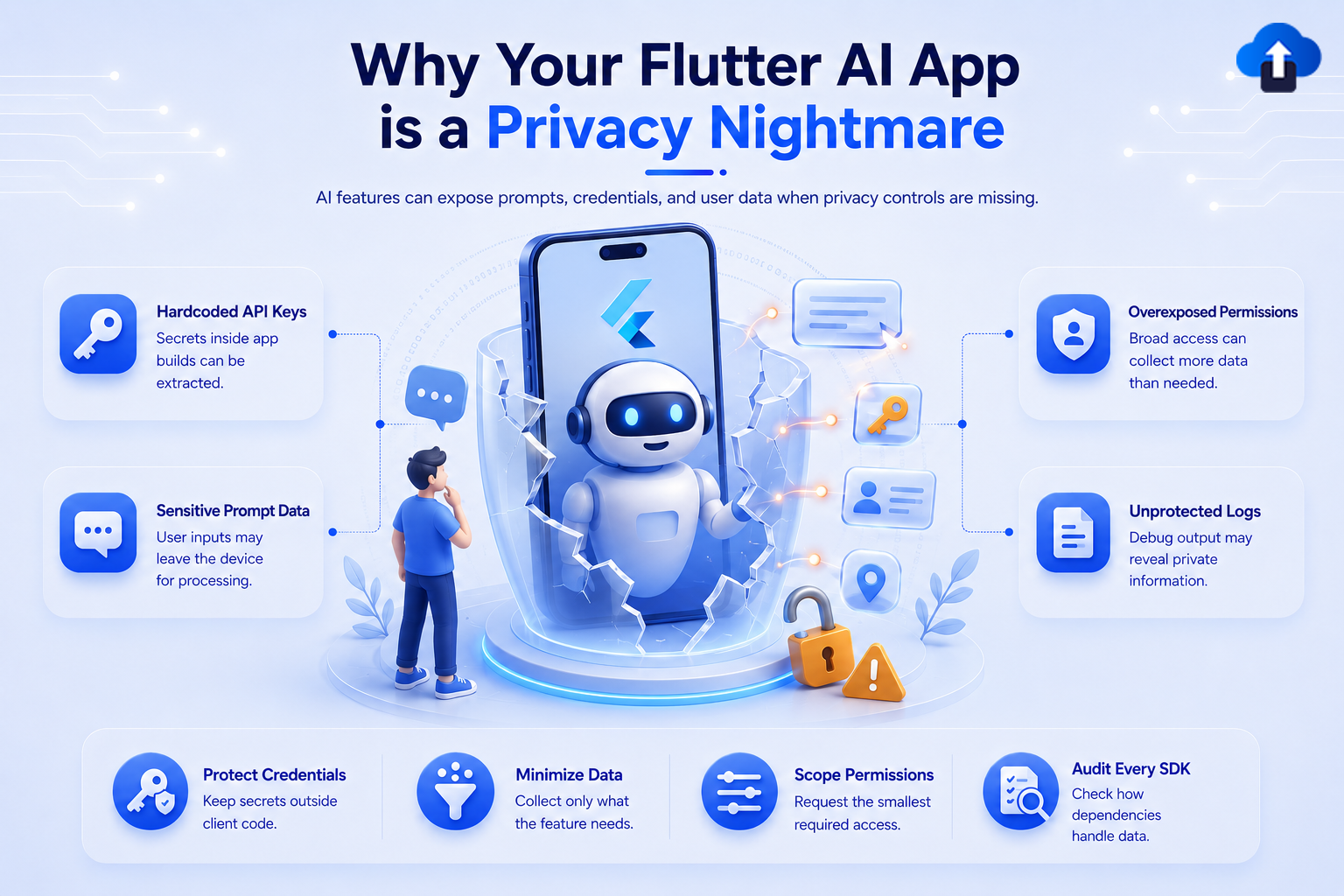
Flutter has matured into a serious platform for production applications, and the recent wave of on-device and cloud-connected AI features has accelerated its adoption in domains that handle deeply sensitive data—health, finance, productivity, and communication. But the speed at which developers are integrating large language model APIs, speech recognition pipelines, and on-device inference engines into their Flutter apps has outpaced the industry's collective thinking about what those integrations actually do to user data. The result is a generation of Flutter AI apps that are, in many cases, privacy disasters hiding behind polished Material 3 interfaces.
This is not a regulatory compliance checklist. Those exist in abundance and are largely ignored. This is a technical examination of how Flutter's architecture, combined with the careless integration patterns that dominate AI SDK adoption, creates specific and serious privacy exposure. The problems are architectural, not cosmetic. Fixing them requires understanding how data flows through your Dart code, across platform channels, into native SDKs, and eventually over the network to inference endpoints—and at which points along that path you are leaking information you never intended to share.
The developers building these apps are not negligent. Most are simply moving fast in a space where the tooling is immature, the documentation focuses on capability rather than privacy, and the "it works" moment arrives long before anyone asks "what exactly did we just send?" This article is an attempt to slow that momentum down and look clearly at the structural risks.

Foundational Concept: The Privacy Surface of an AI Feature
Privacy surface is the total collection of data touchpoints an application creates—places where user data is captured, persisted, transmitted, or processed by code outside the user's direct control. In a traditional Flutter app, this surface is relatively bounded: local storage, a few REST API calls, maybe some analytics events. When you add AI features, the surface expands dramatically and in ways that are non-obvious.
Consider a simple "summarize this document" feature. The user selects a file. Your Flutter code reads it, passes it to an LLM API, receives a summary, and displays it. From a product perspective, that is one feature. From a privacy perspective, that is a chain of exposures: the full document content leaves the device and is transmitted to a third-party inference endpoint, where it may be logged for model improvement, retained for a defined or undefined period, processed by infrastructure your application has no visibility into, and potentially associated with metadata (IP address, API key, request timestamp) that links the document to a specific user or session. None of this appears in your app's privacy policy, because the developer never thought through the chain.
The AI privacy surface has several distinct layers that require independent analysis:
- Input capture layer: What raw data is being collected before inference (audio, text, images, location, clipboard content)?
- Transmission layer: What is sent over the network, to whom, and under what terms?
- Inference layer: Where does computation happen—on-device, in a managed cloud, or on a third-party endpoint?
- Output layer: What does the model return, and does the response contain inferred private data about the user?
- Persistence layer: What is cached locally and for how long?
Why It Matters in Modern Mobile Development
The mobile AI integration market has collapsed several years of cautious API design into a chaotic sprint. Developers are reaching for SDKs that abstract away the complexity of model inference, which is valuable, but that abstraction also hides what data is actually being transmitted. In Flutter specifically, the cross-platform promise creates an additional risk: behavior that is visible and auditable on one platform may be invisible on another because it executes inside a native SDK layer that Dart never observes.
The stakes are higher than they were in the era of simple REST integrations. AI models trained on conversational data can infer sensitive attributes from seemingly innocuous input. A model that summarizes medical notes can expose a patient's diagnosis to a logging pipeline the developer didn't know existed. A voice assistant that runs speech-to-text through a cloud API is transmitting raw audio that may contain background conversations, ambient location cues, or identifying vocal characteristics. These are not edge cases. They are the default behavior of the tools developers are using right now.
The consequences of getting this wrong are also escalating. GDPR enforcement around AI data processing has intensified. The EU AI Act introduces specific obligations for certain AI system categories. Apple's App Store privacy nutrition labels require accurate disclosure of data collection, and the data actually collected by third-party AI SDKs embedded in your Flutter app is your disclosure responsibility, not the SDK vendor's. Beyond regulation, there is the simple trust asymmetry: users are increasingly aware that AI features consume their data, and a single breach or disclosure can destroy an application's reputation in hours.
The specific risks that make Flutter AI apps particularly vulnerable:
- Third-party AI SDKs wrapping native Android/iOS libraries that operate outside Dart's observation
- Prompts constructed with full conversation history, inadvertently including sensitive prior messages
- On-device model outputs cached to disk without encryption
- API keys embedded in Dart source or assets, exposed through decompilation
- No user-visible data retention controls, even when the underlying API supports them
Architecture & System Design Breakdown
A typical Flutter AI app has a deceptively simple architecture at the product level but a complex and often opaque data flow at the privacy level. Understanding where data actually travels requires mapping the full stack, not just the Dart layer.
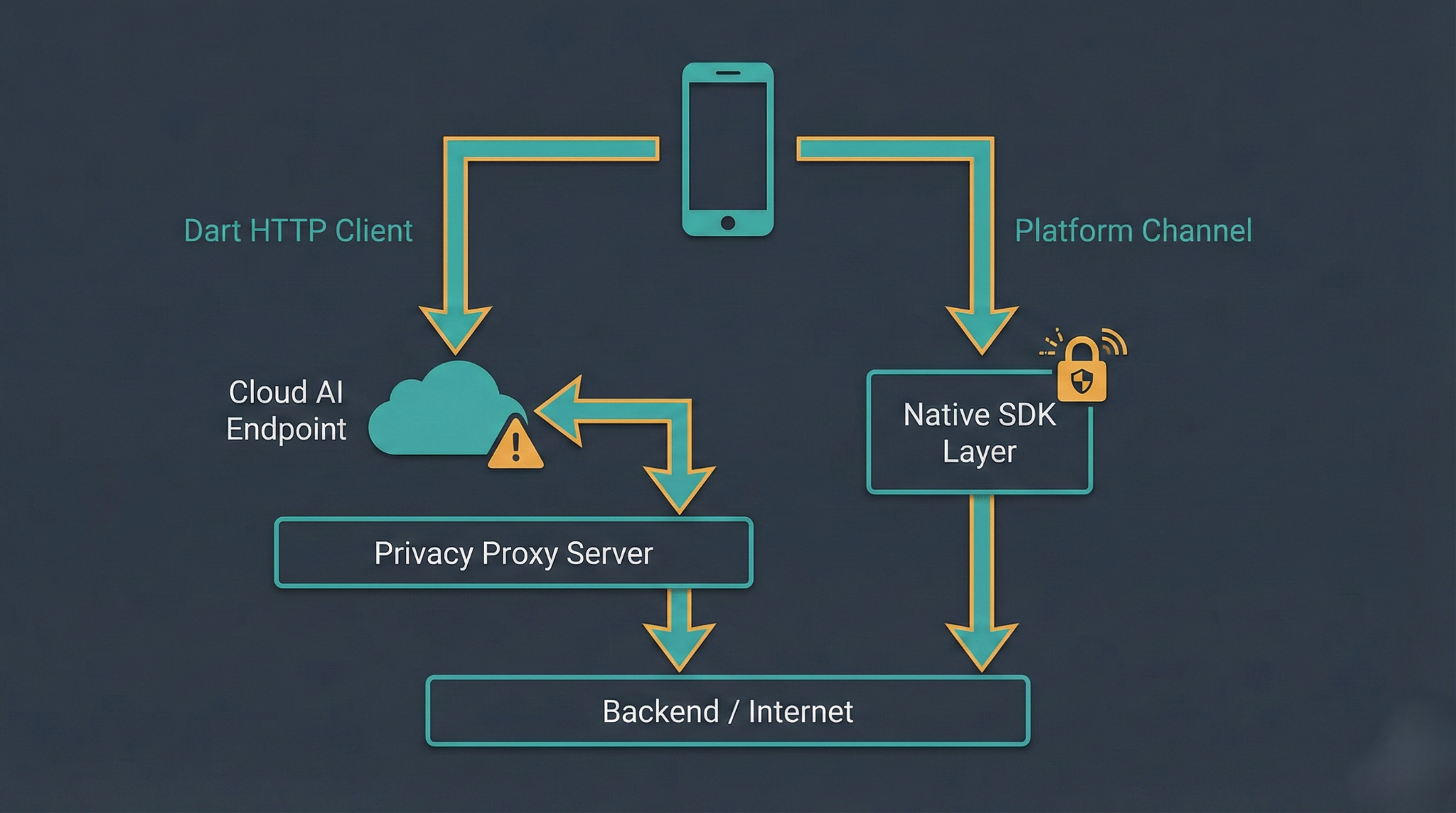
The left path—Dart HTTP client calling a cloud AI endpoint directly—is the one most developers reason about. They configure an http or dio client, send a request body, receive a response. The privacy risk here is primarily in the request body construction and the API terms of service. But the right path is where Flutter's cross-platform model introduces a specific vulnerability: when you use a native AI SDK through a platform channel, you lose Dart-level observability of what data that SDK is collecting, transmitting, or persisting. The SDK operates in native code, follows its own threading model, and may make network requests entirely independent of your application's network stack.
A Flutter app using Google's ML Kit for on-device text recognition, for example, passes image data across a platform channel into native Android or iOS code. On Android, that code runs inside the Google Play Services context. Whether and how that data is processed, whether any metadata is sent to Google's infrastructure, and what the data retention behavior is—none of this is visible from Dart. The developer has full visibility of what they passed to the channel; they have zero visibility of what the native layer does with it.
The architectural implication is clear: privacy analysis must happen at the boundary of every platform channel that touches user data, not just at the Dart layer.
Implementation Deep Dive: Where Privacy Breaks in Practice
The most common privacy failures in Flutter AI apps are not the result of malicious intent or even negligence in the traditional sense. They are the result of developers building features incrementally, following SDK documentation that optimizes for integration speed, and never having a moment where the full data flow is examined as a system.
Here is how the failure typically unfolds in a production codebase:
- Prompt construction without scope control.
The developer builds a chat interface that passes the full List<Message> history to the LLM on every turn. This means that a user who mentioned their medical condition in message three will have that information re-transmitted with every subsequent message, even if the current query is entirely unrelated. Conversation history should be scoped and pruned based on relevance, not blindly concatenated.
- Clipboard and input field monitoring.
Several AI SDKs offer "smart completion" features that observe input field content as the user types. In Flutter, a TextEditingController listener feeding content to a debounced API call is a common pattern. Without explicit user consent and visible UI feedback, this constitutes continuous data exfiltration of keystrokes.
- Response caching without encryption.
AI API responses are expensive. Caching them locally is rational. But many Flutter developers cache responses in SharedPreferences or in unencrypted files in the application document directory. On non-rooted Android devices this is relatively contained, but on iOS with iCloud backup enabled, those cached responses may be uploaded to Apple's infrastructure without the developer or user realizing it.
- API key exposure.
This deserves explicit mention because it remains endemic. Dart source code is compiled but not obfuscated by default. Strings in compiled Dart binaries are recoverable. An API key stored as a const String in your Dart code is recoverable by anyone who extracts your application binary. AI API keys are high-value targets because they enable attackers to run inference at your cost and potentially access conversation history if your API provider stores it.
- Unsanitized error logging.
When an LLM API call fails, the error response often echoes part of the request back. If your error logging pipeline captures these errors and sends them to a crash reporting service, you may be transmitting user data (portions of the prompt) to a third crash analytics service that has entirely different data retention and access controls than your AI provider.
- Inadequate model output handling.
LLM outputs can contain inferred private information about the user derived from the input. If a model infers that a user is likely pregnant based on their queries and that inference appears in the output, and that output is then logged or analytics-tracked, you have created a sensitive data record that almost certainly exceeds the privacy disclosure your application makes.
// Common pattern -- full history transmitted every turn
Future<String> getCompletion(List<ChatMessage> history, String newMessage) async {
  final response = await _openAIClient.chat.completions.create(
    model: 'gpt-4o',
    messages: [
      ...history.map((m) => m.toOpenAI()), // ← entire history, no pruning
      ChatCompletionUserMessageParam(content: newMessage),
    ],
  );
  return response.choices.first.message.content ?? '';
}

// Better -- windowed history with explicit scope control
Future<String> getCompletion(List<ChatMessage> history, String newMessage) async {
  final recentHistory = history.length > 10
      ? history.sublist(history.length - 10)
      : history;

  final response = await _openAIClient.chat.completions.create(
    model: 'gpt-4o',
    messages: [
      ChatCompletionSystemMessageParam(content: _systemPrompt),
      ...recentHistory.map((m) => m.toOpenAI()),
      ChatCompletionUserMessageParam(content: newMessage),
    ],
  );
The windowed approach is a minimum. In a production system handling sensitive domains, relevance-based history selection is more appropriate than recency-based selection.
Advanced Patterns & Optimization
The developers who have thought most carefully about privacy in their Flutter AI apps have converged on a set of architectural patterns that treat data minimization as a first-class design constraint rather than a post-hoc compliance activity.
The most significant shift is the adoption of a privacy proxy layer between the Flutter application and the AI endpoint. Rather than calling the AI API directly from the client, the Flutter app calls an application-specific backend endpoint that the development team controls. This backend is responsible for prompt construction (using server-side user context that never touches the client), response filtering (removing or redacting inferred sensitive attributes before they reach the client), request logging with appropriate retention policies, and API key management. This pattern also enables the team to switch underlying AI providers without shipping an app update, and to implement rate limiting and abuse detection.
On the on-device side, Flutter's integration with TensorFlow Lite and ONNX runtimes via platform channels enables genuine on-device inference for models that fit within device memory constraints. On-device inference eliminates the transmission risk entirely for compatible use cases—classification, intent detection, entity recognition, and increasingly, lightweight generative tasks. The privacy tradeoff is capability: on-device models are smaller and less capable than frontier cloud models, and the right choice depends on the sensitivity of the input data relative to the capability requirement.
Key architectural optimizations for privacy-preserving Flutter AI apps:
- Implement a server-side privacy proxy that controls what user data is included in inference requests
- Use on-device inference for input classification before deciding whether cloud inference is required
- Apply differential privacy or data masking to inputs before transmission when full fidelity is unnecessary
- Treat conversation history as a scoped context window, not an append-only log
- Implement explicit data lifecycle controls: user-visible history deletion that triggers actual API-side deletion
Real-World Production Scenarios
Healthcare journaling app with AI summarization.
A wellness application allows users to log symptoms, moods, and medications and uses an LLM to generate weekly health summaries. The privacy exposure is extreme: the full journal content, including medication names and symptom descriptions, is transmitted to a third-party LLM endpoint. If the API provider's terms of service permit training data use and the developer has not explicitly opted out (which requires reading the API terms in detail and, in some cases, paying for an enterprise tier), user health data may be incorporated into future model training. In a HIPAA-adjacent context, this is not merely a privacy concern—it is a potential regulatory violation. The correct architecture is on-device summarization for journal content, with cloud LLM used only for non-sensitive query types after explicit user consent.
AI-powered customer support with conversation context.
A retail application uses an LLM to handle customer support queries. The system prompt includes the user's order history, account details, and previous support interactions to provide context. Each API call transmits this data to the LLM endpoint. The privacy issue here is not that the data is used—using context to provide better support is legitimate—but that the full account data is transmitted on every turn regardless of whether it is relevant to the current query. A user asking "what are your store hours?" does not require their full purchase history to be transmitted. Dynamic context injection—only including account data when the query classifier determines it is relevant—reduces the transmission surface without degrading the user experience.
Voice assistant with cloud speech-to-text.
A productivity app offers a voice input feature that routes audio through a cloud speech-to-text service before passing the transcript to an LLM. The user understands they are using a voice feature. They almost certainly do not understand that raw audio is being transmitted to a cloud service, that audio may be retained for quality improvement purposes, and that the transcript is then transmitted to a separate cloud service for LLM processing. This is two separate data transmissions of voice data to two separate third parties with two separate privacy policies. The disclosure complexity is real, and most app privacy policies fail to reflect it accurately.
Recommendation engine with implicit feedback.
An application uses implicit behavioral signals—scroll depth, dwell time, interaction patterns—to train a personalization model. The privacy issue is that implicit behavioral data is collected continuously without explicit user awareness, and when that data is transmitted to a cloud inference endpoint for recommendation generation, it creates a detailed behavioral profile that the user never explicitly consented to share. Flutter's ease of adding gesture detectors and scroll notification listeners makes this pattern trivially easy to implement and just as trivially easy to implement in a privacy-invasive way.
Common Pitfalls and Failure Patterns
The failures that recur most consistently across Flutter AI apps are not exotic. They are predictable and preventable, but they require deliberate architectural attention that most development timelines do not allocate.
The most foundational failure is treating AI SDK integration as a black box. When a Flutter developer adds a dependency, initializes an SDK, and calls an inference method, they typically treat the SDK as a trusted component whose internal behavior is outside their scope. This assumption is incorrect. Every SDK embedded in your application is an extension of your application's privacy posture. The user trusts your application. Your application trusts the SDK. If the SDK behaves in ways that violate user privacy, your application is the responsible party in the user's mental model and, increasingly, in regulatory frameworks.
The second common failure is inadequate data minimization at the prompt construction level. Developers building context-aware AI features tend to include more context because more context produces better results. This is empirically true from a capability standpoint and tends to be privacy-negative from a data minimization standpoint. The discipline of asking "what is the minimum information required to answer this query adequately?" is not instinctive when you are optimizing for answer quality.
Five specific failure patterns that appear repeatedly in production Flutter AI codebases:
- Storing raw LLM API responses in SharedPreferences without encryption, making them accessible to other apps on rooted devices and to iCloud backup
- Using dart:developer log statements that include prompt content, which may be captured by crash reporting SDKs
- Failing to implement user-accessible data deletion that propagates to the API provider's stored request logs
- Initializing AI SDKs with automatic data collection enabled (the default in many SDKs) without reviewing the opt-out mechanism
- Constructing system prompts server-side but embedding them as Dart constants, making them recoverable and allowing attackers to understand exactly what context is being provided to the model
Strategic Best Practices
Building a Flutter AI app that handles user data responsibly requires treating privacy as a design constraint from the beginning of architecture, not a compliance layer applied at the end. The practices that follow are not aspirational—they are achievable with current tooling and represent the standard that serious production applications should meet.
The starting point is a data flow audit conducted before any AI feature ships. This means tracing every piece of user data from collection to final disposition: what is collected, what is included in inference requests, what the API provider's data retention policy is, what is cached locally, and what is logged. This audit should produce a document that can be used to write an accurate privacy policy, because if you cannot write an accurate privacy policy from your data flow audit, you do not understand your own application's privacy behavior well enough to ship it.
The second practice is implementing a consent architecture that is granular and user-comprehensible. "We use AI to improve your experience" is not adequate. Users should understand which features use AI, whether that AI is on-device or cloud-based, what data is transmitted, and how to opt out. Flutter's navigation architecture makes it straightforward to gate AI features behind explicit consent flows using Flutter's navigation and deep linking system. Consent should be revocable, and revocation should have actual technical effect.
Strategic best practices for production Flutter AI apps:
- Conduct a full data flow audit before shipping any AI feature, and update it when AI integrations change
- Route all cloud AI calls through a server-side proxy that enforces data minimization and handles API key management
- Prefer on-device inference for sensitive input categories, even at the cost of model capability
- Implement user-visible conversation history management with deletion that propagates to API provider logs
- Apply prompt injection defense at the proxy layer—never pass raw user input directly to an LLM without sanitization
- Review the data processing agreements and training data opt-out mechanisms for every AI SDK and API provider your application uses
The final practice, and perhaps the most important, is ongoing monitoring. AI SDK vendors update their data collection practices. API providers change their terms of service. Flutter dependencies introduce new native SDKs through transitive dependencies. A privacy posture that was adequate at launch can become inadequate within months without any action on the development team's part. Treating privacy review as a one-time pre-launch activity is structurally insufficient.
Conclusion
Flutter is a strong choice for AI apps, but it introduces privacy challenges—especially where Dart code interacts with native SDKs, which are often less visible to developers.
Even if your Dart code is secure, sensitive data can still be transmitted through native layers or
third-party AI services. So privacy checks must include:
- Platform channel interactions
- Native SDK behavior
- Network/data flows
- Cloud AI data handling and retention
With rising user expectations and stricter regulations, teams must clearly explain:
- What data is collected
- Where it goes
- How long it’s stored
- How users can control it
Flutter already provides tools (on-device AI, secure storage, server-side proxies), but the key is designing with privacy in mind from the start, not as an afterthought.
In short, privacy-focused AI design is becoming a competitive advantage, not just a compliance requirement.