.png)


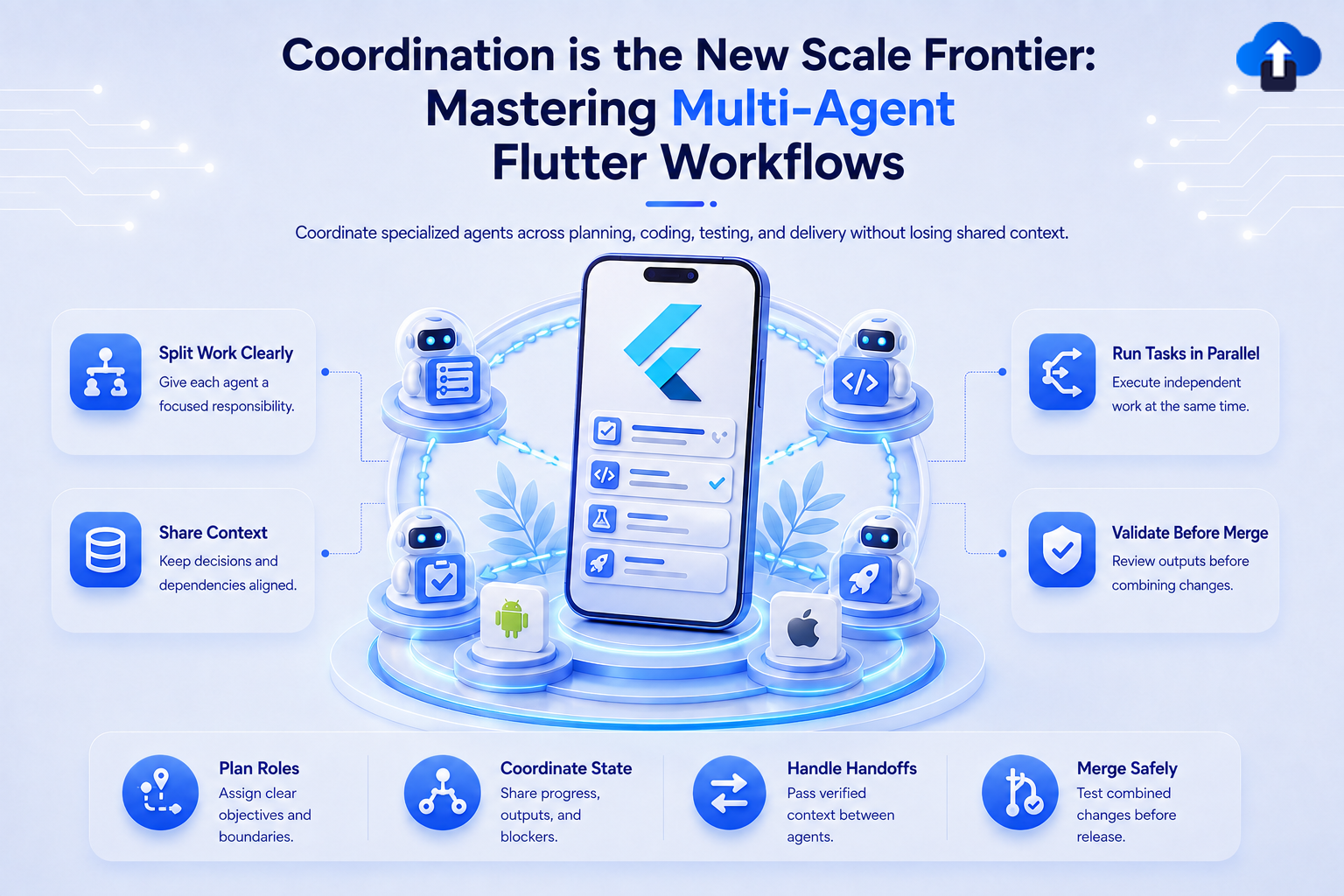
The conversation around AI in mobile development has matured past the point of asking "should we integrate an agent?" and moved firmly into "how do we orchestrate multiple agents without the system collapsing under its own weight?" For Flutter teams shipping production applications, this distinction is not academic. A single AI agent can answer questions, generate UI suggestions, or run a lint pass. A coordinated multi-agent system can manage your entire release pipeline, detect regressions across widget trees, generate localization assets, and push build artifacts to your distribution infrastructure—all in parallel, all with traceability.
The challenge is that multi-agent architectures introduce coordination complexity that most Flutter codebases are not structurally prepared for. Dart's isolate model, Flutter's layered rendering pipeline, and the asynchronous nature of platform channels all create specific constraints that generic multi-agent frameworks don't account for. Building coordination that works with Flutter's architecture rather than around it requires a deliberate design approach, not just connecting a few LLM APIs together.
This article focuses on that deliberate design—the architectural patterns, coordination protocols, failure boundaries, and production realities of running multi-agent workflows inside and alongside Flutter applications.
Foundational Concept: What Multi-Agent Coordination Actually Means
The term "multi-agent" gets used loosely. In the context of Flutter development workflows, an agent is a bounded autonomous process that receives a task, has access to a defined set of tools or APIs, produces a structured output, and can communicate with other agents through a message-passing interface. The key word is bounded. An agent that can do anything is not an agent—it's a monolith with aspirations.
Multi-agent coordination, then, is the discipline of decomposing a large development workflow into these bounded units and defining how they interact. This is meaningfully different from microservices, though the analogy is instructive. Where microservices decompose persistent system responsibilities, agents decompose ephemeral task execution. A service manages state across time; an agent executes a task and terminates.
In Flutter workflows specifically, this manifests across several layers: agents that understand the Dart AST and can reason about widget trees, agents that invoke Flutter's build toolchain and interpret its output, agents that interact with CI systems, and orchestrator agents that sequence all of the above. The evolution from single-agent assistants to coordinated networks reflects the same maturity curve that distributed systems went through—first you get the single server working, then you figure out why it falls over, then you redesign for coordination.
The essential concepts to internalize before designing anything:
- Task isolation: each agent should have a single, testable responsibility with defined inputs and outputs.
- Shared context, not shared state: agents should read from a shared context store but should not mutate shared mutable state directly.
- Explicit communication contracts: inter-agent messages must have a schema, just like any API.
- Idempotency: agents should be re-triggerable without producing duplicate side effects.
- Observable execution: every agent invocation should emit structured logs for debugging and auditing.
Why It Matters in Modern Mobile Development
Flutter's cross-platform promise means that shipping a single codebase to Android, iOS, web, and desktop is achievable—but it also means the complexity of that codebase grows in all four directions simultaneously. A release cycle for a serious Flutter product now involves platform-specific testing matrices, localization pipelines, design token synchronization, backend contract validation, and app store compliance checks. These are not naturally sequential tasks. Many of them can and should run in parallel, with dependencies declared explicitly rather than encoded in a linear script.
Multi-agent workflows are the engineering response to this reality. Rather than a monolithic CI pipeline that runs everything in a waterfall, a coordinated agent network can fan out across independent tasks, checkpoint at natural dependency boundaries, and reassemble results at the orchestrator level. The performance gains are real, but they're secondary to the architectural clarity. When you model your Flutter release workflow as a graph of coordinated agents, the dependencies become explicit, the failure modes become localized, and the system becomes incrementally improvable rather than requiring wholesale rewrites every time the pipeline grows.
From a developer experience standpoint, multi-agent systems also make it possible to bring AI assistance into parts of the development lifecycle that have been resistant to it—like widget regression detection, golden test generation, or automated accessibility audits—because these can now be encapsulated as agents with clear contracts rather than bolted onto existing tools.
The concrete benefits that justify the architectural investment:
- Parallel execution of independent pipeline stages (e.g., Android and iOS builds running simultaneously under agent coordination).
- Localized failure recovery—a failing localization agent doesn't block your build agent.
- Modular AI specialization—each agent can use a model or tool tuned for its specific task.
- Incremental adoption—you can introduce agents into existing pipelines one at a time.
- Auditability—structured agent outputs are traceable in ways that bash script logs are not.
Architecture & System Design Breakdown
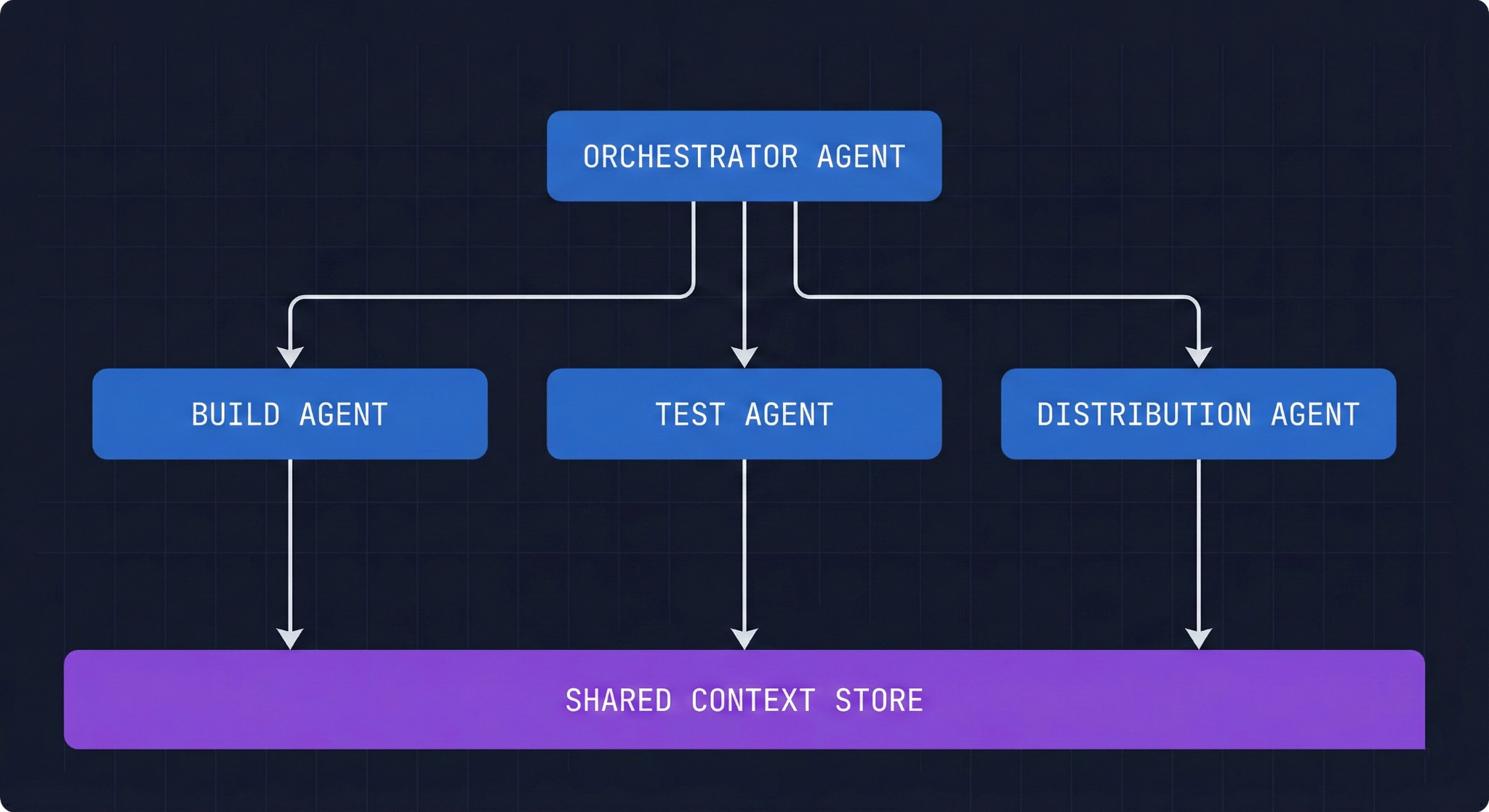
The architecture that works for multi-agent Flutter workflows follows a hierarchical orchestration model. At the top sits an orchestrator agent responsible for workflow planning, task sequencing, and result aggregation. Below it are domain agents, each scoped to a specific area of the Flutter development lifecycle. Beneath the domain agents are tool-layer integrations—Flutter CLI, Dart Analyzer, Fastlane, Firebase App Distribution, or whatever your distribution stack looks like.
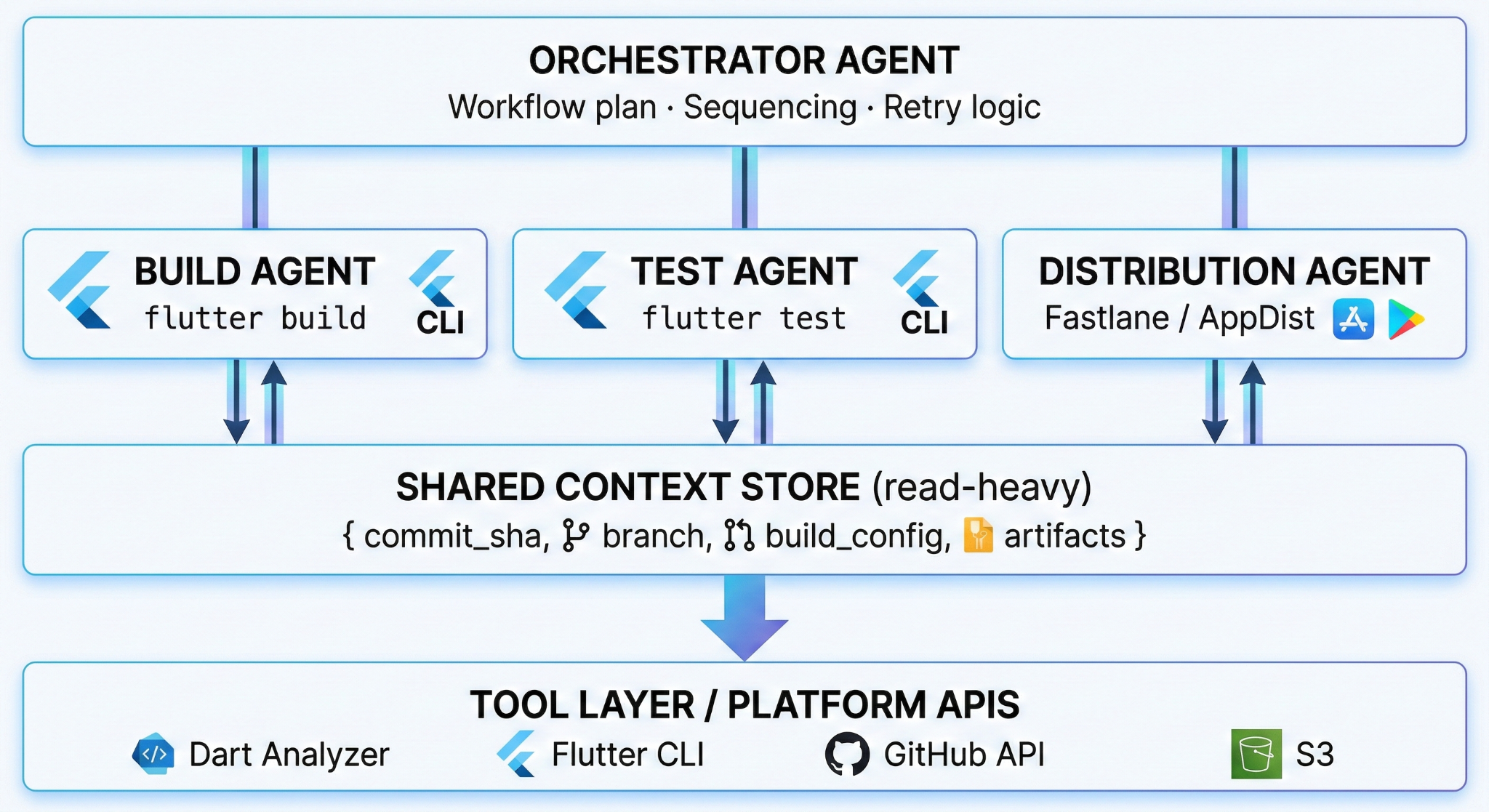
The shared context store is the system's memory. It is written to by the orchestrator at initialization and by agents only when they produce artifacts—never during intermediate computation. This prevents race conditions and keeps the store's state coherent. In practice, this store can be a Redis instance, a database row, or even a JSON file on a shared volume depending on your infrastructure. The important constraint is that agents read from it liberally but write to it sparingly and atomically.
Inter-agent communication follows a message-passing model. The orchestrator publishes task messages to a queue. Each domain agent subscribes to the task types it handles, consumes a message, executes its task, and publishes a result message. The orchestrator consumes result messages, updates the workflow plan, and publishes the next set of tasks. This is deliberately similar to the actor model, and for good reason—it provides natural backpressure, failure isolation, and observability.
Implementation Deep Dive
Building this system in a Flutter engineering context requires deciding which parts live inside the Flutter application, which parts are external pipeline infrastructure, and how they communicate. The most common pattern is to keep the Flutter app as a consumer and reporter, while the agent network lives in your CI/CD infrastructure. The app exposes hooks—build flavors, environment flags, performance metrics endpoints—that agents can interact with.
The implementation sequence that produces a working system without over-engineering the first iteration:
- Define your agent taxonomy. Map every repeating task in your Flutter workflow to a candidate agent. At minimum: a build agent, a test agent, a static analysis agent, and a distribution agent. Resist the urge to create more than you can monitor.
- Design message schemas. Every inter-agent message needs a typed schema. Use JSON Schema or Protocol Buffers depending on your infrastructure. A task message must include: task type, task ID, input parameters, and a correlation ID for tracing.
- Implement the orchestrator as a state machine. The orchestrator's workflow plan is a directed acyclic graph of tasks. Map its state transitions explicitly. Tools like XState (if your orchestration layer is TypeScript-based) or a simple finite state machine in Dart can both work.
- Implement agents as stateless functions. An agent receives a task message, executes, and emits a result. No in-memory state persists between invocations. If an agent needs an intermediate state, it reads from and writes to the shared context store.
- Integrate Flutter toolchain calls. The build agent wraps flutter build apk --release (or its IPA equivalent), captures stdout and stderr, parses build output for artifact paths, and publishes those paths to the shared context store.
- Add retry and timeout policies at the orchestrator level. Each task type should have a defined timeout and a maximum retry count. The orchestrator enforces these, not the agents themselves. This keeps agents simple and centralizes failure policy.
A minimal Dart implementation of a task message schema:
class AgentTaskMessage {
  final String taskId;
  final String correlationId;
  final String taskType;
  final Map<String, dynamic> parameters;
  final DateTime issuedAt;

  const AgentTaskMessage({
    required this.taskId,
    required this.correlationId,
    required this.taskType,
    required this.parameters,
    required this.issuedAt,
  });

  factory AgentTaskMessage.fromJson(Map<String, dynamic> json) => AgentTaskMessage(
    taskId: json['task_id'] as String,
    correlationId: json['correlation_id'] as String,
    taskType: json['task_type'] as String,
    parameters: json['parameters'] as Map<String, dynamic>,
    issuedAt: DateTime.parse(json['issued_at'] as String),
  );
}
The schema is deliberately flat. Nesting parameters deeply creates parsing complexity and makes schema evolution harder. Flat structures serialize predictably and are easier to log and debug.
Advanced Patterns & Optimization
Once the baseline coordination model is stable, the interesting optimization work begins. The naive implementation treats all agents as equivalent and all tasks as uniformly expensive. Production systems quickly reveal that this is wrong. Build agents are slow and resource-intensive; static analysis agents are fast and cheap. Distribution agents are sequential by necessity; test agents can run in parallel matrices.
The optimization layer requires you to model these differences explicitly. Weighted task scheduling, where the orchestrator assigns priority and resource allocation based on task type metadata, is the first improvement. The second is speculative execution: when the orchestrator has high confidence that a downstream task will be needed (e.g., if the test agent succeeds, distribution will always follow), it can pre-warm the distribution agent while tests are still running, reducing end-to-end latency.
The orchestrator's Isolates documentation in Flutter is directly relevant here if any of your orchestration logic runs inside the Flutter application itself—isolates are Flutter's mechanism for parallel computation without blocking the UI thread, and they map naturally onto the agent execution model.
Key optimization strategies for mature multi-agent Flutter pipelines:
- Task batching: group multiple small Dart analysis tasks into a single agent invocation to amortize startup overhead.
- Artifact caching: build agents should hash their inputs and skip re-execution when a cached artifact exists for that hash.
- Parallelism by platform: Android and iOS build agents should always run concurrently, never sequentially.
- Result streaming: agents that produce large outputs (golden test diffs, coverage reports) should stream results to storage rather than passing them through the message queue.
- Adaptive retry backoff: exponential backoff with jitter prevents thundering herd behavior when a dependency (like a signing service) recovers from a transient failure.
Real-World Production Scenarios
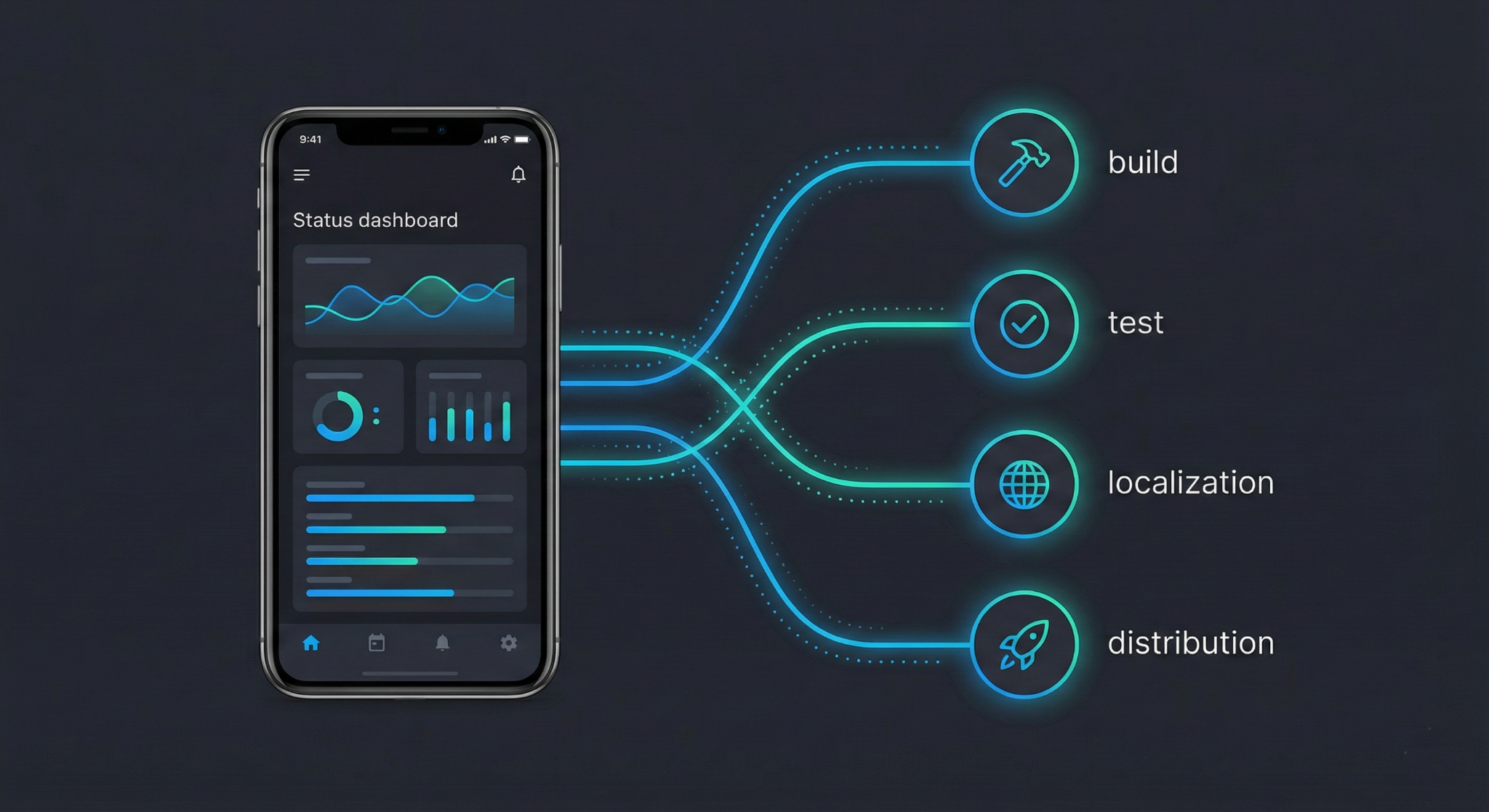
Automated Widget Regression Pipeline.
A Flutter team shipping weekly releases uses a three-agent system for visual regression: a capture agent that runs golden tests against the current branch, a comparison agent that diffs results against a blessed baseline stored in S3, and a reporting agent that formats diffs as annotated PR comments via the GitHub API. The orchestrator runs this pipeline on every pull request. The result is that visual regressions are caught before human review, and reviewers see annotated diffs rather than hunting through CI logs. The tradeoff is infrastructure cost—golden tests require consistent rendering environments, which means dedicated CI runners rather than shared pools.
Localization Agent Network.
Internationalization in Flutter involves maintaining ARB files, synchronizing them with a translation service, running flutter gen-l10n, and validating that all locale files have the same key set. Each of these is a natural agent boundary. A four-agent system handles this: an extraction agent parses the Dart source for new AppLocalizations references, a sync agent pushes new keys to the translation API, a generation agent invokes flutter gen-l10n, and a validation agent diffs key sets across locales. Because the extraction and sync steps are independent of each other only at the key level, the orchestrator can pipeline them—sync begins as soon as keys are extracted, without waiting for generation to complete.
Release Certification Workflow.
For teams subject to compliance requirements (healthcare apps, financial apps), a multi-agent release certification workflow can automate the evidence collection that manual processes currently handle. A permissions audit agent scans the AndroidManifest.xml and iOS Info.plist for declared permissions and compares them against an approved list. A dependency license agent scans pubspec.lock and reports any packages with non-compliant licenses. A signing verification agent confirms that release artifacts are signed with the correct certificate chain. The orchestrator aggregates these reports and gates the distribution agent on a passing certification result. This pattern is described in detail in the context of app distribution best practices on AppsOnAir's blog, where the integration of automated checks into Flutter release pipelines is covered from a practical infrastructure perspective.
Crash Analytics Feedback Loop.
A production system can close the feedback loop between crash analytics and development by running an agent that monitors Firebase Crashlytics reports, extracts stack traces, maps them back to Dart source using symbol files, and creates formatted GitHub issues with the relevant widget tree context. This agent runs on a schedule rather than triggered by a commit event, and its output feeds into the development workflow rather than the CI pipeline. The coordination challenge here is that the agent needs access to both the crash reporting API and the source repository, which requires careful credential scoping at the orchestrator level.
Common Pitfalls and Failure Patterns
The most common failure mode in multi-agent Flutter systems is what you might call context drift—the shared context store becomes inconsistent because agents are writing to it without atomic guarantees. This typically happens when teams implement the shared store as a simple key-value map without transaction semantics, then add concurrent agents later. The fix is to enforce a strict write protocol: agents append to event logs, and the orchestrator derives current state from the log, never writing derived state back to the store.
A second failure pattern is agent over-specialization. Teams that start with clean agent boundaries sometimes respond to edge cases by adding more agents rather than improving existing ones. A pipeline that started with four agents ends up with fourteen, each handling one specific scenario. The coordination overhead grows super-linearly with agent count, and the system becomes harder to debug than the monolithic pipeline it replaced. The discipline is to merge agents aggressively when their inputs and outputs are tightly coupled.
The five pitfalls that consistently appear in production multi-agent Flutter systems:
- Missing correlation IDs: without end-to-end tracing, debugging a failure that spans three agents is nearly impossible. Every message must carry a correlation ID from the moment the orchestrator creates the workflow.
- Unbounded retry loops: agents that retry indefinitely without a maximum attempt count will consume resources silently until they exhaust the queue.
- Secrets in message payloads: task messages should reference secret identifiers (e.g., a Vault path), never contain secret values. Messages are often logged.
- Synchronous blocking in async agents: an agent that makes synchronous network calls inside an async execution context creates backpressure that isn't visible in monitoring until it becomes a timeout cascade.
- Missing idempotency keys: agents that create side effects (posting a comment, triggering a build) without idempotency checks will duplicate those effects on retry.
Strategic Best Practices
The teams that operate multi-agent Flutter workflows successfully share a common discipline: they treat the agent network as a system with its own engineering standards, not as a collection of scripts with a coordinator bolted on. This means the agent network has tests, has observability, has a deployment process, and has documented failure modes. It means the orchestrator's state machine is reviewed with the same rigor as application code. And it means that the boundary between the agent network and the Flutter application is treated as an API surface with versioning and backward compatibility expectations.
One practice that consistently separates effective implementations from struggling ones is
progressive disclosure of complexity. Start with two agents—a build agent and a test agent—connected by the simplest possible orchestrator. Get that to production. Measure it. Add the next agent only when you have a clear metric showing that the current system's bottleneck is the task you're about to automate. This approach prevents the common failure of designing a ten-agent system on a whiteboard and never shipping any of it.
The Flutter DevTools documentation is worth reviewing when considering which telemetry to expose from the Flutter application layer to your agent network—DevTools' structured performance data can serve as inputs to a performance regression agent without requiring custom instrumentation.
Practices that produce stable, maintainable multi-agent Flutter pipelines:
- Version your message schemas: treat task message schemas as versioned APIs. Use a schema_version field in every message and handle version mismatches explicitly in agents.
- Make every agent independently testable: each agent should have a test suite that can run without the orchestrator. This means agents accept dependency injection for their tool integrations.
- Centralize secret management at the orchestrator: agents should receive credentials via secure injection at runtime, never from environment variables in shared CI runners.
- Emit structured logs, not print statements: every agent invocation should produce JSON-structured logs with task ID, correlation ID, duration, and result code. These feed observability tooling.
- Document the agent graph: maintain a living diagram of your agent topology. When the graph changes, the documentation changes first. This forces deliberate design rather than organic sprawl.
- Set SLOs for agent execution time: each agent type should have a defined expected duration and an alert threshold. Slow agents indicate either external dependency degradation or input data anomalies, both of which require investigation.
Conclusion
Multi-agent workflows in Flutter aren’t about adding AI for hype—they’re a response to growing release complexity. Instead of one pipeline handling everything, multiple specialized agents coordinate tasks more clearly and efficiently.
These systems use proven ideas from distributed systems (bounded roles, clear communication, centralized orchestration), similar to Dart isolates but applied to development workflows.
The result: faster pipelines, clearer failure insights, parallel execution, and automated processes like compliance checks.
Over time, this approach compounds—each new agent is easier to add, making teams more scalable, reliable, and efficient without increasing complexity.